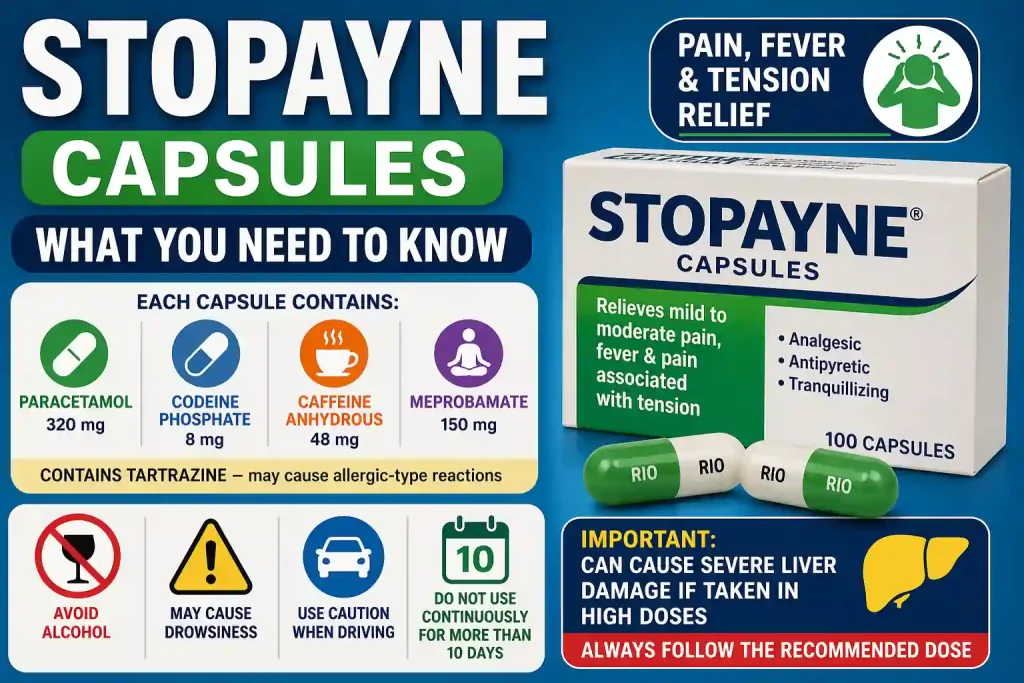
If you are using Stopayne Capsules, or caring for someone who is, it helps to know exactly what is in it, what it is meant to do, and where you need to be careful. This medicine contains four active ingredients: paracetamol, codeine phosphate, caffeine anhydrous, and meprobamate. It is used to relieve mild to moderate pain, fever, and pain linked to tension.
Stopayne Capsules are a Schedule 5 medicine in the source provided.
What it is and what it is used for
Stopayne Capsules are a combination pain-relief medicine. The source classifies it as an analgesic combination, which means it combines more than one ingredient to help with pain and related symptoms.
Active ingredients
Each capsule contains:
- Paracetamol 320 mg
- Codeine phosphate 8 mg
- Caffeine anhydrous 48 mg
- Meprobamate 150 mg
The source also states that the capsules contain tartrazine. This is important if you have had allergic-type reactions to colourants or if you are sensitive to aspirin.
What Stopayne Capsules are used for
According to the source, Stopayne Capsules are used to relieve:
- Mild to moderate pain
- Fever
- Pain associated with tension
That means you would use this medicine for the specific uses listed above, and not for other conditions unless a healthcare professional has told you to do so.
How it works (simple explanation)
Stopayne Capsules work because the ingredients play different roles.
- Paracetamol helps lower pain and fever.
- Codeine phosphate is a pain-relieving ingredient that can add extra pain control.
- Caffeine anhydrous is included in the combination and may contribute stimulant effects.
- Meprobamate gives the medicine its tranquillising property, according to the source.
In everyday terms, this combination is meant to help when you have pain or fever and when tension seems to be part of the problem as well. Because it includes ingredients that may make you sleepy and affect your judgement or coordination, it is not a medicine to take casually or for longer than advised.
Who should NOT use this medicine
Do not use Stopayne Capsules if you:
- Are allergic or hypersensitive to any of the active ingredients
- Have acute intermittent porphyria
- Have a history of epilepsy
- Have respiratory depression
- Have respiratory depression together with cyanosis or excessive bronchial secretions
- Have recently had operations on the biliary tract
- Have acute alcoholism
- Have a head injury
- Have a condition where intracranial pressure is raised
- Are having an attack of bronchial asthma
- Have heart failure secondary to chronic lung disease
- Are taking monoamine oxidase inhibitors (MAOIs)
- Stopped taking an MAOI within the last 14 days
A practical way to think about this
If any of the above applies to you, this medicine is not suitable unless your doctor has specifically addressed that situation. Because the source lists these as contra-indications, they are not minor cautions. They are situations where the medicine should not be used.
Warnings and precautions (Read before use)
Before taking Stopayne Capsules, there are a number of important warnings to understand.
Do not exceed the recommended dose
Warning: The source states that taking paracetamol in doses higher than recommended may cause severe liver damage. This is one of the most important safety points with this medicine. Never increase your dose on your own because the pain feels stronger or because the medicine seems to be taking time to work.
Do not use it continuously for longer than 10 days without advice
The source says:
- Do not use continuously for more than 10 days without consulting your doctor
- Consult your doctor if you get no relief from the recommended dose
If your pain is lasting that long, or if the usual dose is not helping, that is a sign to check in with a healthcare professional rather than keep going on your own.
Driving and operating machinery
This medicine may cause drowsiness. The source specifically says care should be taken when driving or operating machinery, and the dose should be reduced if necessary.
Note: If you feel sleepy, slowed down, dizzy, or mentally foggy after taking it, do not drive, operate equipment, or do anything that could put you or someone else at risk.
Alcohol and other medicines that slow the nervous system
The source warns that meprobamate may lower your tolerance to alcohol and other central nervous system depressants, which means these substances may affect you more strongly than usual. This can impair your judgement and coordination.
The source also says the depressant effects of codeine are enhanced by:
- Alcohol
- Anaesthetics
- Hypnotics
- Sedatives
- Phenothiazines
This matters because the combination can make sleepiness, slowed breathing, poor coordination, and impaired decision-making worse.
Liver or kidney disease
If you have liver disease or kidney disease, the source says paracetamol should be taken under medical supervision.
Other conditions needing caution
The source says codeine should be used with caution if you have:
- Hypothyroidism
- Adrenocortical insufficiency
- Impaired liver function
- Prostatic hypertrophy
- Shock
- Inflammatory bowel disorders
- Obstructive bowel disorders
It also says the dose should be reduced in:
- Elderly patients
- Debilitated patients
Tartrazine sensitivity
Stopayne Capsules contain tartrazine. The source states that tartrazine may cause allergic-type reactions, including bronchial asthma, in certain people. It adds that this sensitivity is seen more often in people who also have aspirin sensitivity.
Dependence risk
The source warns that:
- Prolonged use of high doses of codeine has produced dependence of the morphine type
- Prolonged use of meprobamate may lead to dependence of the barbiturate-alcohol type
This is another reason not to use the medicine continuously for longer than advised.
Pregnancy, planning pregnancy, and breastfeeding
The source states that Stopayne Capsules are not recommended for use by pregnant or breastfeeding women.
If you are pregnant, planning a pregnancy, or breastfeeding, do not assume this medicine is safe for you just because it is used for pain or fever. The source does not give a more detailed decision guide beyond this warning.
Interactions
The source gives several important interaction warnings.
Alcohol
Alcohol can increase the depressant effects of this medicine, especially because of the codeine and meprobamate. It may also reduce your judgement and coordination.
Practical advice: Avoid alcohol while using this medicine.
Other central nervous system depressants
The source says the effects of codeine are enhanced by medicines and substances such as:
- Alcohol
- Anaesthetics
- Hypnotics
- Sedatives
- Phenothiazines
Because meprobamate can also lower tolerance to these kinds of substances, combining them may make side effects more intense.
Monoamine oxidase inhibitors (MAOIs)
Do not use this medicine if you are taking MAO inhibitors, or if you stopped them within the previous 14 days. This is listed as a contra-indication, not just a caution.
Drug metabolism
The source says meprobamate may induce the hepatic microsomal enzymes involved in drug metabolism.
In simple terms, that means it may affect the way your body handles some medicines. The source does not list specific medicines for this effect.
Food and medical tests
Food interactions are not specified in the source.
Interactions with laboratory tests are not specified in the source.
How to take (Step-by-step)
Take this medicine exactly as described in the source or as directed by your doctor.
Adult dosing
The source gives the following adult dose:
- Two capsules
- Three or four times a day
- As required
Length of use
Do not use it continuously for more than 10 days unless your doctor tells you to.
Children
Dosing for children is not specified in the source.
How to take it in daily life
The source does not say whether to take it with food or without food.
It also does not say exactly how far apart doses should be spaced.
A sensible way to use the source guidance is to take it only as required, stay within the stated adult amount, and avoid continuing beyond 10 days without medical advice. If you are elderly, frail, or have one of the listed medical conditions, speak to your doctor or pharmacist because the source says the dosage should be reduced in elderly and debilitated patients.
If you miss a dose
Because the source says the medicine is taken as required, a missed-dose instruction is not specified in the source.
If you take too much
If too much is taken, the source says:
- Consult a doctor or take the patient to the nearest hospital immediately
- Specialised treatment is essential as soon as possible
- The latest treatment information can be obtained from the nearest poison information centre
Symptoms of overdose mentioned in the source include:
- Nausea
- Vomiting
- Liver damage, which may be fatal and may only appear after a few days
- Kidney failure following acute intoxication
- With acute meprobamate overdose: stupor, coma, convulsions, shock, circulatory collapse, and respiratory collapse
Warning: Even if the person seems fairly well at first, urgent medical help is still necessary because serious liver damage may appear later.
Simple adherence tips based on the source
- Stick to the recommended adult dose
- Do not use it for longer than 10 days continuously
- Do not add extra paracetamol-containing medicines unless a healthcare professional has checked this for you
- If the medicine is not helping at the recommended dose, see your doctor instead of increasing it yourself
Dosing table
| Age or weight | Dose | Frequency | Maximum daily dose | |
|---|---|---|---|---|
| Adults | 2 capsules | 3 or 4 times a day, as required | Not specified in the source | |
| Children | Not specified in the source | Not specified in the source | Not specified in the source |
Possible side effects
Not everyone will get side effects, but Stopayne Capsules can cause several. Because this is a combination medicine, side effects may come from more than one ingredient.
Common
The source specifically says the most frequent side effect of meprobamate is drowsiness. It also notes that the medicine may cause drowsiness generally.
Other effects listed in the source include:
- Nausea
- Vomiting
- Constipation
- Dry mouth
- Sweating
- Facial flushing
- Dizziness
- Headache
- Weakness
- Restlessness
- Excitement
- Mood changes
- Confusion
Caffeine-related effects may include:
- Restlessness
- Excitement
- Muscle tremor
- Tinnitus (ringing in the ears)
- Scintillating scotoma (visual disturbance)
- Tachycardia
- Extrasystoles
Less common
The source also lists:
- Diarrhoea
- Paraesthesia (abnormal tingling or “pins and needles”)
- Ataxia (poor balance or unsteadiness)
- Disturbances of vision
- Bradycardia
- Palpitations
- Orthostatic hypotension (feeling faint when standing up)
- Hypothermia
- Vertigo
- Miosis (small pupils)
- Difficulty with micturition (passing urine)
- Ureteric or biliary spasm
- Raised intracranial pressure
The source also states that caffeine may increase gastric secretions and may cause gastric ulceration, and that it should be used with care in people with a history of peptic ulceration.
Serious—seek urgent help
Get urgent medical help if you notice signs of a serious reaction such as:
- Severe allergic reactions
- Bronchospasm (tight chest or wheezing)
- Angioneurotic oedema (swelling, especially of the face or throat)
- Anuria (not passing urine)
- Severe skin reactions such as erythema multiforme
- Signs of blood disorders, as the source mentions agranulocytosis, eosinophilia, leucopenia, thrombocytopenia, and aplastic anaemia
The source also mentions:
- Purpura
- Urticaria
- Pruritus
- Skin rashes
If you develop a rash, swelling, trouble breathing, extreme sleepiness, collapse, or anything that feels severe or unusual, get help urgently.
Storage and disposal
Store Stopayne Capsules:
- Below 25 °C
- Protected from light
- Protected from moisture
- In a safe place
- Out of reach of children
Expiry and disposal
Expiry guidance is not specified in the source.
Disposal instructions are not specified in the source.
A practical safety point is not to use medicine that is damaged, looks unusual, or has gone past its expiry date on the pack, but this specific advice is not stated in the source.
What the medicine contains
Active ingredients per capsule
- Paracetamol 320 mg
- Codeine phosphate 8 mg
- Caffeine anhydrous 48 mg
- Meprobamate 150 mg
Other important ingredients
- Tartrazine
Other excipients are not specified in the source.
Pack information and appearance
The source describes the capsules as:
- Green/white, two-coloured capsules
- Marked “RIO” on each half
Pack size
The source says they are supplied in:
- Push-through blister packs of 100 capsules
Registration and applicant details
The source lists the registration number as:
- C/2.8/15
The applicant named in the source is:
- Adcock Ingram Limited
- 17 Harrison Avenue
- Bryanston, 2021
- P/Bag X69, Bryanston, 2021
Practical FAQs (based ONLY on the source)
Can I take this if I am pregnant?
No. The source says Stopayne Capsules are not recommended for pregnant women.
Can I use it while breastfeeding?
No. The source says it is not recommended for breastfeeding women.
Can I drink alcohol while taking it?
It is best not to. The source warns that alcohol can increase the depressant effects of the medicine and may impair judgement and coordination.
Can I drive after taking it?
Be careful. The medicine may cause drowsiness, and the source says care should be taken when driving or operating machinery.
How long can I keep taking it?
Do not use it continuously for more than 10 days without consulting your doctor.
What should I do if the recommended dose is not helping?
Do not simply take more. The source says you should consult your doctor if no relief is obtained with the recommended dosage.
Can I use it if I have asthma?
Not during an attack of bronchial asthma. The source lists this as a contra-indication.
Can I take it if I have liver or kidney disease?
Only under medical supervision, according to the source.
Is it suitable for children?
Child dosing is not specified in the source.
What should I do if someone takes too much?
Go to a doctor or the nearest hospital immediately. The source says specialised treatment is essential as soon as possible.