The Beating Heart of Healthcare in South Africa
If you ask anyone in Johannesburg about hospitals, there’s one name that always comes up first — Baragwanath.
Officially known as Chris Hani Baragwanath Academic Hospital, this place isn’t just a hospital. It’s a city within a city, a lifeline for millions, and one of the most important medical institutions not just in South Africa, but across the entire African continent.
Located in the heart of Soweto, Gauteng, it stands as the largest hospital in Africa and one of the largest in the world. But size alone doesn’t tell the story. What truly defines Baragwanath is the constant movement of people, the urgency of care, and the quiet resilience of the staff who keep it running day and night.
This is a place where life begins, where lives are saved, and sometimes, where life slips away — all in a single day.
Hospital at a Glance
| Information | Details |
|---|---|
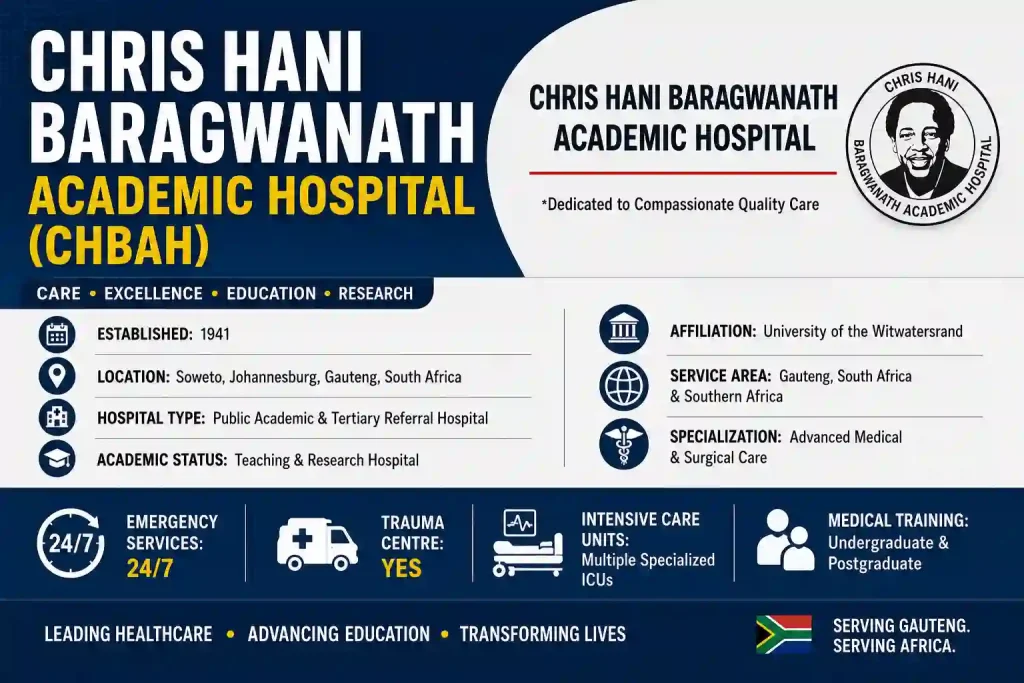
| Hospital Name | Chris Hani Baragwanath Academic Hospital (CHBAH) |
| Hospital Type | Public Academic & Tertiary Referral Hospital |
| Location | Soweto, Johannesburg, Gauteng, South Africa |
| Established | 1941 |
| Academic Status | Teaching & Research Hospital |
| Healthcare Level | Tertiary & Quaternary Care |
| Affiliation | University of the Witwatersrand |
| Service Area | Gauteng, South Africa & Southern Africa |
| Specialization | Advanced Medical & Surgical Care |
| Emergency Services | 24/7 |
| Trauma Centre | Yes |
| Intensive Care Units | Multiple Specialized ICUs |
| Medical Training | Undergraduate & Postgraduate |
📍 The Place and Its People
Baragwanath sits along Chris Hani Road in Soweto, one of South Africa’s most historically rich and densely populated townships. The hospital is deeply connected to the community it serves — not just geographically, but emotionally and socially.
Millions of people rely on it. Patients come from Soweto itself, from Johannesburg, from Gauteng province, and even from neighbouring countries in Southern Africa.
It is not unusual to see people arriving at dawn, some after long journeys, waiting patiently for care. Others arrive in ambulances, rushed through the gates in critical condition.
The hospital is accessible through major transport routes, taxis, buses, private vehicles, and emergency services. It is designed — or perhaps has evolved — to handle overwhelming demand.
🕰️ A Brief History That Runs Deep
The story of Baragwanath begins in 1941, during the Second World War. It was originally established as a military hospital for British troops stationed in South Africa.
After the war ended, the hospital did not fade away. Instead, it transformed into a civilian healthcare institution, growing rapidly as the population of Johannesburg expanded.
Over the decades, it became clear that this was no ordinary hospital. It kept expanding — more wards, more departments, more specialist services.
Eventually, it was renamed in honour of Chris Hani, the anti-apartheid struggle hero whose legacy still resonates deeply in South Africa today.
From its military roots to its modern academic role, Baragwanath has always adapted to the needs of the time.
🏥 Not Just Big — The Largest Hospital in Africa
When people say Baragwanath is big, they often don’t realise how big.
- It spans an enormous physical area
- It has thousands of beds
- It employs thousands of healthcare workers
- It handles tens of thousands of patients every month
But beyond numbers, what makes it truly massive is its responsibility.
This hospital is a tertiary and quaternary referral centre, meaning it receives the most complex and serious cases from other hospitals that cannot treat them.
If a patient is critically injured in a road accident, suffering from advanced cancer, or dealing with complex heart or brain conditions — chances are, they’ll end up here.
🎓 A Major Academic Teaching Hospital
Baragwanath is not just a place of healing — it is also a place of learning.
It is closely affiliated with the University of the Witwatersrand Faculty of Health Sciences, one of Africa’s leading medical training institutions.
This means that every day, the hospital is filled with:
- Medical students
- Nursing students
- Interns
- Registrars
- Specialists in training
You’ll often see young doctors standing beside senior consultants, learning in real time — not from textbooks, but from real patients with real conditions.
It is intense, yes. But it is also where the next generation of South African healthcare professionals is shaped.
🚑 Emergency & Trauma: Where Seconds Matter
One of the most critical parts of Baragwanath is its Emergency Department and Trauma Centre.
This is where life and death decisions are made every minute.
Patients arrive with:
- Road accident injuries
- Gunshot wounds
- Severe burns
- Medical emergencies like heart attacks and strokes
- Complications from chronic illnesses
The trauma unit is one of the busiest in the country. At any given moment, it is dealing with multiple emergencies at once.
Doctors and nurses here are trained to work under extreme pressure. There is no “slow day” in trauma — only constant urgency.
🫀 Specialist Medical Services
Baragwanath is home to a wide range of specialised departments, each handling complex medical needs.
🧠 Neurosciences
This includes neurology and neurosurgery — treating:
- Brain injuries
- Stroke patients
- Spinal disorders
- Epilepsy cases
❤️ Cardiology & Cardiothoracic Surgery
Heart conditions are treated here with advanced technology:
- Heart disease management
- Open-heart surgery
- Cardiac rehabilitation
- Emergency cardiac care
🦴 Orthopaedics
From fractures to joint replacements:
- Accident trauma injuries
- Sports injuries
- Bone reconstruction surgeries
👶 Paediatrics & Neonatal Care
Children are a major focus:
- Premature baby care
- Intensive neonatal support
- Child illness treatment
- Developmental care
🤰 Obstetrics & Gynaecology
Maternity services are vital here:
- Pregnancy monitoring
- High-risk deliveries
- Emergency childbirth care
- Women’s reproductive health
Every day, babies are born at Baragwanath — many in complicated circumstances, many safely delivered because of skilled medical teams.
🧬 Research and Innovation
Baragwanath is not just about treating patients — it is also about changing medicine itself.
It is a major centre for clinical research, especially in:
- HIV/AIDS
- Tuberculosis (TB)
- Maternal health
- Child health
- Infectious diseases
- Surgical innovation
South Africa has been heavily affected by HIV and TB, and hospitals like Baragwanath have played a major role in improving treatment, survival rates, and public health strategies.
Researchers here work closely with clinicians, meaning discoveries are quickly applied to real patient care.
🏨 Hospital Infrastructure
Inside Baragwanath, you will find a full medical ecosystem:
- Emergency departments
- Operating theatres
- Intensive Care Units (ICUs)
- Specialist clinics
- Diagnostic laboratories
- Rehabilitation centres
- Teaching facilities
There are multiple ICUs for different needs:
- Adult ICU
- Paediatric ICU
- Neonatal ICU
- Cardiac ICU
- Surgical ICU
Each unit is highly specialised, ensuring patients receive targeted care.
🧑⚕️ The People Who Keep It Running
A hospital like this doesn’t run on buildings or machines alone — it runs on people.
At Baragwanath, you’ll find:
- Doctors working long shifts
- Nurses handling overwhelming patient loads
- Cleaners maintaining hygiene standards
- Administrative staff coordinating thousands of cases
- Security teams managing constant movement
It is not easy work. The emotional and physical demands are high.
But there is also pride — because working here means being part of something bigger than yourself.
🌍 Community Impact
Baragwanath is more than a hospital for Soweto — it is a healthcare pillar for the entire region.
It provides:
- Emergency care for surrounding areas
- Specialist referrals for complex cases
- Public health outreach
- Chronic disease management
- Maternal and child healthcare support
For many families, this hospital has saved multiple generations.
It is not unusual for someone to say:
“My child was born there, and my father was treated there too.”
That is the level of impact it has.
⚠️ Challenges on the Ground
Of course, a hospital of this size is not without challenges.
Some of the common pressures include:
- Overcrowding
- High patient demand
- Limited resources at times
- Long waiting periods for non-emergency cases
- Staff burnout due to workload
But despite these challenges, the hospital continues to function as one of the most important healthcare institutions in Africa.
The system is constantly under pressure — yet it still holds.
🧭 Vision and Mission
The hospital aims to remain a world-class academic medical centre, focusing on:
- High-quality patient care
- Medical education
- Research and innovation
- Community health improvement
Its mission is simple but powerful: to deliver care that saves lives and improves health outcomes for all who walk through its doors.
🧾 Patient Experience
For many patients, visiting Baragwanath is overwhelming at first.
You walk into a space filled with movement — ambulances, wheelchairs, families, nurses, doctors calling out instructions.
Patients are advised to bring:
- ID or passport
- Referral letters
- Medical history if available
- Medication lists
In emergencies, patients are taken directly to the trauma unit — no delays, no questions, just care.
🏁 Final Thoughts
Chris Hani Baragwanath Academic Hospital is not just a building in Soweto.
It is a living, breathing institution.
It is where South Africa’s healthcare system meets its greatest challenges — and where its greatest successes are also born.
From newborn babies taking their first breath, to critical trauma patients fighting for survival, to medical students learning how to save lives — everything happens under one roof.
And through it all, Baragwanath stands strong.
As many South Africans would simply say:
“It’s not just a hospital — it’s where lives are held together.”