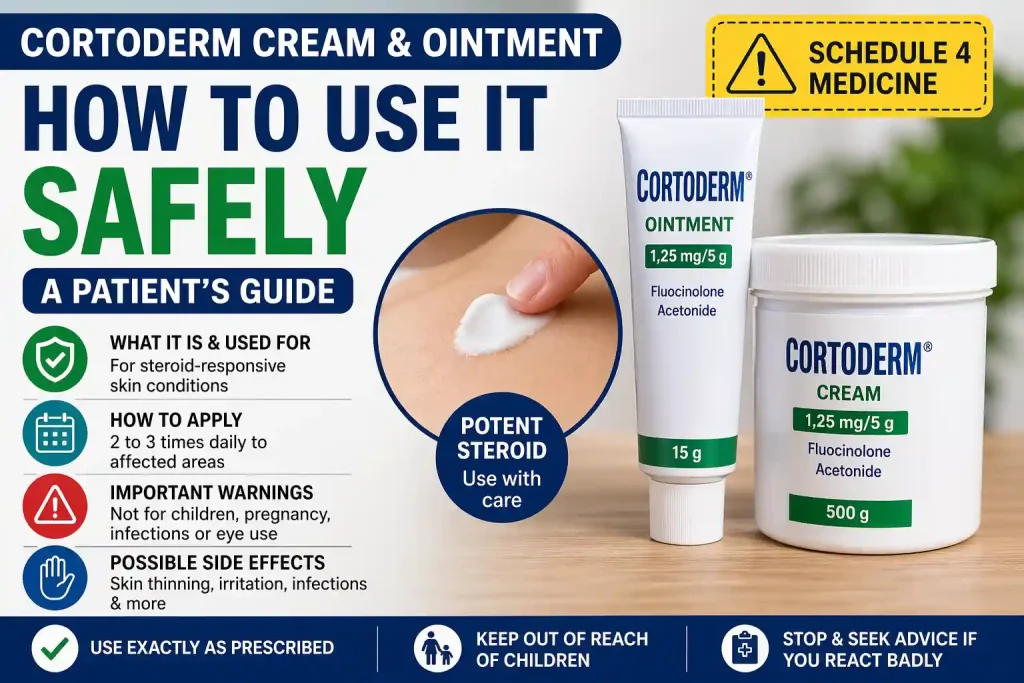
If you have been prescribed CORTODERM cream or ointment, this medicine is used on the skin for steroid-responsive dermatoses. In simple terms, that means skin conditions that are expected to improve with a corticosteroid applied to the skin. CORTODERM contains the active ingredient fluocinolone acetonide, which is a potent topical corticosteroid.
CORTODERM is a Schedule 4 medicine in South Africa.
What it is and what it is used for
CORTODERM contains fluocinolone acetonide as the active ingredient. This medicine belongs to a group called corticosteroids, which are used on the skin to help settle inflammation and irritation. It is available in two forms:
- CORTODERM Ointment 1.25 mg/5 g
- CORTODERM Cream 1.25 mg/5 g
The source states that CORTODERM is indicated for:
- Steroid-responsive dermatoses
That is the only use specifically given in the source. The exact skin conditions included under this term are not specified in the source.
How it works (simple explanation)
CORTODERM works where it is applied on your skin. The active ingredient, fluocinolone acetonide, has anti-inflammatory, anti-pruritic (anti-itch), anti-allergic, and vasoconstrictive effects. In everyday terms, this means it helps calm skin inflammation, reduce itching, and ease some allergic-type skin reactions.
If your skin is red, irritated, itchy, or inflamed and your doctor has chosen this treatment, the medicine is meant to help settle that reaction. Because it is a potent steroid, it needs to be used carefully and exactly as directed.
Who should NOT use this medicine
Do not use CORTODERM if you:
- are allergic to fluocinolone acetonide or any of the other ingredients in the product
- are pregnant
- need treatment for herpes simplex, vaccinia, or varicella
- need long-term use and you have diabetes mellitus
- need long-term use and you have tuberculosis
- are an infant or young child
Important point for children
The source is very clear that CORTODERM should not be used on infants and young children. Children can absorb a larger proportion of topical corticosteroids through the skin and may be more likely to develop harmful effects in the body.
Warnings and precautions (Read before use)
Before you start using CORTODERM, there are important safety points to know.
Stop and get advice if you react badly to it
If you notice an unfavourable reaction, treatment should be stopped. The source also says that the need for continuing treatment should be reviewed regularly.
Be careful if there is an infection or a wound
If you have a secondary microbial skin infection, suitable antimicrobial treatment should be used at the same time. CORTODERM should not be used to treat:
- infections
- leg ulcers
This is because it can:
- delay wound healing
- increase the chance of infection
Do not apply it to skin crease areas
The source says CORTODERM should not be applied to skin crease areas.
Take special care near the eyes
CORTODERM should be used with caution near the eyes, and only for short courses. Applying it to the eyes has been linked to:
- corneal ulcers
- raised intraocular pressure
- reduced visual function
Warning: This medicine is for the skin. Avoid getting it in your eyes.
Psoriasis warning
If you are being treated for psoriasis, the source says that CORTODERM may provoke the pustular form of the disease.
Risk of withdrawal reactions after long-term or inappropriate use
Long-term continuous or inappropriate use of topical steroids can lead to rebound flares after stopping treatment. The source describes a severe form where the skin becomes intensely red, stings and burns, and the reaction may spread beyond the original treatment area. This is more likely when delicate areas such as the face and flexures are treated.
If your condition comes back within days to weeks after you seemed to improve, a withdrawal reaction should be suspected. Reapplying the medicine should be done with caution, and specialist advice is recommended.
Why children are at extra risk
The source warns that children may absorb more corticosteroid through the skin and may be more likely to develop systemic toxicity, meaning effects in the rest of the body. Reported effects in children include:
- slowed growth in height
- delayed weight gain
- low plasma cortisol
- lack of response to ACTH stimulation
- bulging fontanelles
- headaches
- bilateral papilloedema
Driving and using machines
CORTODERM has no or negligible influence on your ability to drive or use machines.
Alcohol
Not specified in the source.
Pregnancy, planning pregnancy, and breastfeeding
Pregnancy
Do not use CORTODERM if you are pregnant. The source states that use in pregnancy is contraindicated. It also explains that corticosteroids have caused birth defects in animals after being applied to the skin, and because these medicines can be absorbed through the skin, that risk cannot be excluded with topical use.
Planning pregnancy
The source does not separately give instructions for planning pregnancy. Because pregnancy itself is listed as a contraindication, it would be sensible to speak to your doctor or pharmacist if you may become pregnant.
Breastfeeding
It is not known whether using topical corticosteroids like CORTODERM leads to enough absorption for measurable amounts to pass into breast milk. The source says caution should be exercised when a breastfeeding woman uses topical corticosteroids.
Fertility
There are no data available on fertility.
Interactions
The source says interactions with other medicines and other forms of interaction are:
- Not known
Food interactions
Not specified in the source.
Alcohol interactions
Not specified in the source.
Interactions with medical tests
Not specified in the source.
How to take (Step-by-step)
Always use CORTODERM exactly as prescribed for you.
General method
- It is for topical application only.
- Apply it to the affected areas of skin.
If you are using CORTODERM Ointment
The source says to:
- apply it to the affected areas 2 to 3 times daily
- use gentle inunction (gently rub it in)
- it may also be used with occlusive dressings
If you are using CORTODERM Cream
The source says to:
- apply it to the affected areas 2 to 3 times daily
- use gentle inunction (gently rub it in)
Adults
The source gives the same application frequency for adult use of the cream and ointment as above. No separate adult-only dosing category is provided.
Children
CORTODERM should not be used in infants and young children.
For older children, a separate dosing schedule is not specified in the source.
With or without food
Because this medicine is applied to the skin, food instructions are not specified in the source.
Missed dose
Instructions for a missed dose are not specified in the source.
Overdose
If too much is used, side effects may happen or may become more severe. The source says treatment for overdose is:
- supportive
- symptomatic
Warning: If you think far too much has been used and you feel unwell or notice worsening side effects, get medical advice promptly.
Simple adherence tips based on the source
Because the source says this medicine should be applied 2 to 3 times daily, it may help to:
- use it at the same times each day
- apply it only to the areas your clinician told you to treat
- stop and ask for advice if you notice a bad reaction
- keep follow-up appointments so the need for continued treatment can be reviewed regularly
Dosing table
| Product | Age or weight | Dose | Frequency | Maximum daily dose | |
|---|---|---|---|---|---|
| CORTODERM Ointment | Not specified in the source | Apply to affected areas by gentle inunction; may also be used with occlusive dressings | 2 to 3 times daily | Not specified in the source | |
| CORTODERM Cream | Not specified in the source | Apply to affected areas by gentle inunction | 2 to 3 times daily | Not specified in the source |
Possible side effects
Not everyone gets side effects, but it is important to know what to watch for.
Common
The source does not list any side effects as common or frequent.
Less common
The following are listed as less frequent:
- Worsened or more widespread local infections
- Hypersensitivity reactions, including itching and irritation
- Depression of the hypothalamic-pituitary-adrenal axis
- Adrenal gland suppression
- Growth retardation in children
- Cushingoid state (features caused by excess steroid effect in the body)
- Benign intracranial hypertension
- skin changes such as:
- atrophy of the epidermis and dermal collagen
- atrophic striae (stretch-mark-like skin thinning)
- drying and thinning of the skin
- loss of elasticity
- widening of small superficial blood vessels
- telangiectasiae
- ecchymoses
- fragile skin blood vessels causing bruising and purpura
- rosacea-like dermatitis
- perioral dermatitis
- hypopigmentation
- acneiform eruptions
- allergic contact dermatitis
- folliculitis
- hypertrichosis
- withdrawal reactions
Some of these changes are said to be especially likely on the face and when occlusive dressings are used. Occlusive dressings are also associated with maceration of the skin and miliaria.
Serious—seek urgent help
Get urgent medical help if you develop signs of a serious reaction or complication such as:
- a hypersensitivity reaction
- marked worsening or spread of an infection in the treated area
- severe skin redness, burning, stinging, itching, peeling, or oozing pustules after stopping treatment, especially if this spreads beyond the original area
- problems suggesting steroid effects in the body, particularly if large amounts were used, if it was applied to large or damaged areas, or used with occlusive dressings
Side effects linked to absorption through the skin
The source says systemic absorption may happen, especially:
- when large quantities are used
- when it is applied to wide areas
- when it is used on damaged skin
- when occlusive dressings are used
This matters because absorption can lead to steroid effects elsewhere in the body.
Reporting side effects in South Africa
Suspected adverse reactions can be reported to SAHPRA through the Med Safety App (Medsafety X SAHPRA) and the eReporting platform on the SAHPRA website. The source also provides Aspen Pharmacare contact details for safety reporting.
Storage and disposal
Store CORTODERM:
- at or below 25 °C
- protected from light
- in well-closed containers
- in the original packaging until required for use
Also remember:
- keep it out of reach of children — this wording is not stated in the source, but the source makes clear that infants and young children should not use it, and safe storage is standard medicine practice.
Note: If you want this phrased strictly from the source only, the source does not state this instruction directly. - special disposal requirements are not needed, because the source says there are no special requirements for disposal or handling.
Expiry guidance
Shelf life is:
- CORTODERM Ointment: 36 months
- CORTODERM Cream: 24 months
The source does not give extra instructions about using it after expiry beyond the shelf-life information.
What the medicine contains
Active ingredient
Each 5 g contains:
- 1.25 mg fluocinolone acetonide in the ointment
- 1.25 mg fluocinolone acetonide in the cream
Preservative
- Chlorocresol 0.1% m/m
Other ingredients in the ointment
- beeswax white
- cholesterol
- paraffin white soft
- propylene glycol
- stearyl alcohol
Other ingredients in the cream
- cetyl alcohol
- chlorocresol
- emulsifying wax
- liquid paraffin
- propylene glycol
- purified water
- citric acid monohydrate
- disodium phosphate dodecahydrate
Sugar, lactose, gluten, tartrazine
Not specified in the source.
Pack information and appearance
What it looks like
- CORTODERM Ointment is a soft white translucent ointment
- CORTODERM Cream is a soft, smooth, white cream
Pack sizes
Both the ointment and cream are available in:
- 15 g packs
- 500 g packs
The source also says:
- Not all pack sizes may be marketed.
Container details
The 15 g packs are supplied in an aluminium foil tube with a white high-density polyethylene screw cap and placed in a cardboard carton. The 500 g packs are supplied in a white high-density polyethylene jar with a white polypropylene screw cap.
Practical FAQs (based ONLY on the source)
Can I use CORTODERM during pregnancy?
No. Pregnancy is listed as a contraindication, which means you should not use it if you are pregnant.
Can I use it while breastfeeding?
The source says it is not known whether enough of the medicine is absorbed to appear in breast milk, so caution should be exercised during breastfeeding.
Can I put it near my eyes?
You need to be very careful. The source says it should be used with caution near the eyes and only for short courses, because application to the eyes has been linked to serious eye problems.
Can I use it on a child?
Not in infants and young children. The source says it should not be used in this age group.
Can I use it on infected skin?
Not on its own to treat infection. If there is a secondary microbial skin infection, suitable antimicrobial treatment should be used at the same time. CORTODERM should not be used to treat infections or leg ulcers.
How often should I apply it?
For both the cream and ointment, the source says to apply it 2 to 3 times daily to the affected areas.
Can I use a dressing over it?
For the ointment, the source says it may be used with occlusive dressings. However, the source also warns that systemic absorption and certain skin problems are more likely when occlusive dressings are used.
Can I drive while using it?
Yes, in general. The source says CORTODERM has no or negligible influence on driving or using machines.
Can I drink alcohol while taking this?
Not specified in the source.
What should I do if I use too much?
Too much may bring on side effects or make them worse. The source says treatment of overdose is supportive and symptomatic.