
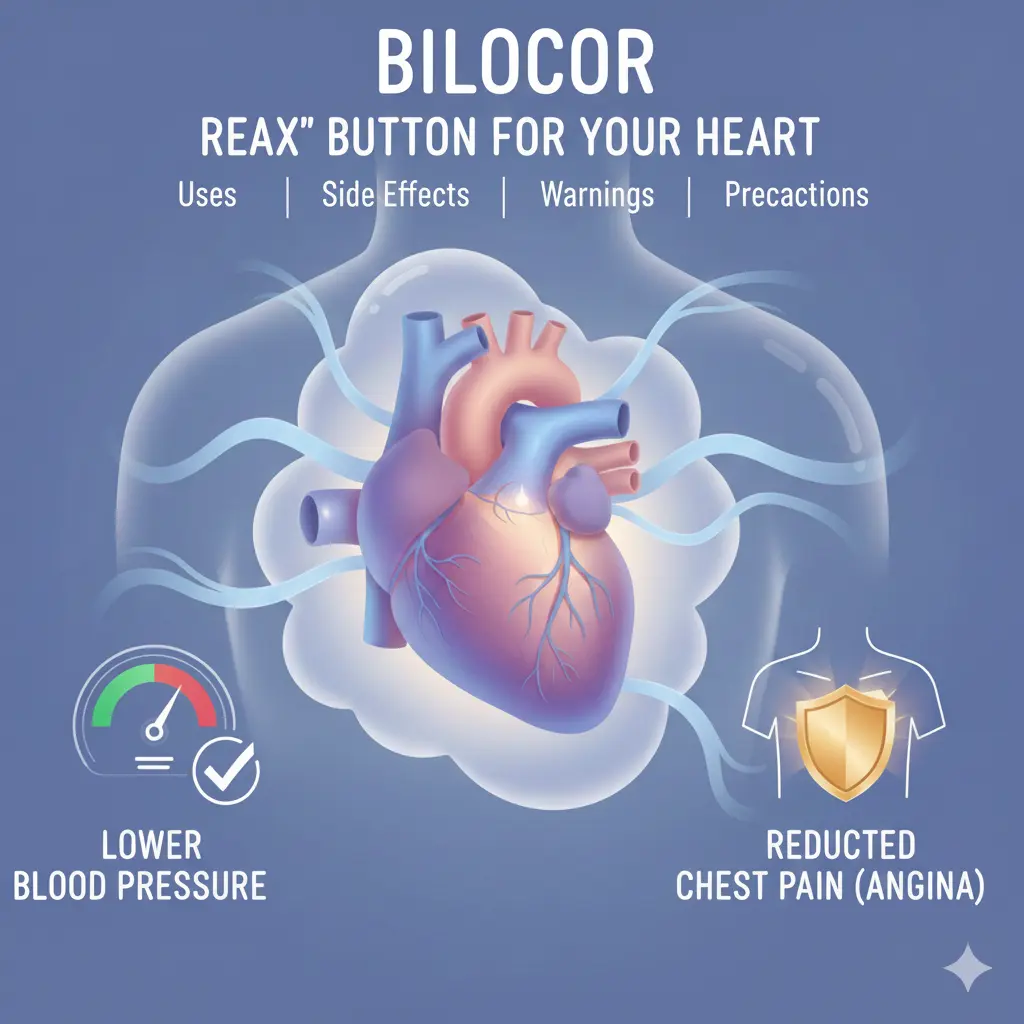
This medicine is a prescription drug called a beta-blocker. What does that mean? In simple words, it helps your heart relax a little so it doesn’t have to work so hard. When the heart is calmer, two important things happen:
- Blood pressure becomes easier to control, and
- Chest pain caused by poor blood flow (angina) gets better
The active ingredient in this medicine is bisoprolol fumarate. You’ll usually find it in 5 mg or 10 mg tablets.
Doctors may prescribe it on its own, or they might combine it with other blood pressure medicines if someone needs stronger control.
Another useful thing is that the tablets have a score line in the middle. This line isn’t for decoration — it’s there so you can break the tablet into equal halves if your doctor recommends a smaller dose.
Because this medicine works directly on the heart, it is listed as Schedule 3 (S3) in South Africa, which means you can only get it with a prescription from a doctor or a clinic; this rule helps protect people from taking the wrong dose.
Public clinics and state hospitals can also provide it, sometimes free, depending on availability. So even though the name sounds serious, there is no need to panic — the medicine is simply there to help the heart rest a little and stay healthy, as long as it is used exactly the way the doctor explained.
What it is and what it is used for
Active ingredient and class
- Bisoprolol fumarate, a selective β1-adrenoceptor (beta-1) blocker.
Indications (uses) exactly as per source
- Management of mild to moderate hypertension.
- Management of angina pectoris.
- May be used alone or with other antihypertensive medicines.
How it works
Bisoprolol mainly blocks beta-1 receptors in the heart and in the kidneys’ juxtaglomerular apparatus. By doing this, it:
- Slows the heart rate and reduces how hard the heart works, so the heart needs less oxygen.
- Lowers the release of renin from the kidneys, which helps reduce blood pressure.
- Lowers overall cardiac output and helps bring down blood pressure over 24 hours (typical half-life about 10–12 hours; bioavailability about 90 %; absorption not affected by food—details provided for context from the source).
Put simply: bisoprolol helps the heart to beat more calmly and efficiently and helps the blood vessels’ pressure system to settle, which reduces blood pressure and chest pain.
Who should NOT use this medicine
Do not use BILOCOR if any of the following apply :
- You are allergic to bisoprolol or any ingredient in the tablet (see excipients below).
- Uncontrolled asthma or a history suggesting serious bronchospasm.
- Second- or third-degree heart block (without a pacemaker), sino-atrial block, or sick sinus syndrome; sinus bradycardia (< 50 beats per minute).
- Uncontrolled cardiac failure or cardiogenic shock.
- Symptomatic hypotension (low blood pressure).
- Peripheral arterial occlusive disease or Raynaud’s phenomenon.
- Metabolic acidosis.
- Phaeochromocytoma before full alpha-blockade is achieved.
- Hyperthyroidism (signs may be masked).
- Pregnancy and breastfeeding (contraindicated).
- Paediatric use: safety and efficacy have not been established.
Warnings and precautions (Read before use)
Do not stop suddenly
- Abruptly stopping BILOCOR can worsen angina and may cause a sudden deterioration in people with ischaemic heart disease.
- If stopping is necessary, your dose should be lowered gradually (for example, halve the dose at weekly intervals), and physical exertion should be limited during the taper.
Heart conditions
- If you have hypertension or angina with concomitant heart failure, careful monitoring is needed.
- In patients at risk of congestive cardiac failure, digitalisation (use of digoxin) may be needed and must be carefully managed.
- Use with caution if you have first-degree AV block or Prinzmetal’s (variant) angina; attacks cannot be completely excluded even with beta-1 selectivity.
Lung conditions
- Asthma or chronic obstructive pulmonary disease (COPD): all beta-blockers can cause bronchoconstriction. If treatment is clinically necessary, start at the lowest possible dose, monitor for new breathing symptoms (shortness of breath, cough, exercise intolerance), and ensure bronchodilator therapy is available; β2-agonist doses may need increases.
- Chronic pulmonary disease in general: monitor for bradycardia and heart failure.
Diabetes and fasting
- In people with diabetes mellitus, BILOCOR may mask the signs of low blood sugar (such as palpitations, sweating).
- Caution in strict fasting.
Allergy and desensitisation
- During desensitisation therapy, bisoprolol may increase sensitivity to allergens and increase the severity of anaphylactic reactions. Adrenaline may be less effective than expected.
Peripheral circulation and skin
- May worsen peripheral vascular disease or Raynaud’s; monitor symptoms, especially at the start of therapy.
- Use with caution if you have psoriasis or a history of psoriasis.
Kidneys and liver
- Severe renal impairment (creatinine clearance < 20 mL/min) or severe hepatic impairment: do not exceed 10 mg/day.
- Mild to moderate kidney or liver problems: no routine dose adjustment required (per source).
Elderly
- The normal dose should be reduced in older patients.
Thyroid
- Hyperthyroidism signs may be masked.
Phaeochromocytoma
- Ensure full alpha-blockade before starting BILOCOR.
Anaesthesia and surgery
- If stopping before an operation, allow at least 48 hours from the last dose to anaesthesia.
- If continuing, the anaesthetist must be informed (tachycardia due to blood loss may be masked; interactions with certain anaesthetics may occur).
- Atropine may be used to correct vagal dominance intra-operatively as per the source guidance.
Excipient note
- Contains lactose. Do not take if you have galactose intolerance, total lactase deficiency, or glucose-galactose malabsorption.
Driving and machinery
- BILOCOR has no or negligible direct effect on driving/operating machines, but dizziness or fatigue can occur, particularly at the start of treatment, when the medicine is changed, or with alcohol.
Warning: Some medicine combinations with BILOCOR can be dangerous (see Interactions). Always inform your healthcare provider about everything you take.
Pregnancy, planning pregnancy, and breastfeeding
- Contraindicated in pregnancy. BILOCOR can reduce placental blood flow, which has been associated with growth retardation, intrauterine death, abortion, or early labour. Use shortly before or during labour may cause hypotonia, collapse, or hypoglycaemia in the newborn.
- Contraindicated in breastfeeding. It is not known if bisoprolol is excreted in human milk.
- Planning pregnancy: Not specified in the source. Speak to your doctor or pharmacist before use.
Interactions
Combinations not recommended :
- Verapamil-type calcium channel blockers (and to a lesser extent diltiazem): risk of marked hypotension, AV block, and depressed heart function, especially if verapamil is given intravenously.
- Centrally acting antihypertensives (e.g., clonidine, methyldopa, moxonidine, rilmenidine): may worsen heart failure and cause rebound hypertension if stopped abruptly. If used together, withdraw the beta-blocker several days before stopping clonidine; if switching to a beta-blocker, delay its start for several days after clonidine cessation.
Use with caution:
- Dihydropyridine calcium channel blockers (nifedipine, felodipine, amlodipine): may increase risk of hypotension and can worsen ventricular function in heart failure.
- Class III antiarrhythmics (e.g., amiodarone) and Class I antiarrhythmics (e.g., quinidine, disopyramide, lidocaine, phenytoin, flecainide, propafenone): effects on AV conduction may be additive; negative heart effects may increase.
- Topical beta-blockers (glaucoma eye drops): can add to systemic effects.
- Parasympathomimetics: increased AV conduction time and risk of bradycardia.
- Insulin and oral antidiabetics: greater blood-glucose-lowering effect; beta-blockade may mask hypoglycaemia symptoms.
- Anaesthetic agents: may blunt reflex tachycardia and increase hypotension risk.
- Digitalis glycosides (digoxin): further reduces heart rate and prolongs AV conduction; may be used together in heart failure with monitoring.
- NSAIDs: may reduce the antihypertensive effect.
- Beta-sympathomimetics (e.g., dobutamine) and adrenaline for allergy treatment: effects may be reduced or altered; higher adrenaline doses may be required for allergies (per source).
- Sympathomimetics with both α and β activity (e.g., noradrenaline, adrenaline): may raise blood pressure and worsen intermittent claudication, especially with nonselective beta-blockers; caution still advised.
- Beta-adrenoceptor stimulants (e.g., isoprenaline): may oppose bisoprolol’s effect.
- Alpha stimulants and adrenergic neurone blockers (guanethidine, reserpine): risk of severe vasoconstriction.
- Other medicines that lower blood pressure (e.g., tricyclic antidepressants, barbiturates, phenothiazines): increased risk of hypotension; combinations with phenothiazines and some anti-dysrhythmics can have life-threatening consequences (myocardial depression).
Combinations to be considered:
- Mefloquine: increased risk of bradycardia.
- MAO inhibitors (except MAO-B inhibitors): enhanced hypotension and risk of hypertensive crisis.
- Rifampicin: may slightly reduce bisoprolol half-life (dose adjustment usually not needed).
- Ergotamine derivatives: may worsen peripheral circulation.
- High-dose salicylates: may enhance CNS toxicity of salicylates.
Practical advice: Always tell your doctor, pharmacist, dentist, and anaesthetist you are taking BILOCOR. Do not start or stop interacting medicines (especially clonidine, verapamil/diltiazem, amiodarone, digoxin, NSAIDs) without professional guidance.
How to take (Step-by-step)
- Follow your script: Your healthcare provider will set an individual dose based on your response and tolerance.
- When to take: Take your dose once daily in the morning.
- With food or not: You may take it with or without food.
- How to take: Swallow the tablet with some liquid. Tablets are scored and can be divided into equal halves if needed.
- Usual adult dose: 5–10 mg once daily.
- Maximum daily dose: 20 mg/day. For angina, no benefit was shown by increasing to 20 mg once daily beyond lower doses (per source).
- Special groups:
- Severe kidney impairment (creatinine clearance < 20 mL/min) or severe liver impairment: do not exceed 10 mg/day.
- Elderly: the normal dose should be reduced.
- Children: safety and efficacy not established.
- Dialysis: limited experience; no clear need to alter the regimen per source.
- Duration of treatment: Not limited—depends on your condition.
- Stopping the medicine: Do not stop suddenly. If stopping, reduce the dose gradually (for example, halving the dose weekly) and limit heavy physical activity during the taper.
- Missed dose: Not specified in the source. Ask your pharmacist or doctor for personalised advice.
- Overdose (took too much): May cause slow heart rate, severe low blood pressure, wheezing/bronchospasm, acute heart failure, or low blood sugar. Seek immediate medical care. Do not attempt home treatment.
Note: If you need surgery or anaesthesia, inform your surgical team. If your doctor decides to stop BILOCOR beforehand, the last dose should be taken at least 48 hours before anaesthesia.
Dosing table
| Population / Use | Dose | Frequency | Maximum daily dose | Notes from source |
|---|---|---|---|---|
| Adults (hypertension/angina) | 5–10 mg | Once daily (morning) | 20 mg/day | Individualise based on response and tolerance; take with or without food |
| Angina pectoris (dose escalation) | — | — | 20 mg/day | No additional benefit shown by increasing to 20 mg once daily |
| Severe renal impairment (CrCl < 20 mL/min) | As directed | Once daily | 10 mg/day | Do not exceed 10 mg/day |
| Severe hepatic impairment | As directed | Once daily | 10 mg/day | Do not exceed 10 mg/day |
| Mild–moderate renal/hepatic impairment | As directed | Once daily | As above | No routine adjustment required |
| Elderly | Reduced dose (exact amount not specified) | Once daily | As directed | Reduce the normal dose |
| Paediatric patients | — | — | — | Safety and efficacy not established |
Possible side effects
Side effects are organised here using the frequency terms given in the source. If you develop worrying symptoms—especially breathing difficulty, chest pain, severe dizziness, fainting, swelling of the face/lips/tongue, or signs of very slow pulse—seek urgent medical help.
Common
- Drowsiness, unusual tiredness or weakness, dizziness, mild headache.
- Bradycardia (slow pulse).
- Cold hands/feet, low blood pressure.
- Nausea, vomiting, diarrhoea, constipation.
Less common
- Blood/immune: Leukopenia or thrombocytopenia; hypersensitivity (allergic) reactions.
- Mood/neurological: Sleep problems, depression, nightmares/vivid dreams, hallucinations, confusion; anxiety, nervousness, fainting (syncope); (frequency unknown in source: restlessness, lassitude, paraesthesia).
- Eyes/ears: Dry, sore eyes, reduced tear flow (relevant for contact lens wearers), conjunctivitis; (frequency unknown: vision disturbances, transient hearing loss).
- Heart and circulation: Worsening of pre-existing heart failure, dysrhythmias, reduced peripheral circulation; (frequency unknown: heart block, fluid retention).
- Vascular: Orthostatic hypotension (dizziness on standing); (frequency unknown: exacerbation of peripheral vascular disease, development of Raynaud’s phenomenon, peripheral gangrene may be precipitated).
- Breathing/ENT: Bronchoconstriction/bronchospasm in those with asthma/chronic lung disease, nasal congestion, allergic rhinitis.
- Liver: Hepatotoxicity, hepatitis; (frequency unknown: raised liver enzymes).
- Skin/hair: Rash, psoriasiform eruption, itching, flushing, angio-oedema, hair loss; (frequency unknown: perspiration).
- Muscles/joints: Back or joint pain, chest pain, muscle cramps, skeletal muscle weakness; (frequency unknown: myopathy).
- Sexual function: Decreased sexual ability/impotence, sexual dysfunction.
- Laboratory changes: Increased triglycerides, increased liver enzymes (ALAT, ASAT).
- Metabolism: (frequency unknown) metabolic disturbances, hypoglycaemia, raised uric acid, hypercholesterolaemia.
- Other general: Asthenia, fatigue.
Serious
- Severe bradycardia, heart block, worsening heart failure, serious dysrhythmias, marked hypotension or collapse.
- Bronchospasm/severe shortness of breath (especially if you have asthma/COPD).
- Hypersensitivity reactions, including angio-oedema (swelling of face, lips, tongue) or severe skin reactions.
- Hepatotoxicity/hepatitis (e.g., yellowing of eyes/skin, dark urine).
- Peripheral ischaemia including peripheral gangrene (pain, colour change, non-healing sores on fingers/toes).
Note: Adverse reactions may be more common in patients with renal decompensation .
Storage and disposal
- Store at or below 25 °C and protect from light.
- Keep blister packs in the carton until you need a dose (this protects from light and moisture).
- Shelf life: 36 months.
- Disposal: No special requirements mentioned. Keep all medicines out of the reach and sight of children.
What the medicine contains
Active ingredient
- BILOCOR 5: 5 mg bisoprolol fumarate per tablet.
- BILOCOR 10: 10 mg bisoprolol fumarate per tablet.
Important excipient information
- Contains sugar (lactose):
- BILOCOR 5: lactose monohydrate 136,16 mg per tablet.
- BILOCOR 10: lactose monohydrate 130,86 mg per tablet.
- Patients with galactose intolerance, total lactase deficiency, or glucose-galactose malabsorption should not take this medicine.
Other excipients
- Crospovidone; Iron oxide yellow; Iron oxide red (BILOCOR 10 only); Lactose monohydrate; Magnesium stearate; Microcrystalline cellulose.
Pack information and appearance
- Pharmaceutical form: Tablets.
- BILOCOR 5: Pale yellow, mottled, round, normal convex tablet, debossed with “BI” over a break-line and “5” on one side, plain on the reverse.
- BILOCOR 10: Mottled beige, round, normal convex tablet, debossed with “BI” over a break-line and “10” on one side, plain on the reverse.
- Tablet can be divided into equal halves.
- Packs: Opaque or clear Al/PVC/PVdC blister packs containing 30 tablets.
Holder of certificate of registration: Pharma Dynamics (Pty) Ltd.
FAQs
1) Can I stop BILOCOR suddenly?
No. The source states that abrupt discontinuation may exacerbate angina and worsen your condition. Taper gradually (for example, halve the dose weekly) under medical supervision and limit strenuous activity while stopping.
2) Do I have to take it with food?
No. The source notes you can take it with or without food. It should be taken once each morning.
3) I have severe kidney or liver problems—can I take BILOCOR?
Use may be possible but the source instructs not to exceed 10 mg per day in severe renal (creatinine clearance < 20 mL/min) or severe hepatic impairment. Your doctor will guide you.
4) Is BILOCOR safe in pregnancy or during breastfeeding?
No. The source lists pregnancy and breastfeeding as contraindications. It also describes potential risks to the foetus/newborn and reduced placental perfusion.
5) Can children use BILOCOR?
The safety and efficacy in children have not been established (no data available).
6) I have asthma—what should I know?
All beta-blockers can cause bronchoconstriction. The source says BILOCOR should be avoided in uncontrolled asthma and used with caution only when clinically necessary, starting at the lowest dose, with close monitoring and concomitant bronchodilator therapy as needed.
7) Can I drive or operate machinery while taking BILOCOR?
BILOCOR has no or negligible direct effect, but dizziness or fatigue may occur, especially at the start, if the medicine is changed, or with alcohol.
8) Can I split the tablet?
Yes. The tablets are scored and can be divided into equal halves.
9) What about interactions with pain medicines such as anti-inflammatories?
The source notes that NSAIDs can reduce the blood-pressure-lowering effect of BILOCOR. Discuss ongoing NSAID use with your doctor or pharmacist.
10) I am on clonidine. Can I use BILOCOR?
This combination requires careful medical management. The source explains there is a risk of rebound hypertension if clonidine is stopped incorrectly. If both are used, the beta-blocker should be withdrawn several days before discontinuing clonidine, and starting a beta-blocker should be delayed for several days after stopping clonidine.
11) What if I miss a dose?
Not specified in the source. Please ask your pharmacist or doctor for advice suitable for your situation.
12) I’m scheduled for an operation—should I continue BILOCOR?
The source advises either continuing with caution (inform your anaesthetist) or, if stopping is chosen, allowing at least 48 hours between the last dose and anaesthesia. This decision should be made by your healthcare team.

Manish Sharma is a Master’s graduate in Pharmaceutical Chemistry and a registered pharmacist with a passion for simplifying medical knowledge for everyday readers. Through his platform, he provides clear, easy-to-understand information about medicines — including their correct usage, benefits, and safety tips — while also addressing common myths surrounding them.
Alongside modern medicine, Manish also explores natural and herbal remedies, encouraging a balanced and healthy lifestyle. His mission is to empower people with reliable health information, helping them make informed decisions and live healthier, happier lives.