Venteze is a prescription medicine used to help people breathe more easily when they have certain lung conditions. It contains salbutamol sulphate, a medicine that works by opening up the airways in the lungs. This makes it easier for air to flow in and out, helping to relieve symptoms such as wheezing, shortness of breath, and chest tightness.
It is commonly prescribed for conditions like asthma and chronic obstructive pulmonary disease (COPD), including chronic bronchitis and emphysema. Venteze is available in tablet and syrup forms, both of which are sugar-free.
Quick facts
- Active ingredient: Salbutamol sulphate
- Medicine class: Selective beta-2-adrenergic agonist
- Used for: Asthma, COPD, chronic bronchitis, emphysema
- Forms available: Tablets and syrup
- Scheduling status: S2
- Main action: Relaxes airway muscles to improve breathing
What it is and what it is used for
Venteze contains salbutamol, a medicine that belongs to a group called beta-2 agonists. These medicines are widely used to treat breathing conditions by relaxing the muscles in the lungs.
Indications (uses)
Venteze is used to relieve symptoms associated with:
- Bronchial asthma
- Chronic obstructive bronchitis
- Emphysema
- Chronic obstructive pulmonary disease (COPD)
These conditions cause narrowing of the airways, making breathing difficult. Venteze helps reduce this narrowing.
How it works
In simple terms, Venteze works by relaxing the muscles around the airways in your lungs. When these muscles relax:
- The airways open wider
- Air can move more freely
- Breathing becomes easier
This effect helps relieve symptoms such as:
- Wheezing
- Shortness of breath
- Tight chest
Who should NOT use this medicine
Do not take Venteze if any of the following apply to you:
- You are allergic to salbutamol or any ingredient in the medicine
- You are taking beta-blockers (such as atenolol or propranolol)
- You have an overactive thyroid (hyperthyroidism)
- You have a heart disorder or irregular heartbeat (arrhythmia)
- You are taking or have recently taken monoamine oxidase inhibitors (MAOIs)
- You have a history of miscarriage in early pregnancy
- You are using it to prevent premature labour in early pregnancy
Warning: Using Venteze in these situations may lead to serious health risks.
Warnings and precautions (Read before use)
Before taking Venteze, speak to your doctor or pharmacist if you have any medical conditions.
Important precautions
- Long-term use may lead to reduced effectiveness (tolerance)
- Inform your doctor if you have:
- High blood pressure
- Diabetes
- Glaucoma
- Heart rhythm problems
- Do not use it in sports competitions without medical advice
- If symptoms worsen or do not improve, seek medical help
Use in children
- Not recommended for very young children due to limited safety data
Driving and alcohol
Not specified in the source.
Pregnancy, planning pregnancy, and breastfeeding
- Avoid use if there is a history of miscarriage in early pregnancy
- Do not use for preventing premature labour in early pregnancy
Breastfeeding and general pregnancy guidance:
Not specified in the source. Speak to your doctor or pharmacist before use.
Interactions
Some medicines may affect how Venteze works or increase side effects.
Medicines that may interact
| Medication Type | Examples | Possible Effect | |
|---|---|---|---|
| Beta-blockers | Atenolol, Propranolol | May reduce effect and worsen breathing | |
| Corticosteroids | Prednisone, Dexamethasone | Increased side effects (e.g. tremors, fast heart rate) | |
| Diuretics | Furosemide, Hydrochlorothiazide | May lower potassium levels | |
| Asthma medicines | Theophylline, Aminophylline | Increased jitteriness and palpitations | |
| Antidepressants | Amitriptyline, Fluoxetine | Increased cardiovascular side effects | |
| Blood pressure medicines | Reserpine, Methyldopa | May affect heart rate | |
| Diabetes medicines | Insulin, Metformin | May require dose adjustment |
Practical advice:
Always inform your healthcare provider about all medicines you are taking.
How to take (Step-by-step)
Always take Venteze exactly as prescribed by your doctor.
General instructions
- Follow your doctor’s dosage instructions carefully
- Do not change the dose on your own
- Consult a pharmacist if unsure
Recommended dosing
| Age Group | Tablets | Syrup | |
|---|---|---|---|
| Adults | As prescribed | As prescribed | |
| Elderly | Lower starting dose | Adjusted by doctor | |
| Children | As prescribed | As prescribed |
Missed dose
- Take the missed dose as soon as you remember
- If it is close to your next dose, skip the missed one
- Do not take a double dose
Overdose
Seek urgent medical help if overdose is suspected.
Symptoms may include:
- Fast or irregular heartbeat
- Tremors (shaking)
- Nausea and vomiting
- Blood pressure changes
- Weakness or dizziness
Possible side effects
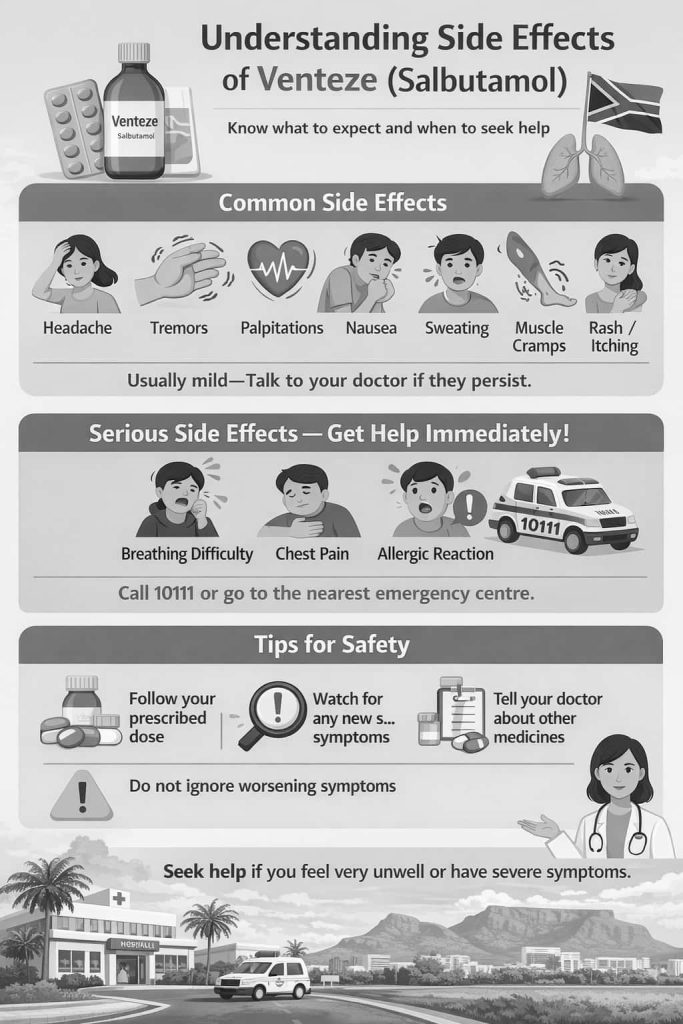
Like all medicines, Venteze (salbutamol) can cause side effects. Not everyone will experience them, and many are mild and temporary. However, it is important to understand what may happen and when to seek help.
Side effects are grouped below to help you recognise them easily and respond appropriately.
Common side effects
These are the side effects most often reported. They are usually mild and may settle as your body adjusts to the medicine.
Headache
You may experience a mild to moderate headache, especially when starting treatment. This happens because salbutamol can slightly affect blood vessels.
What to do: Rest and stay hydrated. If headaches persist or worsen, speak to your doctor.
Tremors (shaking)
Shaking, particularly in the hands, is one of the most well-known effects of salbutamol. It happens because the medicine stimulates certain receptors in muscles.
What to do: Usually harmless and temporary. If severe or persistent, consult your healthcare provider.
Palpitations (fast or noticeable heartbeat)
You may feel your heart beating faster or more strongly than usual.
What to do: Sit down and rest. If palpitations are frequent, severe, or accompanied by chest pain, seek medical advice.
Nausea (feeling sick)
Some people feel slightly nauseous or may even vomit.
What to do: Taking the medicine as directed may help. If vomiting continues, contact your doctor.
Sweating
Increased sweating may occur due to stimulation of the nervous system.
What to do: Keep hydrated. This side effect is usually mild.
Muscle cramps
Painful tightening of muscles, especially in the legs, may happen.
What to do: Gentle stretching and hydration may help. Report persistent cramps.
Difficulty in urination
Some individuals may find it harder to pass urine.
What to do: Seek medical advice if this becomes uncomfortable or ongoing.
Rash or itching
Skin reactions may occur and could indicate sensitivity to the medicine.
What to do: Mild rashes should be monitored. Stop the medicine and seek help if the reaction worsens.
Dizziness
You may feel light-headed or slightly unsteady.
What to do: Avoid standing up quickly. If dizziness is severe or persistent, consult your doctor.
Less common side effects
Not specified in the source.
Serious side effects — seek urgent medical help
Although rare, some side effects are serious and require immediate medical attention.
Severe allergic reaction
This may include:
- Swelling of the face, lips, tongue, or throat
- Severe rash or itching
- Difficulty breathing
Why it matters: This could be a life-threatening allergic reaction (anaphylaxis).
What to do: Seek emergency medical help immediately.
Breathing difficulties or worsening wheezing
Instead of improving breathing, symptoms may suddenly worsen.
What to do: This is urgent—get medical help immediately.
Chest pain or irregular heartbeat
You may feel:
- Tightness or pain in the chest
- Irregular or very fast heartbeat
Why it matters: This could indicate a serious heart-related effect.
What to do: Go to the nearest emergency centre without delay.
Understanding why side effects happen
Venteze works by stimulating beta-2 receptors in the lungs, but it can also affect similar receptors in other parts of the body. This is why side effects like tremors, palpitations, and sweating may occur.
- Muscle effects → tremors, cramps
- Heart effects → palpitations, fast heartbeat
- Nervous system effects → headache, dizziness
These effects are usually dose-related and may improve over time.
Practical safety tips
- Take the medicine exactly as prescribed
- Do not increase your dose without medical advice
- Keep track of any new symptoms after starting treatment
- Inform your doctor about all other medicines you are taking
Storage and disposal
- Keep out of reach of children
- Store below 25°C
- Protect from light
- Keep in original packaging
- Avoid humid places (e.g. bathrooms)
- Do not use after expiry date
- Return unused medicine to a pharmacy for safe disposal
What the medicine contains
Active ingredient
- Salbutamol sulphate (tablets and syrup)
Inactive ingredients
Tablets:
- Calcium sulphate dihydrate
- Croscarmellose sodium
- Magnesium stearate
- Maize starch
- Colourants
Syrup:
- Citric acid
- Disodium edetate
- Orange flavour
- Saccharin sodium
- Sodium benzoate
- Xanthan gum
- Sunset Yellow (E-110)
Pack information and appearance
- Tablets: Lilac, round, flat, bevelled edges, scored on one side
- Syrup: Clear orange liquid with orange smell
- Packaging: Blister packs, securitainers, amber glass, or PVC bottles
Practical FAQs
Can I take Venteze with other medicines?
Only if approved by your doctor, as several medicines may interact with it.
What should I do if my symptoms don’t improve?
Seek medical advice. Your treatment may need adjustment.
Can I double my dose if I miss one?
No. Never take a double dose.
Is Venteze safe for children?
Not recommended for very young children due to limited safety data.
Can I use it long-term?
Long-term use may reduce effectiveness. Regular medical review is important.
What happens if I take too much?
You may experience symptoms like rapid heartbeat or tremors—seek immediate medical help.
Plain-language summary
Venteze is a breathing medicine that helps open the airways, making it easier to breathe. It is commonly used for asthma and COPD-related conditions. When used correctly, it can quickly relieve symptoms like wheezing and shortness of breath.
However, it must be used carefully and only as prescribed. Some people should not use it, and it can interact with other medicines. If you notice serious side effects such as chest pain or difficulty breathing, seek medical help immediately. Always follow your doctor’s advice for safe and effective treatment.

## 🩺 RxZest Medical Team
The **RxZest Medical Team** is dedicated to providing accurate, reliable, and easy-to-understand health information. Our team includes healthcare writers, medical researchers, and pharmacology specialists who simplify complex medical topics into clear, practical guidance.
All content is based on trusted medical sources and carefully reviewed for accuracy and safety. We focus on medicine-related topics such as uses, dosage, side effects, and precautions, ensuring information is helpful and up to date.
Our goal is to make health information accessible to everyone. Content is for educational purposes only and does not replace professional medical advice.