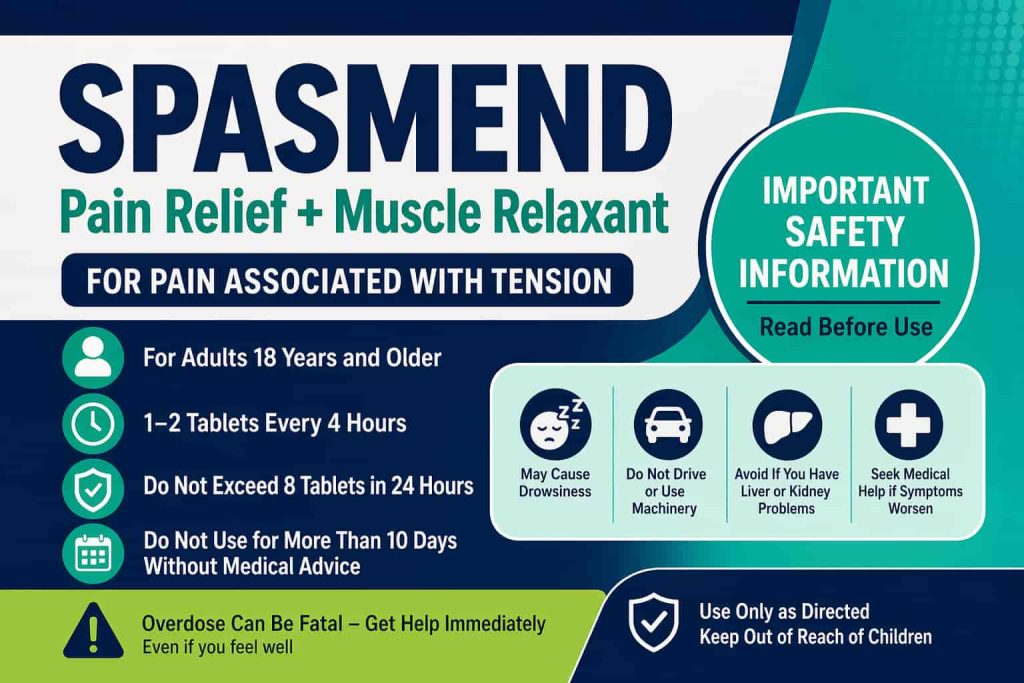
If I am considering using SPASMEND, I need to know that it is a medicine for generalised pain and pain linked to tension. Each tablet contains paracetamol 500 mg for pain relief and mephenesin 150 mg, which is a skeletal muscle relaxant (a medicine that helps relax muscles). Together, these ingredients are meant to help with pain associated with tension.
Quick facts
Before I take SPASMEND, these are the key points I should remember:
- Scheduling status: S2
- Active ingredients: Mephenesin 150 mg and paracetamol 500 mg per tablet
- What it is for: Generalised and symptomatic pain, especially pain associated with tension
- Who may use it: Adults aged 18 years and older
- Usual dose: One or two tablets every four hours by mouth
- Maximum dose: Eight tablets in 24 hours
- How long to use it: Up to 10 days, unless a doctor advises otherwise
- Important warning: Too much paracetamol can be fatal, even if I feel well at first
- May cause drowsiness: I may need to avoid driving or using machinery
- Sugar free: Yes
What it is and what it is used for
If I read the patient information from a user’s point of view, SPASMEND is a combination tablet used for generalised and symptomatic pain. It is specifically intended for pain associated with tension. The product combines a pain reliever with a muscle relaxant, so it is aimed at pain where tension may be playing a role.
What each tablet contains
Each SPASMEND tablet contains:
- Paracetamol 500 mg
- Mephenesin 150 mg
What type of medicine it is
From my perspective as a user, it helps to think of SPASMEND as a two-in-one medicine:
- Paracetamol helps relieve pain
- Mephenesin helps relax skeletal muscles
What it is used for
The source states that SPASMEND is used for:
- Generalised pain
- Symptomatic pain
- Pain associated with tension
The source does not describe other specific illnesses or conditions .
How it works
If I want a simple explanation, SPASMEND works by combining pain relief with muscle relaxation.
The paracetamol part is there to help ease pain. The mephenesin part is there to relax muscles, which may be useful if my pain is linked to tension or tightness. So, in everyday terms, one ingredient helps with the pain itself, while the other may help if tense muscles are part of the problem.
Note: A more detailed medical explanation of how the medicine works in the body is not specified in the source.
Who should NOT use this medicine
Before I take SPASMEND, I need to check whether any of the “do not use” situations apply to me.
I should not use SPASMEND if:
- I am allergic or hypersensitive to mephenesin
- I am allergic or hypersensitive to paracetamol
- I am allergic to any of the other ingredients in the tablets
- I have impaired kidney function
- I have impaired liver function
Age restriction
I should also know that SPASMEND is not for children younger than 18 years old. The source is clear on this point.
Important personal safety reminder
Even if this medicine helps me, I should not share it with anyone else. A medicine that suits one person may not be safe for another.
Warnings and precautions (Read before use)
As a patient, this is one of the most important sections to read carefully before I start taking SPASMEND.
Overdose can be very dangerous
Because SPASMEND contains paracetamol, taking too much can be fatal. The source warns that even if I or someone else seems fine after taking too much, urgent medical help is still needed straight away. The nearest doctor, hospital, or Poison Centre must be contacted immediately in any case of overdose or suspected overdose.
Warning: I must never assume that “no symptoms” means “no danger”. Serious harm can still happen.
I need to be careful if I have kidney or liver problems
The source says SPASMEND should not be used if I have impaired kidney and liver function. It also warns that paracetamol should be taken with care in people with impaired renal or hepatic function.
It may make me drowsy
Because mephenesin may cause drowsiness, I need to be careful about anything that depends on concentration and alertness. If I feel sleepy, slowed down, or less focused, I should not drive or use machinery.
I should not use it continuously for too long
The source says I should not use SPASMEND continuously for more than 10 days without consulting a doctor. If my symptoms get worse or do not improve after 10 days, I should see a doctor.
Practical safety checks before I take it
Before using SPASMEND, I should ask myself:
- Am I taking the right dose?
- Have I checked whether I am allergic to any of the ingredients?
- Do I have kidney or liver problems?
- Am I already taking another medicine that could make me drowsy?
- Have I used it for close to 10 days without improvement?
Driving, machinery, and risky tasks
The source warns that SPASMEND may interfere with daily activities. As a user, I should be especially careful with:
- Driving a vehicle
- Using machinery
- Doing anything hazardous where reduced concentration could lead to injury
It is not always possible to predict how strongly SPASMEND will affect me, so I should wait until I know how I respond before doing these activities.
Alcohol
Not specified
Pregnancy, planning pregnancy, and breastfeeding
If I am pregnant, breastfeeding, planning a pregnancy, or think I may be pregnant, I need to be cautious. The source says that safety relating to fertility, pregnancy, and lactation has not been established. That means the source does not confirm that it is safe in these situations.
So, from a practical point of view, I should speak to my doctor, pharmacist, or another healthcare professional before taking SPASMEND if any of these apply to me.
Interactions
When I am taking any medicine, it is important to think about what else I may be using at the same time.
The source says I should always tell my healthcare professional about any other medicine I am taking, including complementary or traditional medicines.
Medicines I should not combine with SPASMEND
According to the source, SPASMEND should not be taken together with:
- Barbiturates
- Opioids
Why these combinations matter
If I combine SPASMEND with these medicines, the source says I may be more likely to have:
- Increased drowsiness
- Poorer concentration
- Problems with vision
- Speech impairment
- Reduced alertness
Food, drink, and other interactions
- Food: The source says “Not applicable.”
- Alcohol: Not specified in the source
- Laboratory tests: Not specified in the source
- Advice about spacing doses from other medicines: Not specified in the source
How to take (Step-by-step)
If I am going to use SPASMEND, I need to follow the patient instructions exactly or follow the directions given by my doctor or pharmacist. If I am unsure, I should ask before taking it.
Step-by-step guide for me as a user
Take it by mouth
SPASMEND tablets are taken orally, which means I swallow them by mouth.
Use the usual adult dose exactly as stated
If I am 18 years or older, the usual dose is:
- One or two tablets
- Taken every four hours
Stay within the daily limit
Even if I still have pain, I must not go over the maximum dose:
- No more than eight tablets in one day
Do not keep using it too long without advice
The source says the medicine is used for 10 days and should not be used continuously for more than 10 days without consulting a doctor.
Get medical advice if it is not helping
If I do not get relief with the recommended dose, I should consult a doctor. I should also remember the clear instruction: do not exceed the recommended dose.
Adult and paediatric dosing
The source gives dosing information only for adults.
Adults aged 18 years and older
- Dose: One or two tablets
- Route: By mouth
- Frequency: Every four hours
- Maximum: Eight tablets per day
- Duration stated: For 10 days
Children and adolescents
SPASMEND should not be given to anyone younger than 18 years old. No paediatric dose is provided.
Taking it with or without food
Not specified in the source.
If I miss a dose
If I forget to take SPASMEND, the source says:
- I should not take a double dose
- I should take a single dose of one or two tablets as soon as I remember
If I take too much
The source lists nausea and vomiting as symptoms of overdose. It also warns that liver damage, which may be fatal, may only appear after a few days. In severe intoxication, kidney failure has been reported.
If I take too much SPASMEND, or if someone else does, I should:
- Contact a doctor or pharmacist immediately
- If that is not possible, go to the nearest hospital or Poison Centre straight away
Practical adherence tips from the source
To use SPASMEND safely and properly, I should:
- Keep the patient information so I can read it again
- Stick to the recommended dose
- Avoid using it for more than 10 days unless told to do so
- See a doctor if symptoms worsen or do not improve
- Avoid sharing the medicine with another person
Dosing table
| Who am I? | Dose | How often | Maximum daily dose | Important note | |
|---|---|---|---|---|---|
| Adult aged 18 years and older | 1 or 2 tablets by mouth | Every 4 hours | 8 tablets in 24 hours | Do not exceed the recommended dose; consult a doctor if no relief is obtained | |
| Younger than 18 years | Do not use | Not applicable | Not applicable | SPASMEND should not be given to this age group |
Possible side effects
As a user, I should know that SPASMEND can cause side effects, although not everybody gets them. The source also says that not all reported side effects are included. If my general health gets worse while taking it, I should speak to a healthcare professional.
The source gives these side effects as frequency not known. It does not divide them into common and less common groups.
Common
Not specified in the source.
Less common
Not specified in the source.
Serious—seek urgent help
The source says I should tell my doctor immediately if I notice any of the following:
- Fatigue and lack of energy
- Skin rashes, with or without mucous involvement
- Itchy skin
- Redness on the skin
- Swelling
- Nausea
- Vomiting
- Fever
- Anorexia (loss of appetite)
- Increased heart rate
- Low blood pressure
- Anaemia (low red blood cell count)
What I should do if side effects happen
From a practical patient point of view, I should stop and get medical advice if:
- I develop any of the symptoms listed above
- My health worsens while I am taking SPASMEND
- I notice a side effect that is not listed in the source information
Reporting side effects in South Africa
If I get side effects, I can speak to my doctor, pharmacist, or nurse. The source also says side effects can be reported to SAHPRA using the 6.04 Adverse Drug Reaction Reporting Form available on SAHPRA’s publications page. Side effects may also be reported to Adcock Ingram Limited by email.
Storage and disposal
If I keep medicine at home, storage matters. Proper storage helps protect the tablets and helps keep children safe.
How I should store SPASMEND
The source says I should:
- Keep it out of reach of children
- Store it in a cool, dry place
- Keep it at or below 30 °C
- Leave the blister pack in the outer carton until it is needed
- Not store it in a bathroom
- Not use it after the expiry date
- Not use it if I notice visible signs of deterioration
How I should dispose of it
If I have unused SPASMEND:
- I should return it to my pharmacist
- I should not throw it into drains or sewerage systems, including toilets
What the medicine contains
Active ingredients
Each tablet contains:
- Mephenesin 150 mg
- Paracetamol 500 mg
Other ingredients
The source lists these additional ingredients:
- Croscarmellose sodium
- Colloidal anhydrous silica
- Pregelatinised starch
- Colour Green Apple Deep F1620@
- Magnesium stearate
- Maize starch
Sugar content and other excipients
SPASMEND is described as sugar free. Other excipient warnings, such as lactose or sucrose content, are not specified in the source, apart from the ingredients listed above.
Pack information and appearance
If I want to know what the tablets look like, the source describes them as:
- Light green
- Round
- Flat
- With a bevelled edge
- Scored on one side
Available pack sizes
The source lists the following packs:
- 24 tablets in 3 x 8 blister packs
- 48 tablets in 6 x 8 blister packs
- 100 tablets in 5 x 20 blister packs
- 100 tablets in a white cylindrical HDPE screw-type container with induction sealing, screw cap, and silica gel
Note: Not all of these pack sizes may actually be available for sale.
Product and registration details
The source also provides the following details:
- Holder of Certificate of Registration: Adcock Ingram Limited, 1 New Road, Erand Gardens, Midrand, 1685
- Registration number: B 1490 (Act 101/1965)
- Leaflet last revised: 14 October 2022
Practical FAQs
Can I give SPASMEND to my child?
No. The source says it should not be given to children younger than 18 years old.
Can I drive after taking it?
Not until I know how it affects me. SPASMEND may cause drowsiness and may reduce concentration and alertness.
How much can I take?
If I am 18 years or older, the usual dose is one or two tablets every four hours, up to a maximum of eight tablets in one day.
What if I forget a dose?
I should not take a double dose. I should take one or two tablets as soon as I remember.
What if I accidentally take too much?
I should get urgent medical help immediately. Even if there are no symptoms at first, overdose can still be very serious.
Can I take SPASMEND with opioids or barbiturates?
No. The source says these combinations should be avoided because they can worsen drowsiness and reduce alertness, concentration, speech, and vision.
Can I use it for more than 10 days?
Not unless a doctor advises me to. The source says it should not be used continuously for more than 10 days without medical advice.
Can I use it during pregnancy or while breastfeeding?
Safety in pregnancy, breastfeeding, and fertility has not been established. I should ask a doctor, pharmacist, or other healthcare professional before use.
Can I take it with food?
The source says “Not applicable” for food and drinks. It does not give any further food-related instructions.
summary
If I am using SPASMEND, the main thing to remember is that it is a combination of paracetamol 500 mg and mephenesin 150 mg for generalised pain and pain associated with tension. It is meant for adults aged 18 years and older, and the usual dose is one or two tablets every four hours, up to eight tablets in 24 hours. I should not use it continuously for more than 10 days unless a doctor tells me to.
The biggest safety issues are overdose, drowsiness, and using it in the wrong person. Because it contains paracetamol, taking too much can be very dangerous and even fatal. If I feel drowsy, I should not drive or use machinery. I should also get medical help if my symptoms do not improve, if my health worsens, or if I notice serious side effects.