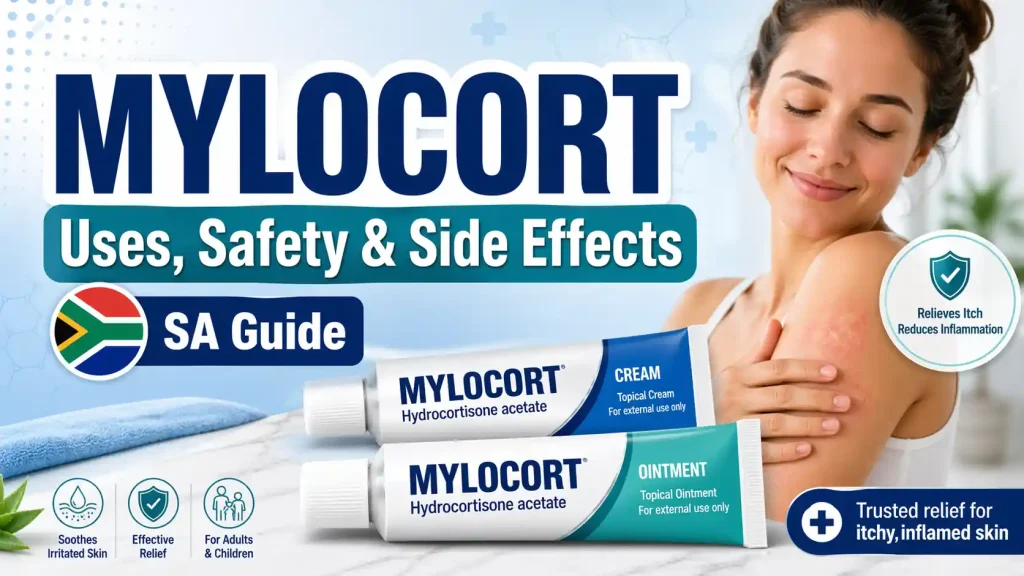
If you are using MYLOCORT cream or ointment, it helps to know exactly what it is for, how to use it properly, and when to stop and get advice. MYLOCORT contains hydrocortisone acetate, a mild topical corticosteroid used on the skin to ease itching and inflammation linked to certain minor skin irritations and conditions. It is sold in South Africa as a Schedule 2 (S2) medicine.
Quick facts: MYLOCORT is meant for short-term use on the skin only. You apply a thin layer to the affected area, usually up to four times a day, and you should not use it for longer than 7 days unless a healthcare professional has told you otherwise. It is not suitable for everyone, including some children, people with certain skin infections, and anyone who is pregnant or breastfeeding.
What it is and what it is used for
Active ingredient and medicine type
MYLOCORT contains hydrocortisone acetate 1,0 g per 100 g. This is a topical corticosteroid, which means it is a steroid medicine applied to the skin rather than taken by mouth. It is used to calm inflammation, reduce itching, and ease allergic-type skin reactions.
MYLOCORT comes in two forms:
- MYLOCORT CREAM 1,0 g/100 g
- MYLOCORT OINTMENT 1,0 g/100 g
What it is used for
MYLOCORT is used for the temporary relief of itching caused by minor skin irritations due to:
- eczema
- insect bites
- poisonous plants
- soaps
- detergents
- cosmetics
- jewellery
- seborrhoeic dermatitis (a skin condition linked to increased oil gland activity)
- external genital and anal itching in people older than 12 years
It is important to remember that the source describes this medicine as helping with temporary relief. That means it is aimed at short-term symptom control rather than long-term self-treatment.
How it works (simple explanation)
Hydrocortisone acetate works by calming the skin’s inflammatory response. In everyday terms, this means it helps settle the redness, irritation, swelling, and itching that happen when your skin reacts to something irritating or when a condition like eczema flares up.
The source also explains that hydrocortisone has:
- anti-inflammatory activity, which means it reduces inflammation
- anti-pruritic activity, which means it eases itching
- anti-allergic activity, which means it helps with allergic skin reactions
- vasoconstrictive activity, which means it narrows small blood vessels in the skin
For you as a patient or caregiver, the practical point is this: if the skin is itchy, inflamed, or irritated for one of the listed reasons, MYLOCORT may help settle those symptoms for a short time.
Who should NOT use this medicine
Use this checklist carefully.
Do not use if you…
- are allergic to hydrocortisone or any of the other ingredients in MYLOCORT
- have vaginal discharge
- want to use it for cosmetic purposes
- have anal itching with bleeding
- want to use it for nappy rash
- are treating a child under 12 years for genital or anal use
- are treating a child under 2 years
- have an untreated bacterial, viral, or fungal infection
- have tuberculosis of the skin
- have varicose ulcers
- have a scabetic infection caused by the scabies mite
- have rosacea
- have perioral dermatitis (a rash around the mouth)
- are pregnant
- are breastfeeding
- need to use it around or on the eyes
- want to apply it to broken skin
- want to use it for acne
Age restrictions to remember
Do not use MYLOCORT:
- in children under 2 years old
- in children under 12 years old for genital or anal itching indications
Warning: If you are not sure whether your skin problem fits one of the “do not use” situations above, the safe option is to check with your doctor or pharmacist before applying the medicine.
Warnings and precautions (Read before use)
It is for external use only
MYLOCORT is meant to be used on the outside of the body only. It should be kept away from the eyes. You should also not put it into the rectum using your fingers, an applicator, or any other device.
Use extra caution on the face
If the affected area is on the face, the source says MYLOCORT should be used cautiously and only for short periods, not longer than 7 days. Facial skin is more delicate, so this matters.
Long-term use can damage the skin
Using MYLOCORT for too long can cause changes in the skin, including:
- thinning of the skin
- loss of skin elasticity
- widening of small blood vessels
- bruising or bleeding into the skin
- reduced pigmentation
This is one reason the product should not be used for longer than 7 days unless a healthcare professional advises otherwise.
The medicine can be absorbed into the body
Although MYLOCORT is applied to the skin, the source says it can sometimes be absorbed more widely into the body. This is more likely if:
- large amounts are used
- it is applied over wide areas of skin
- it is used on damaged skin
- a fully covering dressing is applied
- it is used in skin folds or moist areas
- it is used in the nappy area in young children
If too much is absorbed, it can affect the body’s steroid hormone system, including the adrenal glands. According to the source, these effects may be more severe in children. Rarely, this may lead to:
- slowed growth
- a Cushingoid state (features linked to excess cortisol, such as facial puffiness, weight gain, skin thinning, weakness, bruising, high blood pressure, diabetes, or weak bones)
- moderately raised pressure inside the skull
Children need special care
MYLOCORT must not be used for skin conditions in younger children, including nappy rash. The source explains that a nappy can act like a covering dressing and increase absorption of the medicine.
If there is an infection, more treatment may be needed
If a bacterial infection is present, the source says a suitable antimicrobial should be used together with MYLOCORT.
Use with caution in psoriasis
If you have psoriasis, the source says MYLOCORT should be used with caution.
Rebound flares can happen if it is used incorrectly
If MYLOCORT has been used continuously for too long or inappropriately, stopping it can sometimes lead to a rebound flare or topical steroid withdrawal reaction. The source describes symptoms such as:
- intense redness
- stinging
- burning
- spread beyond the original treatment area
Driving and using machines
The source says MYLOCORT may cause visual impairment and could affect your ability to drive, use machinery, or do tasks that need concentration. You should avoid these activities until you know whether the medicine affects you in this way.
Important ingredient warning for the cream
MYLOCORT CREAM contains chlorocresol. This ingredient may cause allergic reactions or local skin reactions. If this happens, stop treatment.
Note: This warning applies specifically to the cream, not the ointment.
Pregnancy, planning pregnancy, and breastfeeding
The source states that the safety of MYLOCORT during pregnancy and while breastfeeding has not been established. It also clearly says you should not use MYLOCORT if you are pregnant or breastfeeding your baby.
If you are pregnant, breastfeeding, think you may be pregnant, or are planning to have a baby, the source advises that you should speak to your doctor, pharmacist, or another healthcare provider before using it.
Interactions
Other medicines
The source says you should always tell your healthcare professional about any other medicines you are taking. This includes complementary or traditional medicines as well.
At the same time, the source also states that no interactions have been reported with the use of MYLOCORT.
Food, alcohol, and tests
- Food interactions: Not specified in the source.
- Alcohol: Not specified in the source.
- Interactions with medical tests: Not specified in the source.
Even though no interactions are reported, it is still sensible to let your pharmacist or doctor know what else you are using, especially if you are treating a larger skin area or using other skin products at the same time.
How to take (Step-by-step)
Before you apply it
Start by thoroughly cleaning the affected skin. This helps make sure the medicine is being applied to clean skin.
How to apply it
Apply a thin layer of MYLOCORT and smooth it gently into the affected area or areas. The source says there is no extra benefit from vigorous rubbing, so there is no need to rub hard.
How often to use it
MYLOCORT is usually applied four times a day until improvement occurs. Once the skin improves, the frequency of application may be reduced.
Cream or ointment: which one suits which type of skin problem?
According to the source:
- MYLOCORT CREAM is usually suitable for moist or fluid-filled blisters on the skin (weeping surfaces)
- MYLOCORT OINTMENT is usually better for dry, scaly, or lichenified skin (skin that has become thickened and leathery)
How long to use it
Do not use this product for longer than 7 days.
The source also says your doctor will tell you how long your treatment should last, and if you feel the effect is too strong or too weak, you should tell your doctor or pharmacist.
If you miss a dose
If you forget to apply MYLOCORT at the usual time, apply it as soon as you remember. Do not apply a double amount to make up for the missed dose.
If too much is used or it is swallowed
If MYLOCORT is accidentally swallowed, contact your doctor or pharmacist. If neither is available, contact the nearest hospital or poison control centre.
Simple practical tips for using it correctly
Based on the source, these habits may help:
- clean the skin first
- apply only a thin layer
- do not rub vigorously
- avoid using it longer than 7 days
- keep it away from the eyes
- do not use it on broken skin
- do not cover the area completely unless specifically instructed by a healthcare professional
- use it only on the affected area
Dosing table
The source gives general dosing instructions rather than separate adult and child dose amounts. The table below includes only what is stated.
| Age or group | Dose | Frequency | Maximum daily dose |
|---|---|---|---|
| Adults and children who are allowed to use it for the listed indication | Apply a thin layer to the affected area(s) after cleaning the skin | Usually 4 times a day until improvement occurs; frequency may then be reduced | Not specified in the source |
| Children under 12 years for genital and anal use | Do not use | Not applicable | Not applicable |
| Children under 2 years | Do not use | Not applicable | Not applicable |
Possible side effects
Not everyone will get side effects, but it is important to know what to watch for.
Serious — seek urgent help
Stop using MYLOCORT and get urgent medical help straight away if you develop signs of a serious reaction, including:
- swelling of the hands, feet, ankles, face, lips, mouth, or throat
- difficulty swallowing
- difficulty breathing
- rash or itching
- fainting
The source also lists serious effects that need urgent medical attention:
- build-up of pressure around the brain (benign intracranial hypertension), which may cause:
- headache behind the eyes
- shoulder and neck pain
- ringing in the ears
- low cortisol due to suppression of the hypothalamic pituitary adrenal axis, which may cause:
- depression
- weakness
- fatigue
- weight loss
Less common
The source describes these as less frequent side effects:
- loss of skin collagen
- thinning of the skin
- loss of elasticity of the skin
- widening of small blood vessels
- bruising or bleeding into the skin
- skin becoming lighter than usual in deeply pigmented skin
Side effects with unknown frequency
These side effects are listed, but the source does not say how often they happen:
- blurred vision
- steroid withdrawal reaction after prolonged continuous use, including:
- redness of the skin that may spread beyond the treated area
- burning or stinging
- intense itching
- peeling skin
- oozing open sores
Common
Common side effects: Not specified in the source.
What to do if side effects happen
If your general health worsens, or if you get any unwanted effects while using MYLOCORT, speak to your doctor, pharmacist, or another healthcare provider.
You can also report side effects to SAHPRA using the 6.04 Adverse Drug Reactions Reporting Form on the SAHPRA website. The source also provides Aspen Pharmacare contact details for safety reporting:
- E-mail: Drugsafety@aspenpharma.com
- Tel: 0800 118 088 / +27 (0)11 239-6200
Storage and disposal
To store MYLOCORT safely:
- keep all medicines out of reach of children
- store at or below 25 °C
- protect from light
- keep it in the original packaging until it is needed
- do not use it after the expiry date printed on the tube or carton
- do not store it in a bathroom
For disposal:
- return unused medicine to your pharmacist
- do not throw unused medicine into drains or sewerage systems such as toilets
These instructions matter because heat, moisture, and light can affect medicines, and safe disposal helps protect other people and the environment.
What the medicine contains
Active ingredient
Both products contain the same active medicine:
- Hydrocortisone acetate 1,0 g per 100 g
Other ingredients in MYLOCORT CREAM
MYLOCORT CREAM contains:
- chlorocresol
- emulsifying wax
- purified wax
- yellow soft paraffin
It also contains the preservative:
- chlorocresol 0,1% m/m
Other ingredients in MYLOCORT OINTMENT
MYLOCORT OINTMENT contains:
- liquid paraffin
- white soft paraffin
Important excipients
An important ingredient specifically mentioned in the source is chlorocresol in the cream, because it may cause allergic or local skin reactions.
Pack information and appearance
What the products look like
- MYLOCORT CREAM is a smooth white to off-white cream
- MYLOCORT OINTMENT is a smooth off-white Vaseline-like ointment
Pack size
Both the cream and the ointment are supplied as:
- 25 g filled into an epoxy-lined aluminium sealed tube
- sealed with a high-density polyethylene screw-cap
- packed in a unit cardboard carton
The source also says that not all packs and pack sizes are necessarily marketed.
South African registration and holder information
The holder of certificate of registration is:
Pharmacare Limited
Healthcare Park
Woodlands Drive
Woodmead 2191
South Africa
Contact numbers given in the source:
- Hotline: 0800 122 912 (South Africa)
- Tel: +27 11 239 6200 (Other)
Registration numbers:
- MYLOCORT CREAM: P/13.4.1/93
- MYLOCORT OINTMENT: P/13.4.1/112
The source says the information was last revised on 31 December 2023.
Practical FAQs (based ONLY on the source)
Can I use MYLOCORT for longer than a week?
No. The source says do not use this product for longer than 7 days. If your symptoms get worse or are not improving, you should get advice from a healthcare professional.
Can I put it on broken skin?
No. The source says not to use it on broken skin.
Can I use it near my eyes?
No. MYLOCORT should be kept away from the eyes, and it should not be used around or on the eyes.
Can I use it for acne?
No. The source specifically says do not use MYLOCORT for acne.
Which is better for dry skin: the cream or the ointment?
The source says the ointment should be considered for dry, scaly, or lichenified skin, while the cream is usually suitable for moist or weeping surfaces.
What must I do if I forget an application?
Apply it as soon as you remember, but do not use a double dose to make up for the missed one.
What if someone accidentally swallows it?
Contact your doctor or pharmacist. If they are not available, contact the nearest hospital or poison control centre.
Can I use it during pregnancy or while breastfeeding?
No. The source says the safety has not been established and that you should not use MYLOCORT if you are pregnant or breastfeeding.
Can children use MYLOCORT?
Not all children can use it. It must not be used in children under 2 years, and it must not be used in children under 12 years for genital or anal use.
Can I drink alcohol while taking this?
Not specified in the source.
Plain-language summary
MYLOCORT is a hydrocortisone acetate skin medicine used for short-term relief of itching and inflammation from certain minor skin problems, such as eczema, insect bites, seborrhoeic dermatitis, and irritation caused by things like soaps, detergents, cosmetics, jewellery, or poisonous plants. You should apply a thin layer to clean skin, usually four times a day, and not use it for more than 7 days.
Use it carefully and only in the situations described in the source. Do not use it if you are pregnant, breastfeeding, treating certain infections, applying it to broken skin or near the eyes, or using it for acne or nappy rash. Get urgent help if you develop swelling, trouble breathing, fainting, or other serious symptoms. If side effects happen, speak to your doctor or pharmacist, and side effects can also be reported to SAHPRA.