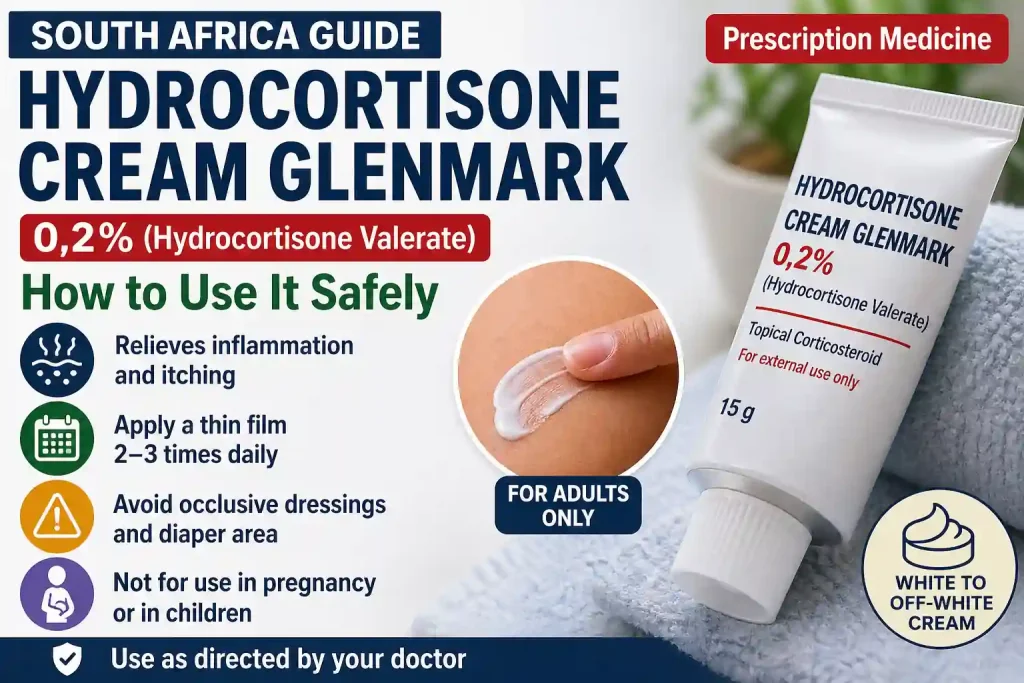
If you are using HYDROCORTISONE CREAM GLENMARK, you are using a prescription skin cream that contains hydrocortisone valerate, a corticosteroid medicine applied to the skin. It is used in adults to help relieve inflammation and itching linked to certain skin conditions that respond to corticosteroids, as long as the skin problem is not infected.
SCHEDULING STATUS : S4
What it is and what it is used for
HYDROCORTISONE CREAM GLENMARK is a topical corticosteroid. “Topical” means it is applied directly to the skin. “Corticosteroid” means it belongs to a group of medicines used to reduce inflammation and itching.
The active ingredient is hydrocortisone valerate. Each gram of the cream contains 2,0 mg hydrocortisone valerate.
This medicine is described as a medium potency corticosteroid. This means it is stronger than mild steroid creams but is not in the strongest group of topical steroids.
It is indicated for adults for the relief of:
- Non-infected inflammatory skin conditions that respond to corticosteroids.
- Itching linked to corticosteroid-responsive skin conditions.
In simple terms, if your doctor has prescribed this cream, it is likely because your skin is inflamed, itchy, irritated, or uncomfortable in a way that may improve with a corticosteroid cream.
Warning: This medicine is for non-infected skin inflammation. If you have signs of infection, such as pus, spreading redness, worsening pain, or a fungal-looking rash, you should speak to your doctor or pharmacist.
How it works
When your skin is inflamed, your body releases substances that can cause redness, swelling, itching, irritation, and discomfort. Hydrocortisone valerate helps calm this reaction in the skin.
The source explains that corticosteroids have:
- Anti-inflammatory effects, meaning they reduce inflammation.
- Antipruritic effects, meaning they help reduce itching.
- Vasoconstrictive effects, meaning they can narrow small blood vessels in the skin.
You do not need to understand all the science to use the cream safely. The practical idea is that the cream helps settle an overactive skin reaction so the affected area can become less itchy and inflamed.
The exact way topical corticosteroids reduce inflammation is not fully clear. The source explains that they are thought to affect certain proteins in the body that help control inflammatory substances.
Who should NOT use this medicine
Do not use this medicine if you:
- Have had a severe allergic or hypersensitivity reaction to hydrocortisone valerate.
- Are allergic or severely sensitive to any of the other ingredients in the cream.
- Are pregnant.
- Are using it for a child, unless a doctor has considered the risks, because safety in children has not been established and it is not recommended for paediatric use.
You should also not use this cream on an infected skin condition unless your doctor has also treated the infection appropriately.
Note: If you are not sure whether your skin problem is infected, ask a healthcare professional before continuing.
Warnings and precautions
Use it only as directed
HYDROCORTISONE CREAM GLENMARK should be applied as a thin film to the affected skin. Using more than needed, using it too often, using it for too long, or covering it tightly can increase the chance of side effects.
You should stop treatment once the condition is controlled. If there is no improvement within 2 weeks, your diagnosis may need to be reassessed by a medical practitioner.
Be careful with large areas of skin
Topical corticosteroids can be absorbed through the skin. This means some of the medicine can enter the body, especially if it is used on large areas, under coverings, or for a prolonged time.
The source explains that absorption of topical corticosteroids can sometimes affect the body’s hormone control system, called the hypothalamic-pituitary-adrenal axis, or HPA axis. In plain language, this is part of the system that helps your body manage natural steroid hormone levels.
Possible effects from absorption may include:
- Reversible adrenal suppression.
- Glucocorticosteroid insufficiency after stopping treatment.
- Cushing’s syndrome features.
- High blood sugar.
- Sugar in the urine.
These are not everyday expected effects for every user, but they are important risks when corticosteroids are absorbed in higher amounts.
Avoid covering the treated area unless told to
Do not use this cream with occlusive dressings unless a medical practitioner tells you to. An occlusive dressing is a covering that seals the area and can increase absorption.
You should not apply this cream in the diaper area if the patient needs diapers or plastic pants, because these can act like an occlusive dressing.
Watch for irritation
If the cream causes irritation, you should stop using it and seek appropriate medical advice.
Sometimes an allergy to a corticosteroid cream does not look like a sudden worsening reaction. It may show as the skin simply failing to heal. The source says this should be confirmed with appropriate patch testing.
Be alert for skin infection
If a skin infection is present or develops while using this cream, an appropriate antifungal or antibacterial medicine should be used.
If the infection does not improve quickly, HYDROCORTISONE CREAM GLENMARK should be stopped until the infection is properly controlled.
Children and babies
This cream is not recommended for paediatric use because safety has not been established.
Children can absorb proportionally more medicine through the skin because they have a larger skin surface area compared with their body weight. This can increase the risk of systemic effects, meaning effects in the whole body rather than only the skin.
In children using topical corticosteroids, the source reports possible risks such as:
- HPA axis suppression.
- Cushing’s syndrome.
- Slower linear growth.
- Delayed weight gain.
- Intracranial hypertension, which means increased pressure inside the skull.
- Striae, also called stretch marks, with inappropriate use.
Signs of adrenal suppression in children may include low plasma cortisol levels and no response to ACTH stimulation testing. Signs of intracranial hypertension may include bulging fontanelles, headaches, and swelling at the back of the eye called bilateral papilledema.
Older adults
Clinical studies did not include enough people aged 65 and older to know whether they respond differently from younger adults. Other reported experience did not identify differences in responses between older and younger patients.
If you are older and using this cream, use it exactly as prescribed and report irritation or unusual effects.
Driving and using machines
No studies have been done on whether HYDROCORTISONE CREAM GLENMARK affects the ability to drive or use machines.
The source does not state that the cream causes drowsiness or directly affects alertness. However, because no studies have been performed, be sensible and speak to your healthcare provider if you feel unwell while using it.
Monitoring and laboratory tests
If you are using a topical steroid on a large area or under occlusion, your healthcare provider may check for HPA axis suppression.
Tests mentioned in the source include:
- ACTH stimulation test.
- Morning plasma cortisol test.
- Urinary free cortisol test.
These tests are not something you do at home. They are arranged by a healthcare professional when clinically needed.
Pregnancy, planning pregnancy, and breastfeeding
Pregnancy
Do not use HYDROCORTISONE CREAM GLENMARK during pregnancy. The source states that use of this medicine is contraindicated during pregnancy.
The source also explains that corticosteroids have caused developmental problems in laboratory animals when given systemically at relatively low doses. Some corticosteroids have also shown such effects after being applied to the skin in laboratory animals.
If you are pregnant, think you may be pregnant, or become pregnant while using this medicine, speak to your doctor as soon as possible.
Planning pregnancy
The source does not give separate instructions for people planning pregnancy.
Because use during pregnancy is contraindicated, you should speak to your doctor or pharmacist before using this medicine if you are trying to fall pregnant or may become pregnant.
Breastfeeding
Systemically administered corticosteroids appear in human milk and could affect growth, interfere with the body’s own corticosteroid production, or cause other unwanted effects.
The source states that it is not known whether topical corticosteroids can be absorbed enough to produce detectable amounts in human milk.
Because many medicines pass into breast milk, caution is needed when HYDROCORTISONE CREAM GLENMARK is used by a nursing woman.
Note: If you are breastfeeding, speak to your doctor or pharmacist before using this cream.
Interactions
Other medicines
The source states: No interactions reported.
This means no specific medicine interactions are listed in the source. However, it does not mean you should ignore other medicines or creams you are using.
Tell your doctor or pharmacist about:
- Other prescription medicines.
- Over-the-counter creams or ointments.
- Antifungal or antibacterial skin treatments.
- Other steroid creams.
- Herbal or complementary products used on the skin.
Food and drink
No food interactions are specified in the source.
Alcohol
Alcohol use is not discussed in the source.
Not specified in the source. Speak to your doctor or pharmacist if you are unsure about alcohol use while using this medicine.
Laboratory tests
If there is concern about systemic absorption or HPA axis suppression, the source mentions that the following tests may be helpful:
- ACTH stimulation test.
- Morning plasma cortisol test.
- Urinary free cortisol test.
If your doctor orders these tests, tell them exactly how you have been using the cream, including how often, where, for how long, and whether the area was covered.
How to take it step by step
Before applying the cream
Use this medicine only on the skin areas your doctor has told you to treat.
Before applying:
- Make sure you understand how often to use it.
- Check that the skin problem is not obviously infected.
- Do not plan to cover the area tightly unless your doctor has told you to.
- Do not use it in the diaper area if diapers or plastic pants are being used.
How much to apply
Apply a thin film to the affected area.
A thin film means enough to lightly cover the affected skin. More cream does not mean faster healing and may increase the chance of side effects.
How often to apply it
Apply the cream two or three times daily, depending on the severity of the condition.
Your doctor may guide whether you should use it twice or three times daily.
When to stop
Stop using the cream when control is achieved. This means when the skin condition has settled as your doctor intended.
If there is no improvement within 2 weeks, speak to your doctor because the diagnosis may need to be reassessed.
Use with dressings or coverings
Do not use the cream under occlusive dressings unless directed by a medical practitioner.
Avoid using it under diapers or plastic pants because these can seal the area and increase absorption.
Missed dose
Missed dose instructions are not specified in the source.
Speak to your doctor or pharmacist if you are unsure what to do after missing an application.
Overdose
If too much is applied, the medicine can be absorbed in enough amounts to cause systemic effects.
The source states that treatment of overdose is symptomatic and supportive. This means a healthcare provider treats the symptoms and supports the body as needed.
If you think you have used too much, used it over a very large area, used it under tight covering, or used it for longer than prescribed, contact your doctor or pharmacist.
Warning: Do not try to “make up” for missed use by applying extra cream unless a healthcare professional tells you to.
Simple adherence tips
To use it safely and consistently:
- Use it at the same times each day if your doctor has told you to apply it regularly.
- Apply only a thin layer.
- Stop once control is achieved, as directed.
- Check your skin daily for irritation or signs of infection.
- Make a note if there is no improvement by 2 weeks, and arrange reassessment.
Dosing table
| Age or group | Dose | Frequency | Maximum daily dose |
|---|---|---|---|
| Adults | Thin film applied to the affected area | Two or three times daily, depending on severity | Not specified in the source |
| Children | Not recommended for paediatric use | Not applicable | Not applicable |
| Pregnant patients | Contraindicated | Not applicable | Not applicable |
Note: The source does not provide a dose by weight, a maximum number of grams per day, or a separate dosing schedule for older adults.
Possible side effects
Like all medicines, HYDROCORTISONE CREAM GLENMARK can cause side effects, although not everyone will experience them.
Some side effects happen where the cream is applied. Others can happen if enough medicine is absorbed into the body, especially with large areas, prolonged use, or occlusive coverings.
Common
Common side effects listed in the source include:
- Infection.
- Fungal infection.
- Gastrointestinal disorder.
- Eczema.
- Burning skin.
- Skin irritation.
- Itching or pruritus.
- Rash.
- Maculopapular rash, which means a rash with flat and raised spots.
- Dry skin.
- Application site reaction.
If you notice mild burning, irritation, dryness, or rash, contact your doctor or pharmacist for advice, especially if it does not settle or your skin is not healing.
Very common
The source lists stinging as very common.
You may notice a stinging feeling after applying the cream. If it is severe, persistent, or worsening, stop using the cream and speak to a healthcare professional.
Less common or frequency unknown
The source lists several reactions with unknown frequency. This means the source does not say how often they occur.
These include:
- Folliculitis, which is inflammation around hair follicles.
- Increased hair growth in the treated area.
- Acne-like eruptions.
- Lightening of the skin, called hypopigmentation.
- Perioral dermatitis, which is a rash around the mouth.
- Allergic contact dermatitis.
- Softening or breakdown of skin from too much moisture, called maceration.
- Secondary infection.
- Skin thinning, called skin atrophy.
- Striae, also called stretch marks.
- Miliaria, also known as heat rash.
Some local skin reactions may be more likely with occlusive use, prolonged use, or use of higher potency corticosteroids. Some local reactions may be irreversible.
Serious — seek urgent help
Seek medical help urgently if you develop signs that may suggest a serious reaction or infection, such as:
- Severe skin irritation after using the cream.
- Worsening redness, swelling, pain, or signs of infection.
- A rash that spreads or becomes severe.
- Signs of an allergic reaction, especially if you have a history of severe hypersensitivity.
- Symptoms that concern you after using the cream over a large area or under a covering.
The source also warns that systemic absorption can lead to effects such as HPA axis suppression, Cushing’s syndrome, high blood sugar, and sugar in the urine. These are medical concerns that need professional assessment.
In children, serious reported effects with topical corticosteroids include adrenal suppression, Cushing’s syndrome, delayed growth or weight gain, and intracranial hypertension. This is one reason the product is not recommended for paediatric use.
Reporting side effects in South Africa
Healthcare providers are asked to report suspected adverse reactions to SAHPRA using the “6.04 Adverse Drug Reactions Reporting Form” available through SAHPRA’s publications.
As a patient or caregiver, you should tell your doctor or pharmacist about any side effect that worries you. Reporting helps with ongoing safety monitoring of medicines in South Africa.
Storage and disposal
Storage
Special storage precautions are listed as none in the source.
The source does not specify a storage temperature, light protection instruction, or moisture instruction.
Even where no special storage precautions are specified, it is still sensible to:
- Keep the tube closed when not in use.
- Keep it out of reach of children.
- Store it safely in its original container.
- Avoid using it after the expiry date.
Shelf life
The shelf life is 24 months.
Disposal
Special precautions for disposal and handling are listed as none in the source.
Do not use expired medicine. If you are not sure how to dispose of unused or expired cream, ask your pharmacist.
What the medicine contains
Active ingredient
The active ingredient is hydrocortisone valerate.
Each gram of HYDROCORTISONE CREAM GLENMARK contains 2,0 mg hydrocortisone valerate.
Preservative
The cream contains the antimicrobial preservative methyl paraben 2,0 mg per 1 gram of cream.
Other ingredients
The listed excipients are:
- Citric acid monohydrate.
- Methyl paraben.
- Polyoxyl stearyl ether.
- Propylene glycol.
- Purified water.
- Sepineo P 600.
- Sodium lauryl sulfate.
- Steareth-100.
- Stearyl alcohol.
- White petroleum.
- Absolute ethyl alcohol.
- Docetaxel.
- Nitrogen polysorbate 80.
Note: If you know you react to any ingredient in creams, preservatives, alcohol-containing products, or topical medicines, discuss this with your doctor or pharmacist before use.
Pack information and appearance
HYDROCORTISONE CREAM GLENMARK is described as a white to off-white homogenous cream.
It is supplied in aluminium tubes in the following pack sizes:
| Pack size | Container information |
|---|---|
| 15 g | Filled and crimped aluminium tube packed in a carton |
| 45 g | Filled and crimped aluminium tube packed in a carton |
| 60 g | Filled and crimped aluminium tube packed in a carton |
The holder of the certificate of registration is Glenmark Pharmaceuticals South Africa (Pty) Ltd, based in Midrand.
The registration number is 55/21.5.1/0072.
The date of first authorisation is 19 September 2023.
Sources :
Written by: RxZest Editorial Team
Editorial review: Checked for readability, structure, and source alignment
Based on SAHPRA-approved information : HYDROCORTISONE CREAM GLENMARK
Last updated: [03/05/2026]
Practical FAQs
Can I use this cream for any itchy rash?
No. It is indicated for adult patients with non-infected inflammatory and itchy skin conditions that respond to corticosteroids. If your rash is infected or you are not sure what is causing it, ask your doctor or pharmacist.
How many times a day should I apply it?
The source says to apply a thin film to the affected area two or three times daily, depending on the severity of the condition. Follow your doctor’s instructions.
Should I keep using it after my skin improves?
The source says therapy should be discontinued when control is achieved. In other words, do not continue longer than needed unless your doctor tells you to.
What should I do if it has not helped after 2 weeks?
If there is no improvement within 2 weeks, your diagnosis may need to be reassessed. Contact your doctor or pharmacist.
Can I cover the area after applying the cream?
Do not use occlusive dressings unless directed by a medical practitioner. Covering the area tightly can increase absorption and may raise the risk of side effects.
Can this cream be used under nappies or plastic pants?
The source says it should not be applied in the diaper area if the patient requires diapers or plastic pants, because these may act like occlusive dressings.
Can children use HYDROCORTISONE CREAM GLENMARK?
It is not recommended for paediatric use. Safety in children has not been established, and children may be at greater risk of systemic side effects from topical corticosteroids.
Can I use it while pregnant?
No. Use during pregnancy is contraindicated.
Can I use it while breastfeeding?
Caution is needed. The source says it is not known whether topical corticosteroids can be absorbed enough to appear in human milk. Speak to your doctor or pharmacist before use.
Are there known interactions with other medicines?
The source says no interactions are reported. Still, tell your doctor or pharmacist about other medicines or skin products you are using, especially other topical treatments.
Plain-language summary
HYDROCORTISONE CREAM GLENMARK is a South African prescription corticosteroid cream containing hydrocortisone valerate 0,2 %. If you are using it, apply only a thin film to the affected adult skin area two or three times daily as directed, and stop once the condition is controlled. Do not use it during pregnancy, do not use it for children, and do not cover the treated area tightly unless your doctor tells you to.
Contact your doctor or pharmacist if your skin becomes irritated, looks infected, worsens, or does not improve within 2 weeks. Use extra care if the cream is being applied over a large area or under any covering, because topical corticosteroids can sometimes be absorbed into the body and cause wider effects.