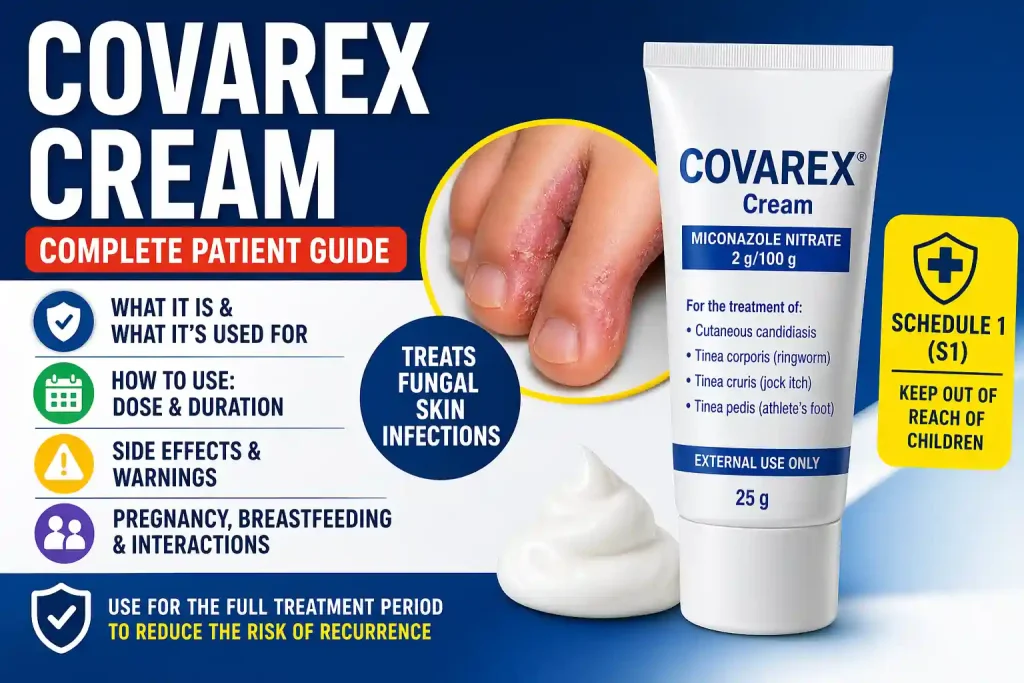
COVAREX Cream is a skin medicine used on the outside of the body for certain fungal skin infections. Its active ingredient is miconazole nitrate, and it is applied directly to the affected skin. In the South African source, the scheduling status is S1, and the medicine is presented as a cream for external use only.
What it is and what it is used for
Active ingredient and medicine type
COVAREX Cream contains miconazole nitrate 2 g per 100 g. The source classifies it under A 13.9.2 Fungicides, which means it is used against fungal infections.
What it is used for
COVAREX Cream is indicated for the topical treatment of skin infections caused by specific fungi. “Topical” means you use it on the skin, not by mouth.
The source says it is used for:
- Cutaneous candidiasis caused by Candida albicans
- Tinea corporis — ringworm of the body
- Tinea cruris — ringworm of the groin
- Tinea pedis — ringworm of the foot or athlete’s foot
The tinea infections listed in the source are caused by Trichophyton rubrum, T. mentagrophytes, and Epidermophyton floccosum.
How it works
COVAREX Cream works because miconazole nitrate has an action against fungi. The source describes miconazole nitrate as fungistatic, which means it helps stop fungi from growing rather than simply washing them away.
In Candida albicans, the source says miconazole nitrate inhibits the change of blastospores into the invasive mycelial form. In simpler words, it helps prevent the fungus from changing into a form that can spread more aggressively in the skin. This is why regular use for the full treatment period matters.
Who should NOT use this medicine
Do not use COVAREX Cream if you:
- Are allergic or hypersensitive to miconazole nitrate
- Are allergic or hypersensitive to any other ingredient in COVAREX Cream
“Hypersensitive” means your body reacts badly to the medicine or one of its ingredients. This could include irritation or an allergic-type reaction. The source lists hypersensitivity to miconazole nitrate or any other ingredient as the contraindication.
Warning: If you know you have reacted badly to miconazole nitrate before, or to any ingredient in this cream, do not use it.
Warnings and precautions
Use it only on the outside of the body
COVAREX Cream is for external use only. This means you should use it on the skin as directed and not take it by mouth.
Complete the full treatment period
The source says you should continue applying COVAREX for the full period of treatment as indicated. This is important because stopping too soon may allow the infection to come back.
Avoid occlusive dressings
The source says to avoid using occlusive dressings when this medicine is used to treat infections caused by Candida albicans. An occlusive dressing is a covering that seals the skin and traps moisture.
This matters because, according to the source, occlusive conditions can favour yeast growth and may release an irritating endotoxin. In plain language, covering the area too tightly may make the environment more suitable for yeast to grow and may irritate the skin.
Prolonged or extensive use
The source warns that after long or widespread application, systemic absorption cannot be ruled out. “Systemic absorption” means some of the medicine may be absorbed into the body rather than staying only on the skin.
If this happens, the source says side effects usually linked with miconazole nitrate given systemically may occur. These include nausea, liver toxicity, low platelet count, dizziness, drowsiness, headache, flushing, red eyes, mouth sores, and stomach or bowel disturbances.
Driving and using machines
Drowsiness and dizziness are listed in the source as possible effects associated with systemic absorption after prolonged and extensive application. The source does not give a specific instruction about driving or operating machinery.
Note: Not specified in the source as a driving warning. However, if you feel dizzy or drowsy while using the cream, it is sensible to avoid activities where alertness is important and speak to a healthcare professional.
Alcohol
Not specified in the source.
Monitoring
Not specified in the source as routine monitoring. The source does advise attention to side effects and irritation, especially if symptoms such as blistering, burning, redness, rash or other irritation appear.
Pregnancy, planning pregnancy, and breastfeeding
The source states that the safety of topical use during pregnancy and lactation has not been established. Lactation means breastfeeding.
If you are pregnant, planning to become pregnant, or breastfeeding, speak to your doctor or pharmacist before using COVAREX Cream. This is especially important because the source does not say that safety has been confirmed in these situations.
Interactions
Other medicines
Not specified in the source.
Foods
Not specified in the source.
Alcohol
Not specified in the source.
Dressings and coverings
The source gives a practical warning about occlusive dressings. You should avoid these when using COVAREX Cream for Candida albicans infections, because occlusive conditions can support yeast growth and may release an irritating endotoxin.
Tests
Not specified in the source.
How to take it step by step
How to apply it
COVAREX Cream is applied to the skin. The source says to apply it twice daily, once in the morning and once in the evening, for cutaneous candidiasis and for the listed tinea infections.
Use it for the condition and area as directed. Do not swallow it, because it is for external use only.
When to apply it
The source gives the timing as:
- Morning
- Evening
Try to use it at around the same times each day so that it becomes part of your routine.
How long to keep using it
To reduce the chance of the infection coming back, the source gives different treatment periods depending on the infection:
- For Candida infections, tinea cruris and tinea corporis, apply COVAREX for 2 weeks
- For tinea pedis, apply COVAREX for 1 month
Do not stop early just because the area looks or feels better. The source specifically says to continue for the full treatment period.
Adults
The source provides the same application instruction for the listed skin infections: apply twice daily, morning and evening. It does not provide separate adult-only dosing instructions.
Children
Not specified in the source.
Missed dose
Not specified in the source.
Overdose
The source says that no symptoms of overdosage are known. Treatment is described as symptomatic and supportive, which means dealing with any symptoms that occur and supporting the person as needed.
Simple adherence tips based on the source
Because the source says to apply the cream in the morning and evening, it may help to link application with daily routines, such as after washing in the morning and before going to bed at night.
Because the source says to continue for the full treatment period, you may want to mark the end date on a calendar. For tinea pedis, remember that the source gives a longer period of one month.
Dosing table
| Age or condition | Dose | Frequency | Maximum daily dose |
|---|---|---|---|
| Cutaneous candidiasis | Apply COVAREX Cream to the affected skin | Twice daily, morning and evening | Not specified in the source |
| Tinea corporis | Apply COVAREX Cream to the affected skin | Twice daily, morning and evening | Not specified in the source |
| Tinea cruris | Apply COVAREX Cream to the affected skin | Twice daily, morning and evening | Not specified in the source |
| Tinea pedis | Apply COVAREX Cream to the affected skin | Twice daily, morning and evening | Not specified in the source |
| Children | Not specified in the source | Not specified in the source | Not specified in the source |
Possible side effects
Not everyone will get side effects, but it is important to know what to watch for. The source lists skin reactions and also mentions possible body-wide effects after prolonged and extensive use.
Common
The source does not say which side effects are common.
Less common
The source does not say which side effects are less common.
Skin reactions to watch for
COVAREX Cream may cause local skin problems, especially if these were not present before treatment. The source lists:
- Blistering
- Burning
- Redness
- Skin rash
- Other signs of skin irritation
- Contact dermatitis not present before therapy
Contact dermatitis is an irritated or inflamed skin reaction that can happen after contact with a substance.
If you notice new irritation, worsening redness, rash, burning or blistering after starting the cream, stop and seek advice from a healthcare professional.
Serious — seek urgent help
The source does not label any side effects as “serious” in a separate category. However, it does say that after prolonged and extensive application, systemic absorption cannot be excluded and side effects usually associated with systemic miconazole nitrate may occur.
Seek urgent medical advice if you experience concerning symptoms such as:
- Severe or worsening skin reaction
- Dizziness or drowsiness that worries you
- Signs that feel unusual or severe while using the medicine
The source specifically lists the following possible effects in the context of prolonged and extensive application:
- Nausea
- Hepatotoxicity, meaning possible liver toxicity
- Thrombocytopenia, meaning a low platelet count
- Dizziness
- Drowsiness
- Headache
- Flushing
- Redness of the eyes
- Sores in the mouth
- Gastrointestinal disturbances, meaning stomach or bowel problems
Storage and disposal
How to store it
Store COVAREX Cream at or below 25 °C. The source says it should be kept at this temperature and used externally only.
Keep the tube closed when not in use. The source does not give extra instructions about moisture or light.
Keep it away from children
Keep COVAREX Cream out of the reach of children. This is stated clearly in the source.
Expiry guidance
The source does not provide specific expiry instructions. Not specified in the source.
Disposal
Not specified in the source.
What the medicine contains
Active ingredient
COVAREX Cream contains:
- Miconazole nitrate 2 g per 100 g
Preservatives and other listed ingredients
The source lists the following:
| Ingredient type | Ingredient | Amount |
|---|---|---|
| Active ingredient | Miconazole nitrate | 2 g per 100 g |
| Preservative | Imidurea | 0,2% m/m |
| Preservative | Methyl paraben | 0,15% m/m |
| Preservative | Sodium propyl paraben | 0,15% m/m |
| Anti-oxidant | Butyl hydroxytoluene | 0,02% m/m |
The source does not list lactose or sugar.
Pack information and appearance
Appearance
COVAREX Cream is described as a smooth white to greyish-white cream.
Pack sizes
The source says it is presented in polyethylene laminated aluminium tubes with a white screw cap.
The listed tube sizes are:
- 25 g
- 30 g
- 40 g
- 50 g
Sources :
Written by: RxZest Editorial Team
Editorial review: Checked for readability, structure, and source alignment
Based on SAHPRA-approved information : COVAREX
Last updated: [03/05/2026]
Practical FAQs
Can I use COVAREX Cream by mouth?
No. The source says COVAREX Cream is for external use only. This means it is used on the skin and should not be swallowed.
How often should I apply it?
The source says to apply COVAREX Cream twice daily, in the morning and evening, for cutaneous candidiasis and the listed tinea infections.
How long should I use it for athlete’s foot?
For tinea pedis, which is ringworm of the foot, the source says to apply COVAREX Cream for one month to reduce the possibility of recurrence.
How long should I use it for Candida, groin ringworm or body ringworm?
For Candida infections, tinea cruris and tinea corporis, the source says to apply COVAREX Cream for 2 weeks to reduce the possibility of recurrence.
Can I cover the treated area with a tight dressing?
The source says to avoid occlusive dressings when treating conditions caused by Candida albicans. Tight or sealed coverings may create conditions that favour yeast growth and may cause irritation.
Can I use it if I am pregnant?
The source says the safety of topical use during pregnancy has not been established. Speak to your doctor or pharmacist before use if you are pregnant or planning pregnancy.
Can I use it while breastfeeding?
The source says the safety of topical use during lactation has not been established. If you are breastfeeding, speak to your doctor or pharmacist before using it.
What should I do if my skin burns or becomes red after using it?
The source lists burning, redness, rash, blistering, irritation and contact dermatitis as possible side effects. If these develop or worsen, stop and get advice from a healthcare professional.
What happens if I use too much?
The source says no symptoms of overdosage are known, and treatment is symptomatic and supportive. If you are worried after using too much or applying it over a very large area, contact a healthcare professional for advice.
Can I drink alcohol while using it?
Not specified in the source.