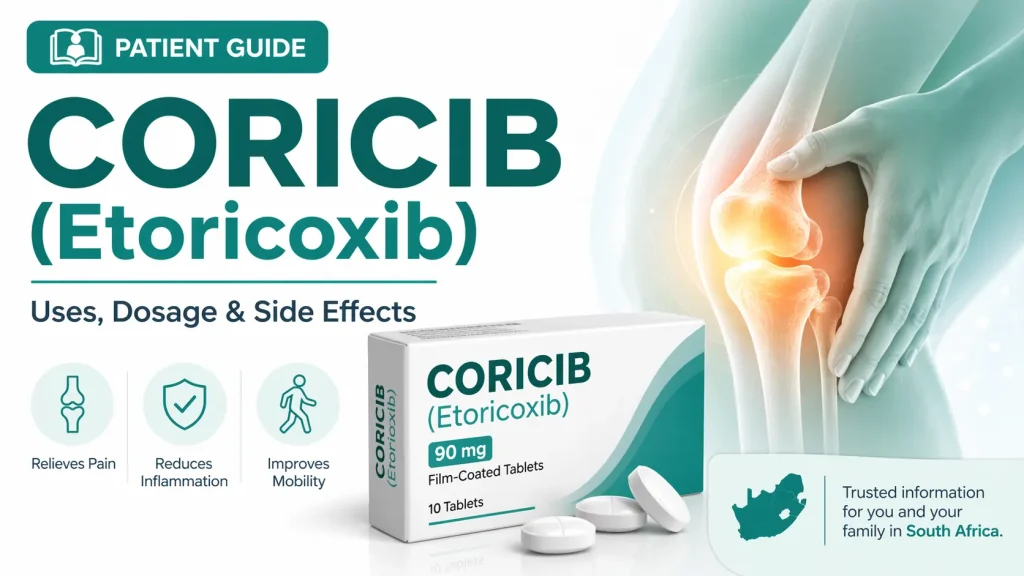
If you have been prescribed CORICIB (generic name: etoricoxib), you are probably looking for clear, practical information about what it does, how to take it properly, and what to watch out for. This medicine is used to help with pain and inflammation in certain joint, muscle, and short-term pain conditions in people aged 16 years and older. It is an S3 medicine in South Africa .
What it is and what it is used for
CORICIB contains the active ingredient etoricoxib. It belongs to a group of medicines described in the source as anti-rheumatics (anti-inflammatory agents). In simple terms, it is used to help reduce pain and swelling (inflammation).
What conditions it is used for
If you are 16 years or older, CORICIB may be prescribed for:
- Osteoarthritis
- Rheumatoid arthritis
- Ankylosing spondylitis
- Gout
- Moderate pain for short-term treatment
- Pain after dental surgery
- Painful periods (primary dysmenorrhoea)
Age group it is intended for
This medicine is for people aged 16 years and older. It should not be used in children or adolescents under 16 years.
How it works (simple explanation)
CORICIB helps by reducing inflammation, which is one of the body’s responses that can cause pain, swelling, heat, and stiffness. When inflammation settles down, you may notice that your joints or muscles feel less painful and easier to move.
For conditions such as arthritis, this can mean less discomfort in everyday activities such as walking, getting out of a chair, or using your hands. For short-term pain, such as after dental surgery or during a gout flare, it is used to help control pain during the painful period. The source explains that it reduces pain and swelling, but it does not describe the medicine’s mechanism in more scientific detail. Not specified in the source.
Who should NOT use this medicine
Do not use CORICIB if you:
- are allergic to etoricoxib or any of the other ingredients in the tablet
- are allergic to NSAIDs (non-steroidal anti-inflammatory drugs), including aspirin and COX-2 inhibitors
- develop asthma, a runny or blocked nose, growths in the nasal passage, or itching and swelling of the skin after taking aspirin or another NSAID
- currently have a stomach ulcer or bleeding in the stomach or intestines
- have serious liver disease
- have serious kidney disease
- are pregnant, could be pregnant, or are breastfeeding
- are under 16 years of age
- have inflammatory bowel disease, such as Crohn’s disease, ulcerative colitis, or colitis
- have high blood pressure that is not controlled
- have been diagnosed with heart failure (moderate or severe) or angina (chest pain)
- have had a heart attack
- have had bypass surgery
- have peripheral arterial disease (poor circulation in the legs or feet due to narrowed or blocked arteries)
- have had any type of stroke, including a mini-stroke or TIA
- are having bypass surgery
Why these checks matter
The source makes it clear that etoricoxib may slightly increase the risk of heart attack and stroke, so it should not be used in people who already have those serious heart or circulation problems.
Warnings and precautions (Read before use)
Before taking CORICIB, it is important to know about situations where extra care is needed.
Use the lowest effective dose for the shortest time
This medicine should be taken for the shortest possible duration, and the lowest daily dose that works should be used. This matters because the risk of heart attack and stroke may rise with longer treatment, especially at higher doses.
Take special care if you have any of these conditions
Tell your doctor if any of the following apply to you:
- you are taking low-dose aspirin
- you have a history of stomach ulcers or stomach bleeding
- you are dehydrated, for example because of prolonged vomiting or diarrhoea
- you have swelling due to fluid retention
- you have a history of heart failure or another form of heart disease
- you have a history of high blood pressure
- you have any history of liver disease or kidney disease
- you are being treated for an infection
- you have diabetes
- you have high cholesterol
- you smoke
- you are a woman trying to become pregnant
- you are 20 weeks pregnant
- you are over 65 years of age
Skin reactions need urgent attention
Warning: If you develop an extensive skin rash with fever, swollen lymph nodes, and swelling of the face, you must inform your doctor immediately. The source states that this can be life-threatening.
A serious skin reaction may also be more important if you have a history of allergy.
Blood pressure and heart monitoring
If you have high blood pressure, your doctor may want to check it from time to time, because CORICIB can increase blood pressure in some people, especially at higher doses. If you are older and have kidney, liver, or heart problems, your doctor may want to keep a close eye on you during treatment.
It can hide signs of infection
If you are being treated for an infection, be aware that CORICIB may mask a fever. That means it can make it harder to notice one of the warning signs that an infection is present or getting worse.
Driving and using machines
Some people taking CORICIB have reported dizziness or sleepiness.
- Do not drive if you feel dizzy or sleepy.
- Do not use tools or machines if you feel dizzy or sleepy.
Alcohol
Not specified in the source.
Pregnancy, planning pregnancy, and breastfeeding
Do not take CORICIB if you are pregnant or breastfeeding.
If you become pregnant or are breastfeeding while taking CORICIB, the source advises that you should consult your doctor, pharmacist, or other healthcare professional for advice before taking CORICIB.
The source also states that pregnant women should not use NSAIDs at 20 weeks or later unless a healthcare professional specifically advises it, because these medicines may cause problems in an unborn baby.
If you are trying to become pregnant, tell your doctor before using this medicine.
Interactions
Always tell your doctor, pharmacist, nurse, or other healthcare professional about all medicines you are taking. This includes complementary or traditional medicines.
Medicines that may interact with CORICIB
Tell your doctor if you take:
- Warfarin or other blood thinners (anticoagulants)
- Rifampicin
- Methotrexate
- Ciclosporin
- Tacrolimus
- Lithium
- ACE inhibitors such as enalapril and ramipril
- Angiotensin receptor blockers such as losartan and valsartan
- Diuretics (water tablets)
- Digoxin
- Minoxidil
- Salbutamol tablets or oral solution
- Birth control pills
- Hormone replacement therapy
- Aspirin
Practical points about aspirin and other anti-inflammatory medicines
- If you are taking low-dose aspirin to help prevent a heart attack or stroke, you should not stop taking it unless your doctor tells you to. CORICIB may be taken with low-dose aspirin.
- The risk of stomach ulcers is greater if you take CORICIB together with aspirin.
- Do not take high-dose aspirin or other anti-inflammatory medicines (NSAIDs) while taking CORICIB.
Food and drink
CORICIB can be taken with or without food.
Alcohol and tests
Alcohol: Not specified in the source.
Medical tests: the source mentions possible changes in blood tests related to the liver, as well as changes in blood or urine tests relating to the kidneys and certain blood cell counts.
How to take (Step-by-step)
Basic instructions
- Take CORICIB exactly as your doctor or pharmacist has told you.
- It is taken by mouth.
- Take the tablets once a day.
- You can take it with or without food.
- Do not share your medicine with anyone else.
- Do not take more than the dose recommended for your condition.
Why dose matters
Your doctor may review your treatment from time to time. It is important to use the lowest dose that controls your pain and not to take CORICIB longer than necessary.
If you have liver problems
- If you have mild liver disease, you should not take more than 60 mg a day.
- If you have moderate liver disease, you should not take more than 30 mg a day.
If you are older
No dose adjustment is necessary just because you are elderly, but caution is advised, especially if you have kidney, liver, or heart problems.
If you miss a dose
If you forget a dose, do not take a double dose. Just continue with your usual schedule the following day.
If you take too much
If you take too much CORICIB, consult your doctor or pharmacist. If neither is available, contact the nearest hospital or poison control centre.
Simple adherence tips based on the source
Because CORICIB is taken once daily, it may help to take it at the same time each day so it becomes part of your routine. Also, follow the strength your doctor prescribed, because there are different tablet strengths available and the correct one depends on your condition.
Dosing table
Only the dosing information stated in the source is included below.
| Condition / group | Age or weight | Dose | Frequency | Maximum daily dose |
|---|---|---|---|---|
| Osteoarthritis | 16 years and older | 30 mg | Once a day | 30 mg stated as recommended dose |
| Rheumatoid arthritis | 16 years and older | 90 mg | Once a day | 90 mg stated as recommended dose |
| Ankylosing spondylitis | 16 years and older | 90 mg | Once a day | 90 mg stated as recommended dose |
| Acute pain conditions | 16 years and older | 90 mg or 120 mg | Once a day | 120 mg; only for the acute painful period, for a maximum of 8 days |
| Gout | 16 years and older | 120 mg | Once a day | 120 mg; only for the acute painful period, for a maximum of 8 days |
| Primary dysmenorrhoea | 16 years and older | 120 mg | Once a day | 120 mg stated as recommended dose |
| Postoperative dental surgery pain | 16 years and older | 90 mg | Once a day | 90 mg stated as recommended dose |
| Mild liver disease | Not specified by age beyond general use | Not more than 60 mg | Once a day | 60 mg |
| Moderate liver disease | Not specified by age beyond general use | Not more than 30 mg | Once a day | 30 mg |
Possible side effects
Like all medicines, CORICIB can cause side effects, although not everybody gets them. The source says not all side effects have been listed there, so it is important to seek medical advice if your general health becomes worse while taking it.
Common
The source describes the following as frequent:
- Stomach pain
- Dry socket after tooth extraction
- Swelling of the legs or feet due to fluid retention
- Dizziness
- Headache
- Increased blood pressure
- Constipation
- Wind
- Gastritis
- Heartburn
- Diarrhoea
- Indigestion or stomach discomfort
- Nausea
- Vomiting
- Inflammation of the oesophagus
- Mouth ulcers
- Weakness
- Fatigue
- Flu-like illness
- Changes in liver blood tests
Less common
The source lists these as less frequent or frequency unknown:
- Bruising
- Gastroenteritis
- Upper respiratory infection
- Urinary tract infection
- Lower numbers of red blood cells, white blood cells, or platelets
- Appetite changes
- Weight gain
- Anxiety
- Depression
- Reduced mental sharpness
- Hallucinations
- Taste changes
- Difficulty sleeping
- Numbness or tingling
- Sleepiness
- Blurred vision
- Eye irritation and redness
- Ringing in the ears
- Vertigo
- Cough
- Breathlessness
- Nosebleeds
- Bloating
- Changes in bowel habits
- Dry mouth
- Stomach ulcer
- Inflammation of the stomach lining that may become serious and may lead to bleeding
- Irritable bowel syndrome
- Inflammation of the pancreas
- Swelling of the face
- Skin rash
- Itchy skin
- Redness of the skin
- Muscle cramps or spasm
- Muscle pain or stiffness
- High potassium in the blood
- Changes in kidney blood or urine tests
- Serious kidney problems
- Confusion
- Restlessness
- Liver problems (hepatitis)
- Low sodium in the blood
Serious—seek urgent help
Stop taking CORICIB and get urgent medical help straight away if you notice:
- Shortness of breath
- Chest pain
- Ankle swelling that appears or gets worse
- Yellowing of the skin or eyes (jaundice)
- Severe or ongoing stomach pain
- Black stools
- A serious allergic reaction, including swelling of the face, lips, tongue, or throat, trouble breathing, ulcers, blistering, or shock
- An extensive skin rash with fever, swollen lymph nodes, and swelling of the face (described in the source as DRESS)
You should also seek urgent medical attention if you notice:
- Palpitations
- Fast or irregular heartbeat
- Atrial fibrillation
- Heart failure
- Tightness, pressure, or heaviness in the chest
- Heart attack
- Stroke
- Mini-stroke (TIA)
- A severe increase in blood pressure
- Inflammation of the blood vessels
- Wheezing
- Bronchospasm
Older adults
In clinical studies, a higher rate of side effects was seen in older patients than in younger patients.
Reporting side effects in South Africa
If you get side effects, you can speak to your doctor, pharmacist, or nurse. The source also says side effects can be reported to SAHPRA using the 6.04 Adverse Drug Reaction Reporting Form available under SAHPRA publications online.
Storage and disposal
To store CORICIB safely:
- Keep all medicines out of reach of children
- Store at or below 25 °C
- Protect from moisture
- Keep the blister in the carton until you need to use it
- Do not use it after the expiry date on the label or carton
Disposal
- Return unused medicine to your pharmacist
- Do not throw unused medicine into drains or sewerage systems such as toilets
What the medicine contains
Active ingredient
The active ingredient is etoricoxib.
Strengths and lactose content
| Product strength | Active ingredient per tablet | Lactose monohydrate per tablet |
|---|---|---|
| CORICIB 30 mg | Etoricoxib 30 mg | 1.05 mg |
| CORICIB 60 mg | Etoricoxib 60 mg | 2.10 mg |
| CORICIB 90 mg | Etoricoxib 90 mg | 3.15 mg |
| CORICIB 120 mg | Etoricoxib 120 mg | 4.20 mg |
Other ingredients
The source lists the following other ingredients:
- Cellulose microcrystalline
- Calcium hydrogen phosphate anhydrous
- Croscarmellose sodium
- Magnesium stearate
Coating ingredients
The tablet coating varies by strength and includes ingredients such as:
- lactose monohydrate
- hypromellose
- titanium dioxide
- triacetin
- indigo carmine aluminium lake
- iron oxide yellow
Note: If you have been told that you cannot tolerate certain sugars, speak to your doctor before taking CORICIB because it contains lactose.
Pack information and appearance
What the tablets look like
- 30 mg: blue-green, round, biconvex, film-coated tablet, marked E30 on one side
- 60 mg: green to dark green, round, biconvex, film-coated tablet, marked E60
- 90 mg: white to off-white, round, biconvex, film-coated tablet, marked E90
- 120 mg: light green to pale green, round, biconvex, film-coated tablet, marked E120
Pack sizes
- The tablets come in cold form blister strips
- Each blister strip contains 7 tablets
- The carton contains 7 or 28 tablets
Registration and holder information
The Holder of Certificate of Registration is:
Ranbaxy Pharmaceuticals (Pty) Ltd
14 Lautre Road
Stormill, Ext. 1
Roodepoort, 1724
South Africa
The source also provides South African registration numbers for each strength.
Practical FAQs (based ONLY on the source)
Can I take CORICIB with food?
Yes. The source says CORICIB can be taken with or without food.
Can I use it if I am pregnant or breastfeeding?
No. The source says do not take CORICIB if you are pregnant or breastfeeding.
Can I drive after taking it?
You should not drive if the medicine makes you feel dizzy or sleepy. The same applies to using tools or machines.
What should I do if I miss a dose?
Skip the missed dose and resume your usual schedule the next day. Do not take two tablets to make up for the missed one.
Can I take it with aspirin?
Sometimes, but it depends on the type of aspirin and why you take it. Low-dose aspirin for prevention of heart attack or stroke may be taken with CORICIB, but high-dose aspirin and other NSAIDs should not be taken with it. Also, taking aspirin with CORICIB increases the risk of stomach ulcers.
Can children take CORICIB?
No. It should not be used by children or adolescents under 16 years of age.
How often do I take it?
CORICIB is taken once a day. The actual strength depends on the condition being treated.
Can I take it for as long as I want if it helps my pain?
No. The source says it should be used for the shortest time necessary and at the lowest dose that works, because longer use and higher doses may increase the risk of heart attack and stroke.
Can I drink alcohol while taking this?
Not specified in the source.
Does it contain sugar or lactose?
Yes. The tablets contain lactose monohydrate, and the amount depends on the tablet strength.
Plain-language summary
CORICIB (etoricoxib) is a once-daily anti-inflammatory pain medicine used in people aged 16 years and older for conditions such as osteoarthritis, rheumatoid arthritis, ankylosing spondylitis, gout, painful periods, and certain short-term pain conditions. To use it safely, take it exactly as prescribed, do not exceed the recommended dose, and use it for the shortest time needed to control your symptoms.
Seek urgent help if you get chest pain, shortness of breath, black stools, yellowing of the eyes or skin, a severe allergic reaction, or a serious rash with fever and facial swelling. If you are pregnant, breastfeeding, under 16, have serious liver or kidney disease, uncontrolled high blood pressure, certain heart or stroke conditions, or a history of NSAID allergy, this medicine may not be suitable for you. When in doubt, speak to your doctor or pharmacist before taking the next dose.