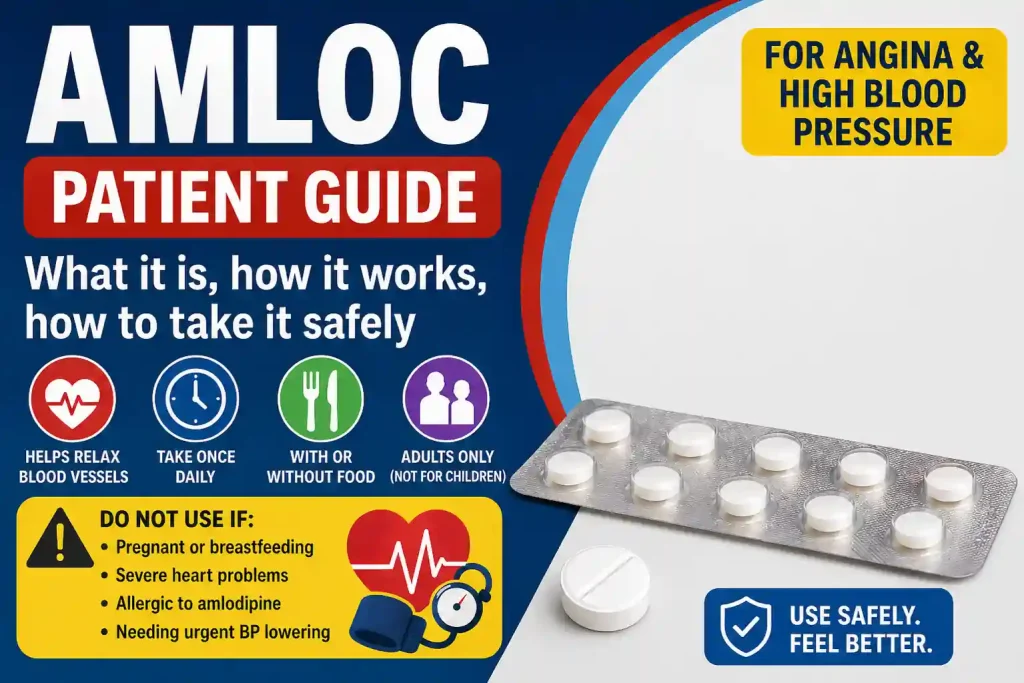
If you have been prescribed AMLOC, you are taking a medicine that helps manage certain heart and blood vessel conditions. AMLOC is used for angina pectoris and mild to moderate hypertension. Angina pectoris is chest pain or discomfort linked to the heart not getting enough oxygen-rich blood. Hypertension means high blood pressure.
AMLOC contains amlodipine, as amlodipine maleate. It belongs to a group of medicines called calcium channel blockers, which help relax blood vessels so blood can flow more easily.
Quick facts: You usually take AMLOC once a day, with or without food. It is available as 5 mg and 10 mg tablets. AMLOC is sugar free and is a Schedule 3 (S3) medicine in South Africa, meaning it should be used under medical supervision.
What it is and what it is used for
AMLOC contains the active ingredient amlodipine, in the form of amlodipine maleate.
The available strengths are:
- AMLOC 5 mg: contains amlodipine maleate equivalent to 5 mg amlodipine
- AMLOC 10 mg: contains amlodipine maleate equivalent to 10 mg amlodipine
AMLOC is classified as a vasodilator and hypotensive medicine. In plain language, this means it helps widen blood vessels and lower blood pressure.
You may be prescribed AMLOC for:
- Angina pectoris
- Mild to moderate hypertension, either on its own or with other blood pressure medicines
AMLOC is not meant for suddenly lowering blood pressure in an emergency.
How it works
AMLOC works by helping the muscle in your blood vessel walls relax. When your blood vessels relax, they widen. This makes it easier for blood to move through them and can help lower blood pressure.
If you have angina, AMLOC helps reduce the strain on your heart. Your heart does not need to pump against as much resistance, so it may need less oxygen and energy.
The source states that amlodipine has minimal effect on the heart’s electrical conduction, contraction, and heart rate.
AMLOC is absorbed slowly after you swallow it. The highest levels in your blood are reached after about 6 to 12 hours. Food does not affect absorption, so you can take it with or without meals.
Who should NOT use this medicine
Do not use AMLOC if you:
- Are allergic to amlodipine
- Are allergic to dihydropyridines
- Are allergic to any ingredient in AMLOC
- Have shock, including cardiogenic shock
- Have haemodynamically unstable heart failure after an acute myocardial infarction during the first 28 days
- Have unstable angina pectoris
- Need treatment for the acute reduction of blood pressure
- Are pregnant
- Are breastfeeding
- Are a child, because safety in children has not been established
Warning: AMLOC should not be used to treat sudden severe high blood pressure unless a doctor is managing your condition. Its safety and effectiveness in hypertensive crisis have not been established.
Warnings and precautions
If you have a blood pressure emergency
AMLOC is not used for sudden blood pressure reduction. If your blood pressure is dangerously high or you feel very unwell, seek urgent medical care.
If you have severe aortic stenosis
If you have severe aortic stenosis, AMLOC may increase your risk of developing heart failure. Aortic stenosis means one of the heart valves is narrowed, making it harder for blood to leave the heart.
Tell your doctor if you have any known heart valve problems.
Do not stop suddenly
If you stop AMLOC suddenly, your angina may get worse. The source recommends a gradual dose reduction under medical supervision.
Do not stop taking AMLOC on your own, even if you feel better.
If you get ischaemic pain after taking it
AMLOC should be stopped in patients who develop ischaemic pain after use. Ischaemic pain is pain caused by reduced blood supply, often linked to the heart.
If you develop chest pain or worsening heart symptoms after taking AMLOC, get medical help urgently.
If you have low blood pressure
AMLOC should be used carefully if you have hypotension, which means low blood pressure. You may feel dizzy, faint, weak, or light-headed, especially when standing up.
If you have diabetes
AMLOC may affect insulin and glucose responses. If you have diabetes, your antidiabetic treatment may need adjustment.
Do not change your diabetes medicine yourself. Speak to your doctor if your glucose control changes.
If you have kidney problems
In renal impairment, the usual dose is recommended. The source also states that severe renal impairment may require a dose reduction.
AMLOC is not dialysable, meaning dialysis is unlikely to remove it effectively from your body.
If you have liver problems
AMLOC is processed mainly by the liver. If your liver function is impaired, AMLOC may stay in your body for longer.
Your doctor may start you on a lower dose and increase it slowly, especially if you have severe hepatic impairment.
If you have heart failure
An increased incidence of pulmonary oedema has been reported. Pulmonary oedema means fluid build-up in the lungs.
The source also states that AMLOC may have a negative inotropic effect, meaning it may reduce the force of heart muscle contraction.
If you are elderly
If you are elderly, your body may clear AMLOC more slowly. This can increase the amount of medicine in your body.
Your doctor may start you on a lower dose.
Children
Safety and effectiveness in children have not been established. Data in children younger than 6 years is limited.
Porphyria
Safety in porphyria has not been established.
Driving and using machines
AMLOC can cause dizziness. Be careful when driving, using machinery, or doing anything that needs full attention.
Note: If you feel dizzy, sleepy, faint, or unsteady, do not drive or operate machinery.
Pregnancy, planning pregnancy, and breastfeeding
AMLOC should not be used during pregnancy or breastfeeding.
The source states that safety in pregnancy and lactation has not been established, and pregnancy and lactation are listed as contraindications.
If you are pregnant, planning a pregnancy, or breastfeeding, speak to your doctor or pharmacist before using this medicine.
Interactions
Tell your doctor or pharmacist about all medicines you take, including prescription medicines, over-the-counter medicines, and herbal products.
Nitrates and angina medicines
AMLOC may have added effects when used with:
- Sublingual nitro-glycerine
- Long-acting nitrates
- Other antianginal medicines
Sublingual nitro-glycerine may be used as needed to stop acute angina attacks during AMLOC therapy. Nitrate medicines may also be used to help prevent angina.
Other blood pressure medicines
AMLOC may increase the blood pressure-lowering effect of other antihypertensive medicines, including beta blockers.
The source states this combination is generally well tolerated. However, AMLOC does not protect you from the effects of suddenly stopping a beta blocker. Beta blockers should be reduced gradually if they need to be stopped.
Medicines that may lower blood pressure
Extra blood pressure-lowering effects may happen with medicines such as:
- Aldesleukin
- Antipsychotics that cause hypotension
Lithium
Using lithium with AMLOC may cause lithium-induced neurotoxicity. Symptoms may include:
- Nausea
- Vomiting
- Diarrhoea
- Poor coordination
- Tremors
- Tinnitus, meaning ringing or noise in the ears
Caution is recommended.
Medicines that affect CYP3A4
AMLOC is processed in the liver by an enzyme called CYP3A4. Some medicines can increase or decrease AMLOC levels in your body.
Medicines that may interact include:
- Quinidine
- Procainamide
- Protease inhibitors
- Azole antifungals
- Clarithromycin
- Erythromycin
- Verapamil
- Diltiazem
- Ketoconazole
- Itraconazole
- Ritonavir
These may increase amlodipine exposure. Monitoring and dose adjustment may be needed, especially in elderly patients.
Anti-epileptic medicines
Some anti-epileptic medicines may reduce the effect of AMLOC, including:
- Carbamazepine
- Phenobarbital
- Phenytoin
Sodium valproate has been reported to increase plasma concentrations.
Rifampicin and St John’s Wort
Rifampicin and St John’s Wort may lower amlodipine levels in the blood. AMLOC should be used carefully with these.
Food
You may take AMLOC with or without food.
Alcohol
Not specified in the source.
Laboratory tests
Calcium channel blockers like AMLOC may interfere with plasma aldosterone and renin ratios in laboratory tests.
Tell healthcare professionals that you are taking AMLOC if you are having blood tests.
How to take AMLOC step by step
Always take AMLOC exactly as your doctor tells you.
Basic instructions
- Swallow your AMLOC tablet by mouth.
- Take it once daily.
- You may take it with or without food.
- Try to take it at the same time every day.
- Do not increase or stop your dose unless your doctor tells you to.
Adults with hypertension or angina
The usual starting dose is 5 mg once daily.
If there is no improvement after 10 to 14 days, your doctor may increase the dose to 10 mg once daily.
Elderly patients
Lower starting doses may be used in elderly patients.
Patients with kidney impairment
The normal dosage is recommended. AMLOC is not dialysable.
Patients with liver impairment
If you have severe hepatic impairment, AMLOC should be started at the lowest dose and increased slowly.
If AMLOC is added to other medicines
No dose reduction is required when AMLOC is added to:
- Thiazide diuretics
- Beta blockers
- Angiotensin-converting enzyme inhibitors
Missed dose
Not specified in the source.
Overdose
If you take too much AMLOC, side effects may become stronger or more severe.
A serious overdose may cause excessive widening of blood vessels, leading to marked and possibly prolonged low blood pressure.
Treatment may include:
- Gastric lavage
- Active cardiovascular support
- Monitoring of heart and breathing function
- Raising the limbs
- Attention to fluid volume and urine output
- A vasoconstrictor, if suitable
- Intravenous calcium gluconate
- Symptomatic and supportive treatment
Dialysis is unlikely to help because amlodipine is highly protein-bound.
Warning: If you think you have taken too much AMLOC, seek urgent medical help immediately.
Dosing table
| Person or situation | Dose | Frequency | Maximum daily dose |
|---|---|---|---|
| Adults with hypertension | 5 mg starting dose | Once daily | 10 mg once daily, if increased after 10–14 days |
| Adults with angina pectoris | 5 mg starting dose | Once daily | 10 mg once daily, if increased after 10–14 days |
| Elderly patients | Lower initial dose may be used | Once daily | Not specified in the source |
| Renal impairment | Normal dosage recommended | Once daily | Not specified in the source |
| Severe hepatic impairment | Start at the lowest dose and increase slowly | Once daily | Not specified in the source |
| Children | Safety and efficacy not established | Not specified in the source | Not specified in the source |
Possible side effects
Like all medicines, AMLOC may cause side effects. You may not get any, or you may only get mild ones.
Common side effects
These are listed as frequent:
- Headache
- Sleepiness or drowsiness
- Dizziness
- Palpitations
- Flushing
- Peripheral oedema
- Nausea
- Abdominal pain
- Ankle swelling
- Facial swelling
- Swelling of the arms or hands
Speak to your doctor or pharmacist if these effects bother you or do not improve.
Less common side effects
Less frequent side effects include:
- Purple spots on the skin
- Low platelets
- Low white blood cells
- Bleeding
- Blood abnormalities
- Itching
- Rash
- Angioedema
- Erythema multiforme
- Breast enlargement in males
- High blood sugar
- Increased muscle tone
- Tingling, numbness, or reduced feeling
- Peripheral neuropathy
- Tremor
- Insomnia
- Mood changes
- Increased sweating
- Visual disturbances
- Tinnitus
- Myocardial infarction
- Abnormal heart rhythm
- Chest pain
- Slow heartbeat
- Low blood pressure
- Fainting
- Vasculitis
- Coughing
- Shortness of breath
- Rhinitis
- Changed bowel habits
- Constipation
- Diarrhoea
- Vomiting
- Indigestion
- Pancreatitis
- Dry mouth
- Gum enlargement
- Hepatitis
- Jaundice
- Raised liver enzymes
- Hair loss
- Skin discolouration
- Joint pain
- Weakness
- Back pain
- Muscle cramps
- Muscle pain
- Increased urination
- Difficulty passing urine
- Night-time urination
- Sexual dysfunction
- Taste changes
- Weight increase or decrease
Serious side effects: seek urgent help
Get urgent medical help if you notice:
- Chest pain
- Worsening angina
- Fainting
- Severe dizziness
- Very low blood pressure symptoms
- Difficulty breathing
- Swelling of the face, lips, tongue, or throat
- Severe rash
- Yellowing of the skin or eyes
- Unusual bleeding or bruising
- Fast, irregular, or very slow heartbeat
- Severe abdominal pain with vomiting
Warning: If you develop chest pain, breathing difficulty, serious swelling, fainting, or signs of an allergic reaction, seek urgent medical care.
Storage and disposal
Store AMLOC at or below 25 °C.
Keep the blister in the outer carton until you need to use it. This helps protect the medicine.
Keep AMLOC out of reach of children.
Expiry guidance
Not specified in the source.
Disposal
Not specified in the source.
What the medicine contains
Active ingredient
AMLOC contains amlodipine, as amlodipine maleate.
- AMLOC 5 mg contains amlodipine maleate equivalent to 5 mg amlodipine
- AMLOC 10 mg contains amlodipine maleate equivalent to 10 mg amlodipine
Inactive ingredients
AMLOC also contains:
- Colloidal anhydrous silica
- Magnesium stearate
- Microcrystalline cellulose
- Pregelatinised starch
- Sodium starch glycolate
AMLOC tablets are sugar free.
Pack information and appearance
AMLOC 5 mg
AMLOC 5 mg tablets are:
- White
- Round
- Slightly biconvex
- Bevelled edge
- Scored on one side
- 8,0 mm in diameter
They are packed in opaque PVC/aluminium foil blisters of 30 tablets, inside a printed outer carton.
AMLOC 10 mg
AMLOC 10 mg tablets are:
- White
- Round
- Slightly biconvex
- Bevelled edge
- Scored on one side
- 10,0 mm in diameter
They are packed in opaque PVC/aluminium foil blisters of 30 tablets, inside a printed outer carton.
Registration details
South African registration numbers:
- AMLOC 5 mg: A38/7.1/0183
- AMLOC 10 mg: A38/7.1/0147
Namibian registration numbers:
- AMLOC 5 mg: NS2 06/7.1/0011
- AMLOC 10 mg: NS2 06/7.1/0012
The holder of the certificate of registration is Pharma Dynamics (Pty) Ltd, Cape Town, South Africa.
Practical FAQs
Can I take AMLOC with food?
Yes. You can take AMLOC with or without food.
What conditions is AMLOC used for?
AMLOC is used for angina pectoris and mild to moderate hypertension.
How often should I take AMLOC?
Adults usually take AMLOC once daily.
Can my dose be increased?
Yes. If there is no improvement after 10 to 14 days, your doctor may increase the dose from 5 mg once daily to 10 mg once daily.
Can I stop AMLOC suddenly?
Do not stop suddenly unless your doctor tells you to. Sudden withdrawal may worsen angina.
Can I drive while taking AMLOC?
Be careful. AMLOC can cause dizziness. Do not drive or use machinery if you feel dizzy or unsafe.
Can I use AMLOC while pregnant or breastfeeding?
No. Pregnancy and lactation are listed as contraindications.
Is AMLOC safe for children?
Safety and efficacy in children have not been established.
Is AMLOC sugar free?
Yes. AMLOC tablets are sugar free.
What should I do if I take too much?
Seek urgent medical help. Overdose may cause severe and prolonged low blood pressure.
Sources :
Written by: RxZest Editorial Team
Editorial review: Checked for readability, structure, and source alignment
Based on SAHPRA-approved information : Amloc
Last updated: [01/05/2026]