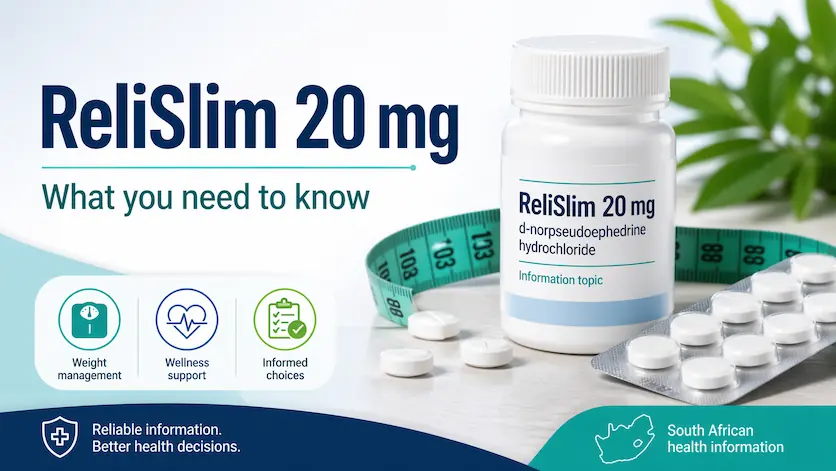
If you have been prescribed ReliSlim 20 mg tablets (generic name: d-norpseudoephedrine hydrochloride), you may be using it as part of a medically supervised plan to help with mass reduction, together with a reduced kilojoule intake. This medicine is not a stand-alone solution. It is meant to support weight loss by helping to reduce your appetite while you are also following a lower-energy eating plan.
Quick facts: ReliSlim is a Schedule 6 medicine in South Africa, which means it must be used with care and under proper medical supervision. Each tablet contains 20 mg of d-norpseudoephedrine hydrochloride. It is taken by mouth, usually in the morning and at lunchtime, and it should not be used for more than 4 weeks at a time. It can affect the brain, heart, blood pressure, sleep, and mood, so it is important to understand exactly how to use it safely.
What it is and what it is used for
Active ingredient and medicine type
ReliSlim contains d-norpseudoephedrine hydrochloride 20 mg in each tablet. It belongs to a group of medicines described as centrally acting anti-obesity products and anorexigenics, which means it works mainly by helping to suppress appetite.
What it is used for
ReliSlim is used as an aid to mass reduction when used in combination with a reduced kilojoule intake. In simple terms, it may be prescribed to support weight loss while you are also eating less energy than usual. It is not described in the source as a cure for obesity, and the source also makes it clear that there is not enough evidence for long-term management of obesity.
How it works
ReliSlim acts on the central nervous system and has a stimulant effect. Its main benefit is that it suppresses appetite, which may make it easier for you to eat less while following a reduced-kilojoule eating plan.
From a practical point of view, this means you may feel less hungry while taking it. But because it is also stimulating, it can affect sleep, mood, and your heart or blood pressure in some people. That is why timing, dose, and medical supervision matter.
Note: The source only says that the medicine promotes weight loss by suppressing appetite. It does not give more detail about the exact body processes involved.
Who should NOT use this medicine
Do not use ReliSlim if you:
- are allergic to d-norpseudoephedrine hydrochloride or any of the other ingredients in the tablets
- are pregnant
- have coronary thrombosis
- have hyperthyroidism
- have closed-angle glaucoma
- have severe hypertension
- have phaeochromocytoma
- are going to have, or are having, anaesthesia with cyclopropane, halothane, or other volatile anaesthetics
- are taking monoamine oxidase inhibitors (MAOIs), or you stopped taking them within the last 2 weeks
- are a young child (the source says ReliSlim should be avoided in young children)
Do not use if you have certain sugar-handling conditions
Do not take ReliSlim if you have rare hereditary problems such as:
- galactose intolerance
- total lactase deficiency
- glucose-galactose malabsorption
This is because the tablets contain lactose monohydrate.
Warnings and precautions (Read before use)
There are several important situations where you need to be especially careful with ReliSlim.
It should not be taken late in the day
ReliSlim should not be taken late afternoon because of its stimulant effect on the central nervous system. If you take it too late, you may find it harder to sleep.
There is a risk of misuse and dependence
The source states that ReliSlim tablets are liable to be abused. It also says that tolerance with dependence has been reported. This means some people may start needing the medicine to feel the same effect, or may become dependent on it.
You must use it with extreme caution if you have:
- a history of drug abuse
- a history of alcohol abuse
- personality disorders
Long-term use is not supported
The source says there is a lack of evidence for efficacy in long-term management of obesity. It also says do not use for longer than 4 weeks at a time. That means this is not meant to be an open-ended medicine you stay on continuously unless your prescriber has specifically guided you based on the source directions.
Speak to your doctor if you have any of these conditions
Use ReliSlim with caution if you have:
- diabetes mellitus
- cardiovascular disorders, including coronary insufficiency, ischaemic heart disease, cardiac dysrhythmias, obstructive cardiomyopathy, cardiac decompensation, or anginal pain
- hypertension
- occlusive vascular disease
- renal impairment
- prostate disorders
- porphyria
- are elderly
- have a history of psychiatric illness
Why these warnings matter in everyday life
If you have diabetes, the source says the effect on blood glucose levels should be considered. If you have high blood pressure or a heart condition, this medicine may raise blood pressure or affect heart rhythm, especially at higher doses. If you have prostate problems, it may increase the risk of urinary retention or difficulty passing urine. If you have had mental health problems, the stimulant effects may be especially important to monitor.
Driving and using machines
You are advised to take special care before doing tasks that require attention, until you know how ReliSlim affects you. If you feel restless, anxious, dizzy, unable to focus, or otherwise not yourself, avoid driving or using machinery.
Alcohol
The source does not give direct instructions about drinking alcohol while taking ReliSlim. However, it does say the medicine should be used with extreme caution in people with a history of drug or alcohol abuse.
Warning: If your sleep, mood, heartbeat, blood pressure, or ability to concentrate changes while taking this medicine, contact your doctor or pharmacist.
Pregnancy, planning pregnancy, and breastfeeding
Pregnancy
Do not use ReliSlim during pregnancy. The source says safety and efficacy have not been established during pregnancy, and that it should not be used because placental perfusion may be reduced.
Breastfeeding
Do not use ReliSlim while breastfeeding. The source says irritability and disturbed sleep have been reported in breastfed infants.
Planning pregnancy
Not specified in the source. Speak to your doctor or pharmacist before use.
Fertility
The source says no data are available on the effect of ReliSlim on fertility.
Interactions
ReliSlim can interact with many other medicines. This is one of the most important parts of using it safely.
Medicines you must be especially careful with
Tell your doctor or pharmacist if you are using:
- MAOIs or RIMAs
- other sympathomimetics
- volatile anaesthetics
- digoxin
- antidysrhythmics, including quinidine
- tricyclic antidepressants
- CNS stimulants
- ergot alkaloids
- oxytocin
- thyroid hormones
- antihypertensive medicines
- medicines that can cause hypotension
- alpha blockers
- non-selective beta blockers
- antiparkinsonian medicines such as levodopa and bromocriptine
- medicines used for psychiatric or emotional conditions
MAOIs and related medicines
This is a major warning. If you are currently taking monoamine oxidase inhibitors, including reversible ones, or if you stopped them within the last 2 weeks, you should not use ReliSlim. The source warns that this combination may cause a hypertensive crisis.
Other stimulant-type medicines
The source lists a number of sympathomimetics that may be especially risky with ReliSlim, including:
- dexamfetamine
- dopamine
- dopexamine
- ephedrine
- isometheptene
- mephentermine
- metaraminol
- methylphenidate
- phenylephrine
- phenylpropanolamine
- pseudoephedrine
Heart and blood pressure risks
Some combinations may increase the chance of:
- dangerous dysrhythmias
- hypertension
- hypotension
- tachycardia
- vasoconstrictor or pressor effects
- cardiovascular toxicity
Caffeine
The source says ReliSlim may increase the rate of metabolism of other medicines, such as caffeine.
Medicines for psychiatric or emotional conditions
The source clearly states: Do not use ReliSlim with other medicines used to treat psychiatric or emotional conditions.
Food, alcohol, and tests
- Food: Not specified in the source.
- Alcohol: Not specified in the source as a direct interaction.
- Medical tests: Not specified in the source.
Note: Before starting ReliSlim, give your doctor or pharmacist a full list of everything you take, including prescription medicines, pharmacy medicines, herbal products, and stimulants.
How to take (Step-by-step)
General directions
Take ReliSlim by mouth with a little water.
Usual dosing instructions
The source gives the following dosing directions:
- take one to two tablets with breakfast
- then take one tablet at lunchtime
- do not exceed the recommended dosage
- do not use for longer than 4 weeks at a time
Why timing matters
Because the medicine has a stimulant effect, it should not be taken late afternoon. Taking it earlier in the day may help reduce the chance of trouble sleeping.
Adults
The source provides a dose, but it does not label it specifically as “adult dose”. Because ReliSlim should be avoided in young children, the given dosing instructions appear to apply to the people for whom it has been prescribed.
Children
The source states that ReliSlim should be avoided in young children. No paediatric dose is provided.
If you miss a dose
Missed dose instructions are not specified in the source.
If you take too much (overdose)
The source says overdose may cause:
- insomnia
- paranoid psychosis
- delusions
- hallucinations
- precordial pain
- tachycardia
Treatment of overdose is described as supportive and symptomatic.
Warning: If you think you or someone else has taken too much, get urgent medical help straight away.
Practical adherence tips based on the source
- Take it with breakfast and at lunchtime rather than later in the day.
- Use a little water when taking the tablets.
- Keep within the recommended dose.
- Do not continue beyond 4 weeks at a time unless your prescriber has specifically directed you within the source guidance.
Dosing table
| Age or weight | Dose | Frequency | Maximum daily dose |
|---|---|---|---|
| Not specified in the source | 1 to 2 tablets with breakfast, followed by 1 tablet at lunchtime | Morning and lunchtime | Do not exceed the recommended dosage; based on the stated schedule, up to 3 tablets daily may be taken |
Possible side effects
Not everyone gets side effects, but you should know what to watch for.
Common / frequent
These are listed in the source as frequent:
- anxiety
- fear
- confusion
- irritability
- psychotic reactions
- restlessness
- insomnia
- headache
- tachycardia (fast heartbeat)
- dyspnoea (shortness of breath)
- nausea
- vomiting
- weakness
Less common / less frequent
These are listed as less frequent:
- tremors
- cardiac dysrhythmias (abnormal heart rhythm)
- impaired circulation to the extremities
- hypertension
- dry mouth
Frequency unknown
The source also lists effects where the frequency is not known:
- agitation
- excitability
- giddiness
- precordial pain
- palpitations
- increased cardiac contractility, which may result in angina or cardiac arrest
- sweating
- muscular weakness
- difficulty in micturition
- urinary retention
Serious — seek urgent help
Get urgent medical help if you develop symptoms such as:
- chest pain
- palpitations
- a very fast heartbeat
- signs of an abnormal heart rhythm
- shortness of breath
- severe mental or behavioural changes such as psychotic reactions, delusions, or hallucinations
- difficulty passing urine or urinary retention
What to do about side effects
If you notice side effects, speak to your doctor or pharmacist. The source also says healthcare providers are encouraged to report suspected side effects to SAHPRA using the Adverse Drug Reaction Reporting Form available on the SAHPRA website.
Storage and disposal
How to store it
- Store at or below 25 °C
- Protect from light
- Shelf life is 2 years
The source also says the medicine does not require any special storage conditions.
Keep it safe at home
Keep this medicine out of reach of children.
This safety instruction is not written out word-for-word in the source, but it is an essential handling precaution consistent with medicine safety. To stay strictly within the source, the source does state that ReliSlim should be avoided in young children.
Disposal
Special disposal instructions are not specified in the source. The source says: Not applicable.
Expiry guidance
The source gives a shelf life of 2 years but does not provide more detailed expiry-use instructions.
What the medicine contains
Active ingredient
Each tablet contains:
- 20 mg d-norpseudoephedrine hydrochloride
Other ingredients
The source lists these excipients:
- lactose monohydrate
- magnesium stearate (E572)
- microcrystalline cellulose (E460)
Important excipient information
Each tablet contains:
- 60 mg lactose monohydrate
This matters if you have certain inherited conditions affecting lactose or galactose handling.
Pack information and appearance
ReliSlim is supplied as:
- tablets
- round, white tablets
- pack sizes of 30 tablets and 90 tablets
- packed in Securitainer packs
Practical FAQs (based ONLY on the source)
Can I take it at night if I forgot earlier?
No. The source says ReliSlim should not be taken late afternoon because it has a stimulant effect on the central nervous system.
How long can I use it for?
The source says do not use for longer than 4 weeks at a time.
Do I need to take it with food?
The source says to take one to two tablets with breakfast and then one tablet at lunchtime. It does not separately say whether it must be taken with or without food beyond that timing.
Can I use it if I am pregnant?
No. Do not use ReliSlim during pregnancy.
Can I breastfeed while using it?
No. The source says do not use it during breastfeeding.
Can I drive while taking it?
Take special care with driving or tasks needing attention until you know how the medicine affects you.
Can I take it with antidepressants or psychiatric medicines?
The source warns that ReliSlim may interact with tricyclic antidepressants and also says: Do not use ReliSlim with other medicines used to treat psychiatric or emotional conditions.
Can children use ReliSlim?
The source says ReliSlim should be avoided in young children. No child dose is provided.
What should I do if I feel my heart racing?
A fast heartbeat (tachycardia) is listed as a side effect, and more serious heart-related effects are also mentioned. You should seek medical advice promptly, especially if you also have chest pain, palpitations, or shortness of breath.
Does it contain lactose?
Yes. Each tablet contains 60 mg lactose monohydrate.
Plain-language summary
ReliSlim 20 mg tablets contain d-norpseudoephedrine hydrochloride and are used as part of a weight-loss plan with reduced kilojoule intake. They help by suppressing appetite, but they also have a stimulant effect, so they can affect sleep, mood, attention, blood pressure, and the heart. That is why it is important to take them exactly as directed: with breakfast and at lunchtime, not later in the day, and not for more than 4 weeks at a time.
Do not use ReliSlim if you are pregnant, breastfeeding, taking MAOIs, or if you have certain conditions such as severe hypertension, closed-angle glaucoma, hyperthyroidism, or phaeochromocytoma. Get help urgently if you have signs of overdose, chest pain, troubling mental changes, severe palpitations, or difficulty passing urine. If anything about your health or other medicines makes you unsure, speak to your doctor or pharmacist before taking the next dose.