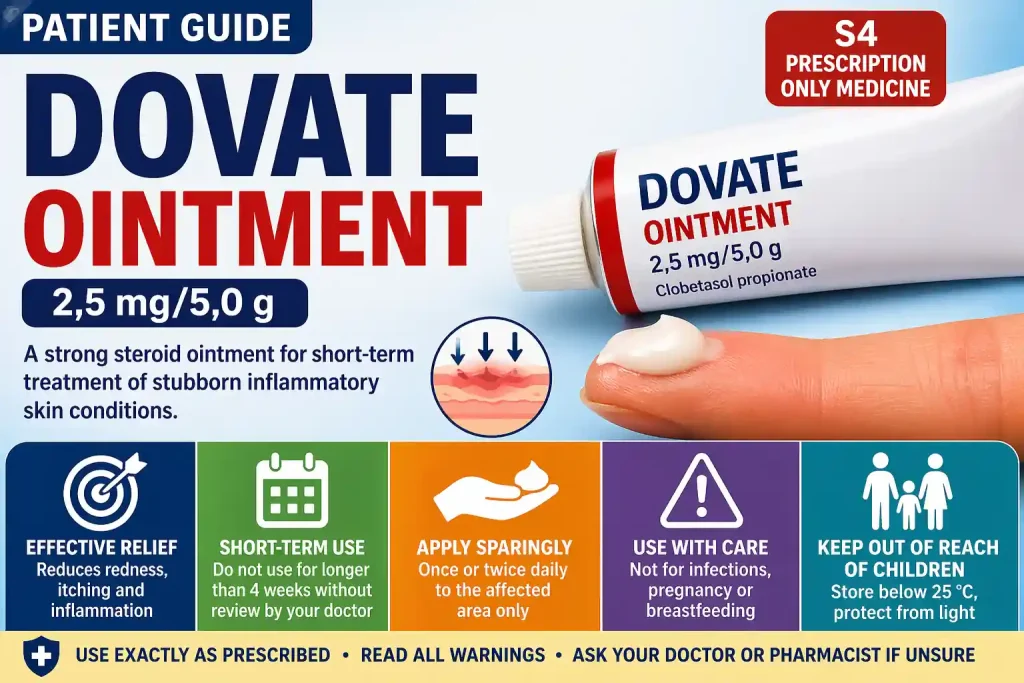
If you have been given DOVATE OINTMENT to use on your skin, it is important to know exactly what it is for, how to apply it properly, and when to get medical advice. This medicine contains clobetasol propionate, which is a very strong topical corticosteroid (a steroid medicine used on the skin). It is meant for short-term treatment of certain skin conditions when milder steroid creams or ointments have not worked well enough.
DOVATE OINTMENT is an S4 medicine in South Africa.
What it is and what it is used for
DOVATE OINTMENT contains the active ingredient clobetasol propionate. This belongs to a group of medicines called topical corticosteroids, which means steroids that are applied directly to the skin.
This ointment is for short-term use in treating skin problems such as:
- Seborrhoeic dermatitis
- Atopic dermatitis
- Lichen chronicus simplex
- Pruritus ani
- Psoriasis
- Later phase of allergic contact dermatitis
- Later phase of irritant dermatitis
- Discoid lupus erythematosus
- Lichen planus
It is used for these conditions when they do not respond to treatment with steroids that are less potent.
In simple terms, this medicine is usually given when your skin condition is more stubborn, more inflamed, or more difficult to control than usual, and your doctor feels you need a stronger steroid treatment for a limited time.
How it works
When your skin is inflamed, it can become:
- red
- itchy
- sore
- swollen
- thickened
- irritated
Clobetasol propionate helps to calm down the inflammation in your skin. This can reduce itching, redness, discomfort, and irritation. As the inflammation settles, your skin may start to feel less painful and look less angry.
Because it is a strong steroid ointment, it can be very effective. But that strength also means it should be used carefully, only on the affected areas, and only for as long as your doctor advises.
Who should NOT use this medicine
Do not use DOVATE OINTMENT if you:
- are allergic to clobetasol propionate
- are allergic to any of the other ingredients in the ointment
- are allergic to other corticosteroids
- currently have a bacterial skin infection, including tuberculous skin infection
- currently have a fungal skin infection
- currently have a viral skin infection
- have ulcerative skin lesions
- have rosacea (a skin condition that affects the face)
- plan to apply it to leg ulcers
- have diabetes mellitus and intend to use this medicine long term
- have tuberculosis and intend to use this medicine long term
- are pregnant
Important note
This ointment was prescribed for you personally. Do not share it with anyone else, even if their skin problem looks similar to yours.
Warnings and precautions (Read before use)
Because DOVATE OINTMENT is a strong steroid, there are some important safety points to keep in mind.
Use it carefully and exactly as directed
Take extra care:
- not to use it continuously for a long time
- not to use it inappropriately on large areas of skin
- not to use it in skin folds (flexures) unless your doctor has told you to
These situations can increase how much medicine is absorbed through the skin and raise the chance of side effects.
Be careful on thin or sensitive skin
Extra caution is needed if you are using it:
- on the face
- on damaged skin
- near the eyes
If it is used on the face, treatment should be limited to 5 days.
If it gets into your eyes
If DOVATE OINTMENT gets into your eyes:
- rinse your eyes with plenty of water
- tell your doctor
Watch for unusual symptoms
Tell your doctor if you notice:
- joint pain
- bone pain
- blisters
- fever
- fatigue
- extreme pain
This is especially important if you have been using the ointment for a prolonged period. These may be symptoms of osteonecrosis and/or necrotising fasciitis.
Also tell your doctor if you notice:
- weight gain
- rounding of the face
- easy bruising
These may be signs of Cushing’s syndrome, which can happen when too much steroid affects the body.
If you have porphyria
Take special care if you have a condition called porphyria.
If you are using a dressing over the area
If you apply this ointment under an airtight dressing, clean the area well before changing the dressing.
Airtight coverings can increase absorption of the medicine and also increase the risk of irritation or infection.
If you have psoriasis
If you are using DOVATE OINTMENT for psoriasis, your doctor may want to see you more often. The source states that the pustular form of psoriasis may be provoked during treatment.
If there is a skin infection
If your skin is infected, that infection will need to be treated.
If your vision changes
Tell your doctor immediately if you have:
- blurred vision
- other vision problems
Your doctor may need to refer you to a specialist.
If the problem comes back after you stop treatment
If your condition settles and then returns soon after stopping treatment:
- do not restart the ointment without speaking to your doctor first
This is especially important if:
- the redness spreads beyond the original treatment area
- you develop a burning sensation
These may be withdrawal-related symptoms or a worsening of the condition that needs medical review.
Driving and using machines
DOVATE OINTMENT can cause blurred vision, which may affect your ability to:
- drive
- use machinery
- do tasks that need concentration
Do not do these activities until you are sure the medicine does not affect you in this way.
Alcohol
Not specified in the source.
Ingredients that may irritate the skin
This ointment contains:
- propylene glycol
- stearyl alcohol
These may cause:
- skin irritation
- local skin reactions
Pregnancy, planning pregnancy, and breastfeeding
You should not use DOVATE OINTMENT if you are:
- pregnant
- breastfeeding
If you are pregnant, breastfeeding, think you may be pregnant, or are planning to have a baby, speak to your doctor, pharmacist or other healthcare provider before using this medicine.
Fertility
Not specified in the source.
Interactions
The source advises that you should always tell your healthcare provider if you are taking any other medicine, including:
- prescription medicines
- over-the-counter medicines
- complementary medicines
- traditional medicines
Specific medicine interactions are not listed in the source.
Food interactions
Not specified in the source.
Alcohol interactions
Not specified in the source.
Test or monitoring issues
The source mentions that your doctor may want to monitor you more closely if:
- you are being treated for psoriasis
- you develop vision problems
- side effects suggest that the steroid may be affecting more than just the skin
How to take (Step-by-step)
Always use DOVATE OINTMENT exactly as your doctor or pharmacist has told you.
Step-by-step directions
- Apply the ointment sparingly
- Use it once or twice daily
- Apply it to the affected area only
- Continue until improvement occurs
Your doctor will tell you how long to use it. However, treatment should not continue for longer than four weeks without the patient being re-evaluated.
Practical points for safe use
- Use only a small amount
- Apply it only where it has been prescribed
- Avoid using it for longer than instructed
- Avoid getting it into your eyes
- If using it with a dressing, make sure the area is cleaned properly before changing the dressing
Face use
If it is used on the face, treatment should be limited to 5 days.
Adults
The source says to apply it sparingly once or twice daily to the affected area until improvement occurs.
Children and adolescents
In infants and children under 12 years, long-term use should be avoided where possible.
Children are more likely than adults to develop:
- thinning of the skin
- bruising
- burning of the skin
If an infant is being treated in the nappy area:
- do not use tight-fitting nappies
- do not use plastic pants
These act like airtight dressings and can increase absorption of the steroid.
If the effect seems too strong or too weak
Tell your doctor or pharmacist if you feel the ointment is:
- too strong
- too weak
If you forget a dose
If you miss a dose:
- apply it as soon as you remember
Do not apply a double dose to make up for the missed one.
If you use too much
In the event of an overdose:
- consult your doctor or pharmacist
If neither is available:
- contact the nearest hospital
- or contact a poison control centre
If you stop using it
You may experience withdrawal reactions, including:
- redness of the skin, which may spread beyond the original affected area
- burning or stinging
- itching
- skin peeling
- oozing pustules
Simple adherence tips
Based on the instructions in the source, it may help to:
- apply it at the same time each day
- use it only on the areas your doctor identified
- keep track of how long you have been using it so you do not continue beyond the advised period without review
Dosing table
| Age group | Dose | Frequency | Maximum daily dose |
|---|---|---|---|
| Adults | Apply sparingly to the affected area | Once or twice daily | Not specified in the source |
| Children under 12 years | Apply sparingly to the affected area; long-term use should be avoided where possible | Once or twice daily | Not specified in the source |
| Use on the face | Apply sparingly | As directed, but treatment limited to 5 days | Not specified in the source |
Possible side effects
Like all medicines, DOVATE OINTMENT can cause side effects, although not everyone gets them. Some side effects involve the skin where the ointment is applied, while others may affect other parts of the body, especially with stronger or prolonged steroid use.
Common
The source lists these as frequent side effects:
- Itchy skin (pruritus)
- Local skin burning
- Skin pain
- Lighter patches of skin (hypopigmentation)
- Excessive hair growth over the body (hypertrichosis)
- Worsening of skin problems such as dermatitis
- Pustular psoriasis
- Redness of the skin (erythema)
- Rash (urticaria)
- Acne
- Irritation or pain where the medicine was applied
What you should do
If these are mild, speak to your doctor or pharmacist for advice. If the reaction is severe, spreading, or getting worse, you should get medical advice promptly.
Less common
The source lists these as less frequent side effects:
- Opportunistic infections
- Delayed weight gain in children
- Weakening of bone strength (osteoporosis)
- High blood sugar (hyperglycaemia)
- Extreme thirst and more frequent urination (glucosuria)
- High blood pressure (hypertension)
- Increased weight (obesity)
- Dizziness
- Fatigue linked to decreased cortisol levels
- Hair loss (alopecia)
- Hair that breaks easily (trichorrhexis)
- Blurred vision
- Seeing halos around lights (cataract)
- Skin thinning (atrophy)
- Stretch marks (striae)
- Spider veins (telangiectasias)
- Wrinkling of the skin
- Dry skin
What you should do
Tell your doctor if you notice any of these effects. Side effects involving growth in children, bones, blood sugar, blood pressure, or vision should be taken seriously and assessed by a healthcare professional.
Serious—seek urgent help
Stop using DOVATE OINTMENT and get urgent medical help if you develop signs of a serious allergic reaction, such as:
- swelling of the hands, feet, ankles, face, lips, mouth or throat
- difficulty swallowing
- difficulty breathing
- rash or itching
- fainting
These are medical emergencies.
Other serious effects that need urgent attention
Go to the nearest casualty department or seek urgent medical care if you notice:
- moon-like face
- unusual rapid weight gain around the belly
- blurred or distorted vision
- eye pain
- redness of the eye
- decreased vision or loss of vision
- delayed growth in children
- worsened recurrence of your condition after stopping treatment, especially with burning, stinging, itching, peeling, or oozing pustules
- headache behind the eyes, which may suggest increased pressure in the brain
Side effects with unknown frequency
The source also mentions the following side effects with unknown frequency:
- Eye pain
- Excessive tearing
- Feeling as if there is something in the eye (corneal ulcer)
- Fragile skin that bruises easily
- A rash of purple spots
- A red rash on the face (rosacea-like dermatitis)
- A red rash around the mouth (perioral dermatitis)
- Withdrawal reactions, including redness, burning, stinging, itching, peeling, and oozing pustules
- Skin that feels soft, wet or soggy (maceration)
- Heat rash (miliaria)
- Worsening or spreading of local infections
Reporting side effects in South Africa
If you get side effects, speak to your doctor, pharmacist or nurse. You can also report side effects to SAHPRA using the 6.04 Adverse Drug Reactions Reporting Form available under SAHPRA publications.
The source also lists Aspen Pharmacare contact details for medicine safety reporting.
Storage and disposal
Store this medicine carefully so it stays effective and safe.
How to store it
- Store at or below 25 °C
- Keep the tube tightly closed
- Protect from light
- Keep all medicines out of reach of children
- Do not store in a bathroom
Expiry
Do not use DOVATE OINTMENT after the expiry date shown on the label.
Disposal
- Return any unused medicine to your pharmacist
- Do not throw unused medicine into drains or sewerage systems, including toilets
What the medicine contains
Active ingredient
The active substance is:
- 2.5 mg clobetasol propionate in each 5.0 g of ointment
Other ingredients
The ointment also contains:
- cholesterol
- propylene glycol
- stearyl alcohol
- white beeswax
- white soft paraffin
Important excipients to know about
The source specifically notes that:
- propylene glycol
- stearyl alcohol
may cause skin irritation and/or local skin reactions.
Pack information and appearance
DOVATE OINTMENT is described as a:
- soft
- smooth
- off-white ointment
Pack size
The source states that:
- 25 g ointment is packed into an aluminium collapsible tube
- the tube has a white self-piercing high-density polyethylene cap
- it is supplied in a unit cardboard carton
Practical FAQs (based ONLY on the source)
Can I use DOVATE OINTMENT for a long time?
No. The source says it is for short-term use and should not be continued for longer than four weeks without re-evaluation by a doctor.
Can I put it on my face?
Only with care. If it is used on the face, treatment should be limited to 5 days.
Can I use it if I am pregnant?
No. The source says you should not use DOVATE OINTMENT if you are pregnant.
Can I breastfeed while using it?
No. The source says you should not use DOVATE OINTMENT if you are breastfeeding your baby.
What should I do if I miss a dose?
Apply the missed dose as soon as you remember. Do not use a double dose to make up for the forgotten one.
What should I do if I accidentally use too much?
Consult your doctor or pharmacist. If neither is available, contact the nearest hospital or a poison control centre.
Can I drive after applying it?
Be careful. This medicine can cause blurred vision, which may affect driving, using machinery, or doing tasks that require concentration. Do not do these activities until you know how the medicine affects you.
Can I use it if I have a skin infection?
Not without proper medical advice. The source says you should not use it if you currently have bacterial, fungal or viral skin infections, and that if you have an infection of the skin, it will need to be treated.
Can I restart it on my own if the rash comes back?
No. If the condition comes back shortly after stopping treatment, the source says do not restart using this medicine without consulting your doctor.
Can I use it on a child?
It may be used only with care and according to medical advice. In children under 12 years, long-term use should be avoided where possible, as children are more likely to get side effects such as skin thinning, bruising and burning.
Plain-language summary
DOVATE OINTMENT contains clobetasol propionate, a strong steroid medicine for the skin. It is used for certain stubborn skin conditions when weaker steroid treatments have not worked well enough. You should apply it sparingly once or twice a day, only to the affected area, and only for the period your doctor recommends. It should not be used for too long without review, and extra care is needed when using it on the face, near the eyes, on damaged skin, or in children.
Get medical advice promptly if you develop swelling, breathing problems, serious rash, vision changes, unusual weight gain, easy bruising, worsening skin symptoms after stopping treatment, or signs that the treated area is becoming infected. Store the ointment below 25 °C, keep the tube tightly closed, protect it from light, and keep it out of reach of children.