If you are using MYPAID capsules for yourself, or helping someone else use them, it is worth taking a few minutes to understand how they work and how to use them safely. This medicine combines ibuprofen 200 mg and paracetamol 250 mg in one capsule. It is intended to help relieve certain kinds of pain and bring down feverishness.
In practical terms, MYPAID is used for headache from musculo-skeletal origin, feverishness, muscular pain, menstrual pain, and dental pain. It is a sugar-free product, and it should be taken with food or after meals, with enough water. It is suitable for adults and children over 12 years, but it is not recommended for children under 12. It should also not be used continuously for more than 10 days unless a doctor advises you to do so.
What it is and what it is used for
Active ingredients and medicine type
Each MYPAID capsule contains:
- Ibuprofen 200 mg
- Paracetamol 250 mg
It is classified as an analgesic combination. That means it combines more than one pain-relieving ingredient in a single medicine. It is also described as having:
- Analgesic action for pain relief
- Anti-inflammatory action to help with inflammation
- Antipyretic action to help reduce fever
What it is used for
MYPAID capsules are indicated for the relief of:
- Headache from musculo-skeletal origin
- Feverishness
- Muscular pain
- Menstrual pain
- Dental pain
If these are the symptoms you are dealing with, this medicine may be suitable, provided none of the safety warnings or “do not use” situations apply to you.
How it works (simple explanation)
When you are in pain or running a temperature, it helps to know why a medicine may bring relief. MYPAID contains two active ingredients that are commonly used to help with pain and fever.
How ibuprofen helps
Ibuprofen helps with pain, inflammation, and fever. If your pain is linked to inflammation in the body, ibuprofen may help reduce both the discomfort and the inflammation that goes with it.
How paracetamol helps
Paracetamol also helps to reduce pain and fever. In simple terms, it supports the body in bringing down temperature and easing discomfort.
Why the combination may help
Because MYPAID combines both ibuprofen and paracetamol in one capsule, it is intended to provide broad relief for the types of pain and feverishness listed for the product. This can be useful when you want one medicine that addresses more than one part of the problem, as long as you use it exactly as directed.
Who should NOT use this medicine
Some medicines are not suitable for everyone. MYPAID should not be used in certain situations because the risks may outweigh the benefits.
Do not use if you…
- Are pregnant
- Are breastfeeding
- Have asthma or bronchospasm
- Have a bleeding disorder
- Have cardiovascular disease
- Have a peptic ulcer
- Have had peptic ulceration in the past
- Have renal failure
- Are taking coumarin anticoagulants
- Have severe liver function impairment
- Are sensitive to any of the ingredients in this medicine
- Are sensitive to aspirin
Age restriction
Do not give MYPAID to a child under 12 years of age. It is not recommended for that age group.
Warning: If any item on this list applies to you, it is safest not to use MYPAID unless a doctor has specifically advised that it is appropriate.
Warnings and precautions (Read before use)
Even if MYPAID is suitable for you, there are still important precautions to follow.
If you have liver or kidney disease
If you have liver disease or kidney disease, paracetamol should only be taken under medical supervision. Because MYPAID contains paracetamol, this is an important precaution for anyone with these conditions.
Do not take more than recommended
Taking more than the recommended dose may cause severe liver damage. This is one of the most important safety points to remember. If you feel that the medicine is not helping enough, do not simply increase the dose on your own.
Do not use continuously for too long
MYPAID should not be used continuously for more than 10 days unless you have spoken to your doctor. If your pain or fever is continuing beyond that point, it may be a sign that you need proper medical assessment.
If there is no relief
If you do not get relief from the recommended dosage, consult your doctor. Continuing without improvement, or taking extra capsules, may expose you to risk without solving the real problem.
Swelling and heart-related risk
The medicine has an inherent potential to cause oedema (swelling due to fluid retention). In some compromised patients, heart failure may be precipitated. If you already have health problems affecting your heart or fluid balance, this is especially important.
Driving, alcohol, and monitoring
- Driving: Not specified in the product information.
- Alcohol: Not specified in the product information.
- Monitoring: Not specified in the product information.
Note: If you have ongoing medical conditions or take regular treatment, it is sensible to speak to your doctor or pharmacist before starting any new pain medicine.
Pregnancy, planning pregnancy, and breastfeeding
If you are pregnant or breastfeeding, MYPAID is not recommended.
If you are planning a pregnancy
Not specified in the product information. Speak to your doctor or pharmacist before use.
Interactions
When you are taking any medicine, it is important to know whether it may clash with other treatment or cause problems in specific situations.
Medicines that may interact
Do not use MYPAID if you are receiving:
- Coumarin anticoagulants
These are medicines used to reduce blood clotting. If you take any blood-thinning medicine, it is important to check with your healthcare professional before using MYPAID.
Aspirin sensitivity
If you are sensitive to aspirin, you should not use MYPAID.
Food and drink guidance
MYPAID should be taken:
- With food, or
- After meals
- With sufficient water
This instruction matters. If you are taking the capsules, make a habit of taking them after eating or with food, rather than on an empty stomach.
Alcohol, other foods, and tests
- Alcohol interaction: Not specified in the product information.
- Food interactions other than taking it with food or after meals: Not specified in the product information.
- Interactions with laboratory tests: Not specified in the product information.
How to take (Step-by-step)
Taking a medicine correctly can make a real difference to both safety and effectiveness. Follow these instructions carefully.
Who can take it
MYPAID is intended for:
- Adults
- Children over 12 years
It is not recommended for children under 12 years.
Standard dose
For adults and children over 12 years:
- Take 2 capsules every 4 hours
- Do not take more than 6 capsules in 24 hours
How to take each dose
Use these steps:
- Take the capsules with food or after meals
- Swallow them with sufficient water
- Keep to the 4-hour spacing
- Stay within the maximum daily limit
If the medicine does not help
If you are using the recommended dosage and you still do not get relief, consult your doctor. That is safer than increasing the dose or continuing for too long without guidance.
Missed dose
Not specified in the product information.
Overdose
If too much MYPAID has been taken, get medical help immediately. You should:
- Consult a doctor straight away, or
- Take the patient to the nearest hospital immediately
Specialised treatment is essential as soon as possible. This is not something to manage at home.
Practical ways to stay on track
A few simple habits can help you use MYPAID more safely:
- Take each dose after food or with food
- Use a glass of water
- Keep note of the time of your last dose
- Do not go above 6 capsules in 24 hours
- Do not continue beyond 10 days unless your doctor has told you to do so
Dosing table
| Age or weight | Dose | Frequency | Maximum daily dose |
|---|---|---|---|
| Children under 12 years | Not recommended | Not applicable | Not applicable |
| Adults and children over 12 years | 2 capsules | Every 4 hours | 6 capsules in 24 hours |
Possible side effects
Like many pain medicines, MYPAID can cause side effects. Some may be mild and temporary, while others are more serious and need urgent attention.
Common
The most frequent adverse effects linked to ibuprofen are gastrointestinal disturbances. In everyday language, that means stomach or digestive upset.
Less common
Other side effects that have been reported include:
- Headache
- Dizziness
- Nervousness
- Skin rash
- Pruritis (itching)
- Tinnitus (ringing in the ears)
- Oedema (swelling)
- Depression
- Drowsiness
- Insomnia
- Blurred vision
- Other ocular reactions (other eye-related effects)
There have also been reports of:
- Abnormal liver function tests
- Impairment of renal function
- Agranulocytosis
- Thrombocytopenia
- Acute, reversible renal failure
With the paracetamol component, the following may also occur:
- Sensitivity reactions
- Reversible skin rash
- Blood disorders such as neutropenia, leucopenia, and pancytopenia
These blood disorders mean that certain blood cells may become lower than normal.
Serious—seek urgent help
Get urgent medical help if you develop any of the following:
- Peptic ulceration
- Gastrointestinal bleeding
- A more serious skin rash
- Rash with fever
- Rash with mucosal lesions, such as sores affecting the mouth or other body linings
- Signs of kidney problems
- Significant swelling
- Symptoms suggesting heart failure, especially if you are already medically vulnerable
What to do if side effects happen
If you notice a mild side effect that does not go away, speak to your doctor or pharmacist. If the reaction seems severe, or if there is bleeding, swelling, a serious rash, or anything worrying, get medical help urgently. That is the safest response when symptoms could point to a serious reaction.
Storage and disposal
How to store MYPAID
Store the capsules:
- In a dry place
- At or below 25 °C
- Protected from light
Keep it safe at home
Always:
- Keep out of reach of children
This is especially important with pain medicines, because accidental overdose can be serious.
Expiry and disposal
- Expiry guidance: Not specified in the product information.
- Disposal instructions: Not specified in the product information.
What the medicine contains
Active ingredients
Each capsule contains:
- Ibuprofen 200 mg
- Paracetamol 250 mg
Other ingredients
The excipients listed are:
- Microcrystalline cellulose (Avicel pH 101)
- Starch 1500
- Sodium stearyl fumarate
Sugar content
MYPAID is described as:
- Sugar free
Pack information and appearance
What the capsules look like
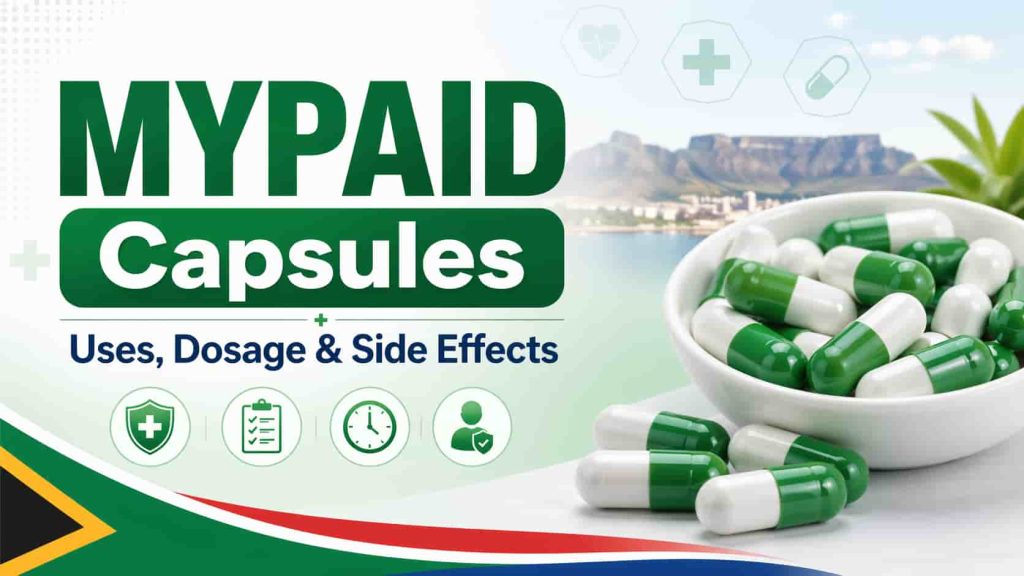
MYPAID capsules are described as:
- Green and white
- Hard gelatin capsules
- Marked with R25 on the cap and body
- Containing white, granular powder
Pack sizes
The medicine comes in:
- Plastic containers with 30 and 60 capsules
- Blister packs with 30 and 60 capsules
Registration and company details
The registration number is:
- 27/2.8/0289
The holder of the certificate of registration is:
- Adcock Ingram Limited
- 1 New Road, Erand Gardens, Midrand, 1685
- Private Bag X69, Bryanston, 2021
Overdose: what needs urgent attention
This section matters because MYPAID contains both ibuprofen and paracetamol, and taking too much can be dangerous.
Symptoms linked to ibuprofen overdose
The most likely symptoms of ibuprofen overdose are:
- Epigastric pains (pain in the upper abdomen)
- Nausea
Treatment is symptomatic and supportive.
Symptoms linked to paracetamol overdose
In the first 24 hours after paracetamol overdose, symptoms may include:
- Pallor
- Nausea
- Vomiting
- Anorexia
- Abdominal pain
Liver damage may only become clear 12 to 48 hours after ingestion. Other serious effects may include:
- Abnormalities of glucose metabolism
- Metabolic acidosis
- Acute renal failure with acute tubular necrosis
- Cardiac arrhythmias
Early symptoms can be misleading
A very important warning is that symptoms during the first two days of acute poisoning do not necessarily show how serious the overdose may become. Nausea, vomiting, loss of appetite, and abdominal pain may continue for a week or even longer.
Liver injury may become apparent on the second day or later, with early signs such as:
- Raised serum transaminase and lactic dehydrogenase activity
- Increased serum bilirubin concentration
- Prolonged prothrombin time
The liver damage may progress to:
- Encephalopathy
- Coma
- Death
The product information also notes:
- Cerebral oedema
- Non-specific myocardial depression
Emergency treatment mentioned
If overdose is suspected:
- Get medical help immediately
- A patient who has ingested about 7.5 g of paracetamol in the preceding 4 hours should undergo gastric lavage
- Specific therapy with an antidote such as acetylcysteine or methionine may be necessary
- If acetylcysteine is used, it should be given as soon as possible, preferably within 8 hours
Acetylcysteine treatment details
Detailed intravenous and oral acetylcysteine treatment instructions are provided, including doses based on body weight and fluid volumes. These are specialist treatment instructions for a medical setting, which is another reason urgent hospital care is essential after an overdose.
Warning: If you think too much has been taken, do not wait for symptoms to become obvious. Immediate medical care is essential.
Practical FAQs (based only on the product information)
Can I take MYPAID for dental pain?
Yes, dental pain is one of the listed uses.
Can I use it for period pain?
Yes, MYPAID is indicated for menstrual pain.
Can I give it to a child under 12?
No. It is not recommended for children under 12 years.
How often should I take it?
For adults and children over 12 years, the dose is 2 capsules every 4 hours.
What is the most I can take in one day?
Do not take more than 6 capsules in 24 hours.
Must I take it with food?
Yes. It should be taken with food or after meals, with sufficient water.
Can I use it while pregnant?
No. It is not recommended during pregnancy.
Can I use it while breastfeeding?
No. It is not recommended while breastfeeding.
Can I use it if I have had an ulcer before?
No. It should not be used if you have peptic ulceration or a history of such ulceration.
What should I do if it does not help?
Consult your doctor if you do not get relief from the recommended dosage.