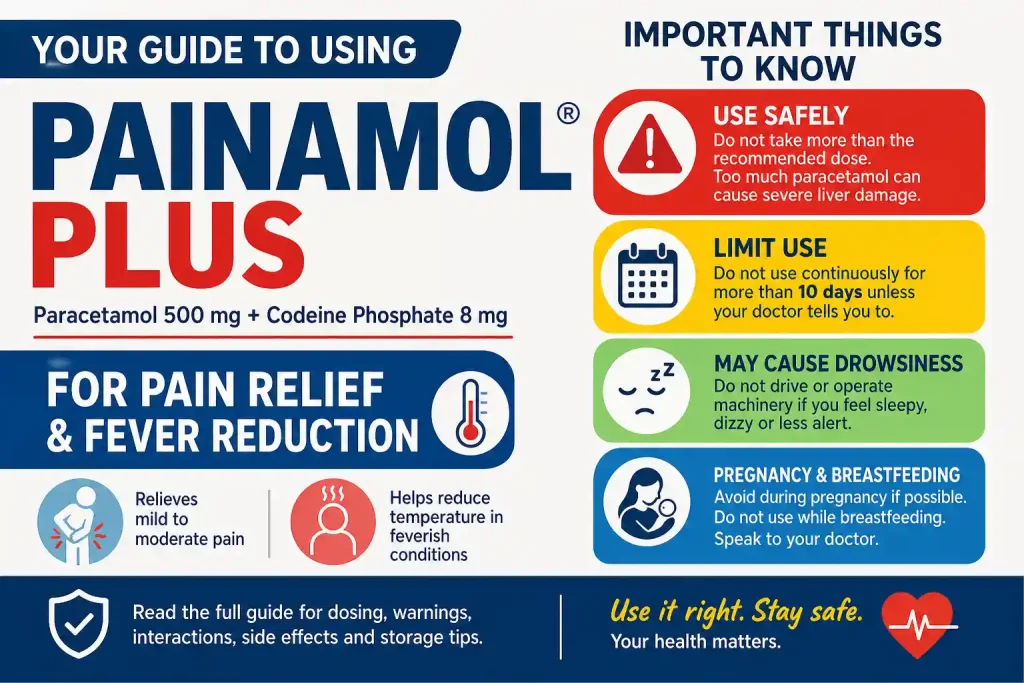
If you are taking Painamol® Plus, you are using a medicine for mild to moderate pain and for helping to bring down a fever. Each tablet contains two active ingredients: paracetamol 500 mg and codeine phosphate 8 mg. Painamol® Plus is taken by mouth and is registered in South Africa as an S2 medicine.
What it is and what it is used for
Painamol® Plus is a tablet that combines two pain-relieving ingredients:
- Paracetamol 500 mg
- Codeine phosphate 8 mg
Paracetamol helps with pain and fever. Codeine phosphate is an opioid pain reliever. Together, they are used as an analgesic combination, which means a medicine combination used to relieve pain.
You may use Painamol® Plus for:
- Mild to moderate pain
- Reducing temperature in febrile conditions, meaning helping to lower a fever
The source does not list specific types of pain, such as headache, toothache, period pain, or back pain. It only states mild to moderate pain and feverish conditions.
How it works
Painamol® Plus works through its two active ingredients.
Paracetamol helps relieve pain and reduce fever. In simple terms, it helps your body feel less pain and helps bring down a raised temperature.
Codeine phosphate works in the central nervous system, which includes your brain and spinal cord. It changes how your body senses pain and how you respond to that pain.
Codeine is described as a centrally acting weak analgesic. This means it works mainly in the brain and spinal cord and is a weaker opioid pain reliever compared with some other opioid medicines. The source explains that codeine’s pain-relieving effect is linked to the way your body changes it into morphine.
When paracetamol and codeine are used together, their pain-relieving effects may add to each other.
Who should NOT use this medicine
Do not use Painamol® Plus if any of the following apply to you.
Do not use if you are allergic or sensitive to it
Do not use this medicine if you:
- Are allergic to Painamol® Plus
- Are allergic to paracetamol, codeine, or any other ingredient in the tablet
- Have reacted badly to tartrazine, if you are known to be sensitive to it
Painamol® Plus contains tartrazine. This may cause allergic-type reactions, including bronchial asthma, in some people. The source notes that tartrazine sensitivity is often seen in people who also have aspirin sensitivity.
Do not use if you have certain breathing problems
Do not use Painamol® Plus if you have:
- Respiratory depression, meaning breathing that is too slow or too weak
- Respiratory depression with cyanosis, which is a bluish colour caused by low oxygen
- Excessive bronchial secretion, meaning too much mucus or fluid in the airways
- An attack of bronchial asthma
Do not use if you have certain serious medical conditions
Do not use this medicine if you have:
- Acute alcoholism
- A head injury
- A condition where pressure inside your skull is raised
- Heart failure caused by lung disease
- Had surgery on the biliary tract
Do not use while breastfeeding
Do not use Painamol® Plus if you are breastfeeding. Codeine is contraindicated during breastfeeding because it may pass into breast milk and may cause breathing depression in the baby.
Do not use if you have certain inherited sugar problems
Painamol® Plus contains sucrose. Do not take it if you have rare hereditary problems of:
- Fructose intolerance
- Glucose-galactose malabsorption
- Sucrase-isomaltase insufficiency
Warnings and precautions
Do not use it for longer than recommended
Do not use Painamol® Plus continuously for more than 10 days unless you have spoken to your doctor.
This is important because longer use, especially if you take more than the recommended dose, may lead to dependence and addiction.
Do not take more than the recommended dose
Warning: Taking more than the recommended dose may cause severe liver damage.
This warning is very important because Painamol® Plus contains paracetamol. Liver damage from too much paracetamol can be serious and may be fatal. The source also states that liver damage may only appear after a few days.
This means you may feel that you are “fine” soon after taking too much, but damage may still be happening in your body. If you take too much, you must get medical help immediately.
Be careful if you have certain health conditions
Codeine should be used with caution if you have:
- Hypothyroidism, meaning an underactive thyroid
- Adrenocortical insufficiency, meaning your adrenal glands do not make enough hormones
- Myasthenia gravis, a condition that causes muscle weakness
- Impaired kidney function
- Impaired liver function
- Prostatic hypertrophy, meaning an enlarged prostate
- Shock
- Inflammatory bowel disorders
- Obstructive bowel disorders
The source also states that the dose should be reduced in elderly and debilitated patients. A debilitated person is someone who is weak or in poor general health.
It may affect driving and using machines
Painamol® Plus contains codeine, which may cause drowsiness.
If you feel sleepy, dizzy, confused, light-headed, or less alert after taking this medicine, do not:
- Drive
- Operate machinery
- Do anything that needs clear thinking or quick reactions
The source also states that this medicine can impair cognitive function. This means it may affect your thinking, judgement, concentration, or reaction time.
Alcohol and sedating medicines can make side effects worse
Codeine’s depressant effects may be increased by substances that slow down the central nervous system.
These include:
- Alcohol
- Anaesthetics
- Hypnotics
- Sedatives
- Phenothiazines
- Tricyclic antidepressants
If you combine Painamol® Plus with these, you may become more drowsy or less alert than expected.
Be careful if you use MAOI medicines
Codeine should be used with extreme caution if you are taking monoamine oxidase inhibitors, also called MAOIs, or if you stopped taking them within the last 14 days.
The source states that central nervous system depression or excitation may happen if codeine is used with MAOIs or within two weeks of stopping them.
Tartrazine warning
Painamol® Plus contains tartrazine. If you are sensitive to tartrazine, you may have an allergic-type reaction. This may include bronchial asthma.
Note: If you know you are sensitive to aspirin or tartrazine, speak to your doctor or pharmacist before using this medicine.
Sucrose warning
Each tablet contains sucrose 20 mg.
If you have been told that you have a rare inherited sugar intolerance or absorption problem, check with your healthcare provider before taking this medicine.
Pregnancy, planning pregnancy, and breastfeeding
If you are pregnant
The source gives different information for paracetamol and codeine.
For paracetamol, studies in human pregnancy have not shown harmful effects when it is used at the recommended dose. The source states that paracetamol can be used during pregnancy if clinically needed, but it should be used:
- At the lowest effective dose
- For the shortest possible time
- As infrequently as possible
For codeine, the source is more cautious. Codeine crosses the placenta, meaning it can pass from you to your unborn baby. The source states that there is not enough evidence of safety in human pregnancy, and a possible association with breathing and heart malformations has been reported.
Regular use during pregnancy may cause the unborn baby to become dependent on the medicine. This may lead to withdrawal symptoms in the newborn baby after birth.
The source states that use during pregnancy should be avoided if possible.
If opioid use is needed for a long time during pregnancy
If opioid use is required for a prolonged period during pregnancy, the patient should be advised about the risk of neonatal opioid withdrawal syndrome. Suitable treatment should also be available.
If you are in labour
Codeine used during labour may depress breathing in the newborn baby. The source states that an antidote for the child should be readily available.
If you are planning pregnancy
Not specified in the source. Speak to your doctor or pharmacist before use if you are planning pregnancy.
If you are breastfeeding
Do not use Painamol® Plus while breastfeeding.
Paracetamol passes into breast milk, but the source states that it is not present in a clinically significant amount. Available published data do not contraindicate breastfeeding for paracetamol.
However, Painamol® Plus also contains codeine, and codeine is contraindicated during breastfeeding.
Codeine may pass into breast milk and may cause breathing depression in the baby. The source also explains that some people are ultra-rapid metabolisers of CYP2D6. This means their bodies may change codeine into morphine faster than usual. In very rare cases, this may lead to opioid toxicity in the baby, which may be fatal.
If symptoms of opioid toxicity develop in either the mother or infant, all codeine-containing medicines should be stopped and alternative non-opioid pain relief should be prescribed. In severe cases, naloxone may be considered to reverse these effects.
Interactions
Interactions can happen when one medicine changes how another medicine works, or when side effects become stronger. Tell your doctor or pharmacist about all medicines you take, including prescription medicines, over-the-counter medicines, and anything you use regularly.
Medicines that may affect paracetamol
Paracetamol absorption may be affected by:
- Metoclopramide: may make paracetamol absorb faster
- Domperidone: may make paracetamol absorb faster
- Colestyramine: may reduce paracetamol absorption
Blood-thinning medicines
If you use warfarin or other coumarins, prolonged regular daily use of paracetamol may increase the blood-thinning effect. This may increase the risk of bleeding.
The source states that occasional doses have no significant effect.
Medicines that may increase paracetamol toxicity risk
The risk of paracetamol toxicity may be increased if you take medicines that may affect the liver or increase liver enzyme activity.
The source lists:
- Carbamazepine
- Phenobarbital
- Phenytoin
- Primidone
- Rifampicin
The source also states that liver toxicity at therapeutic doses of paracetamol has been reported in patients receiving isoniazid.
Probenecid
If paracetamol is taken with probenecid, paracetamol may leave the body more slowly. This may increase paracetamol levels in the blood.
Alcohol and medicines that cause drowsiness
The depressant effects of codeine may be increased by:
- Alcohol
- Anaesthetics
- Hypnotics
- Sedatives
- Tricyclic antidepressants
- Phenothiazines
This may make you more drowsy or less alert.
Blood pressure medicines and water tablets
Opioid pain medicines may increase the blood-pressure-lowering effects of:
- Diuretics, sometimes called water tablets
- Antihypertensive medicines, meaning medicines for high blood pressure
This may make your blood pressure drop more than expected.
Hydroxyzine
Using hydroxyzine with codeine may increase pain relief. It may also increase central nervous system depression and low blood pressure effects.
Medicines for diarrhoea or slowing the bowel
Using codeine with antidiarrhoeal or antiperistaltic medicines may increase the risk of severe constipation.
The source lists:
- Loperamide
- Kaolin
Antimuscarinic medicines
Using codeine with antimuscarinic medicines, or medicines that have antimuscarinic action, may increase the risk of severe constipation. This may lead to paralytic ileus, which is a serious slowing or stopping of bowel movement, and/or urinary retention, meaning difficulty passing urine.
Neuromuscular blocking agents
The breathing-slowing effects caused by neuromuscular blocking agents may add to the breathing-slowing effects of opioid pain medicines.
MAOI medicines
Codeine may cause central nervous system depression or excitation if it is taken with MAOIs or within two weeks of stopping MAOI treatment.
Quinidine
Quinidine can reduce the pain-relieving effect of codeine.
Mexiletine
Codeine may delay the absorption of mexiletine. This may reduce mexiletine’s antiarrhythmic effect.
Metoclopramide, cisapride, and domperidone
Codeine may oppose the gastrointestinal effects of:
- Metoclopramide
- Cisapride
- Domperidone
Cimetidine
Cimetidine inhibits the metabolism of opioid pain medicines. This may increase opioid levels in the blood.
Naloxone and naltrexone
Naloxone blocks the pain-relieving, central nervous system, and breathing-slowing effects of opioid pain medicines.
Naltrexone also blocks the therapeutic effect of opioids.
Laboratory tests and medical investigations
Opioid pain medicines may interfere with several laboratory tests, including:
- Plasma amylase
- Lipase
- Bilirubin
- Alkaline phosphatase
- Lactate dehydrogenase
- Alanine aminotransferase
- Aspartate aminotransferase
Opioids may also interfere with gastric emptying studies because they delay stomach emptying. They may also affect hepatobiliary imaging using technetium Tc99m disofenin because opioid treatment may tighten the sphincter of Oddi and increase pressure in the biliary tract.
Note: If you are going for blood tests, scans, or other investigations, tell the healthcare professional that you are taking Painamol® Plus.
How to take
Painamol® Plus is for oral use, which means you take it by mouth.
Use the dose for your age group and do not take more than recommended. Do not use it continuously for longer than 10 days unless your doctor tells you to.
Step-by-step guide
- Check whether the medicine is suitable for you or the person you are caring for.
- Check the correct dose for the age group.
- Take the tablet by mouth.
- Wait the correct number of hours before the next dose.
- Do not exceed the adult maximum of 8 tablets per day.
- Do not keep taking it continuously for more than 10 days without medical advice.
Adults
Adults may take one or two tablets every four to six hours.
Do not exceed 8 tablets per day.
Children over 12 years
Children over 12 years may take one tablet every four to six hours.
The source does not state a specific maximum daily dose for children over 12 years.
Children aged 6 to 12 years
Children aged 6 to 12 years may take half to one tablet every six hours.
The source does not state a specific maximum daily dose for children aged 6 to 12 years.
Children under 6 years
Not specified in the source.
Taking it with or without food
Not specified in the source.
Missed dose
Not specified in the source.
If you take too much
Warning: If you take too much Painamol® Plus, consult your doctor or take the patient to the nearest hospital immediately.
For paracetamol overdose, symptoms may include nausea and vomiting. Liver damage, which may be fatal, may only appear after a few days. Kidney failure has also been described after acute intoxication.
For codeine overdose, symptoms may include:
- Restlessness
- Excitement
- Breathing depression
- Low blood pressure
- Circulatory failure
- Coma
In children, convulsions may occur.
The source states that specialised treatment is essential as soon as possible. The latest information about overdose treatment can be obtained from the nearest poison centre.
Practical tips for safer use
- Write down the time you take each dose so that you do not take doses too close together.
- Do not take extra tablets if your pain or fever returns before the next dose is due.
- Do not use it continuously for more than 10 days unless your doctor has advised this.
- Store it safely, especially if there are children in the home.
Dosing table
| Age or group | Dose | Frequency | Maximum daily dose |
|---|---|---|---|
| Adults | 1 to 2 tablets | Every 4 to 6 hours | 8 tablets per day |
| Children over 12 years | 1 tablet | Every 4 to 6 hours | Not specified in the source |
| Children 6 to 12 years | Half to 1 tablet | Every 6 hours | Not specified in the source |
| Children under 6 years | Not specified in the source | Not specified in the source | Not specified in the source |
Note: Each tablet contains paracetamol 500 mg and codeine phosphate 8 mg.
Possible side effects
You may not get side effects, but it is important to know what can happen. The source lists most side effects as “frequency unknown”, which means it does not say how often they occur. Some side effects are listed as “less frequent”. No side effects are listed as common in the source.
Common
Not specified in the source.
Less common
Less frequent side effects listed in the source include:
- Acute pancreatitis, meaning inflammation of the pancreas
- Increased risk of abdominal pain
- Serious skin reactions, including:
- Toxic epidermal necrolysis
- Stevens-Johnson syndrome
- Acute generalised exanthematous pustulosis
- Fixed drug eruption
- Allergic reactions, including skin rash
- Drug withdrawal syndrome
Frequency unknown
The following side effects are listed with unknown frequency.
Blood and circulation
- Agranulocytosis, a serious drop in certain white blood cells
- Thrombocytopenia, a low platelet count
- Circulatory failure
Allergic reactions
- Allergic reactions
- Skin redness
- Rash
- Itching
- Hives
- Difficulty breathing
- Anaphylactic reactions, including shock
Mood and behaviour
- Drug dependence
- Change in mood
- Restlessness
Nervous system effects
- Dizziness
- Light-headedness
- Confusion
- Drowsiness
- Raised pressure inside the skull
- Deepening coma
Eye and ear effects
- Miosis, meaning very small pupils
- Vertigo, meaning a spinning sensation
Heart and blood pressure effects
- Slow heartbeat
- Palpitations
- Low blood pressure
- Facial flushing
- A drop in blood pressure when standing up
Stomach and bowel effects
- Constipation
- Nausea
- Vomiting
- Dry mouth
Liver, bile duct, kidney, and urinary effects
- Ureteric or biliary spasm
- Urinary retention
- Micturition-related effects
- Sweating
- Anti-diuretic effect
Muscle and temperature effects
- Muscle rigidity
- Hypothermia, meaning low body temperature
Serious — seek urgent help
Get urgent medical help if you notice signs that may suggest a serious reaction, opioid toxicity, or overdose.
Seek urgent help if you or the person you care for has:
- Difficulty breathing
- Severe drowsiness or confusion
- Fainting, shock, or signs of very low blood pressure
- Hives, swelling, or signs of a serious allergic reaction
- Severe rash, blistering, or peeling skin
- Severe abdominal pain
- Coma or worsening unconsciousness
- Convulsions in a child
- Symptoms after taking too much, even if the person seems well at first
Warning: Liver damage after too much paracetamol may only appear after a few days. Do not wait for severe symptoms before getting help after an overdose.
Reporting side effects in South Africa
The source states that healthcare providers are asked to report suspected adverse reactions to SAHPRA using the “6.04 Adverse Drug Reaction Reporting form” found online under SAHPRA’s publications.
Storage and disposal
Store Painamol® Plus safely and correctly.
How to store it
Keep this medicine:
- At or below 25 °C
- Protected from strong light
- In a well-closed container
- Protected from moisture
- With exposure to air kept to a minimum
Always keep it out of reach of children.
Expiry guidance
Do not use the medicine after the expiry date.
The source states the shelf life as:
- 24 months for 20, 100, 500, 1000 and 5000 tablets
- 15 months for patient-ready packs of different pack sizes
Disposal
Special disposal precautions are listed as not applicable in the source.
Even so, keep unused or expired medicine away from children. If you are unsure what to do with unused medicine, ask a pharmacist for advice.
What the medicine contains
Each Painamol® Plus tablet contains the following:
| Ingredient type | Ingredient | Amount per tablet |
|---|---|---|
| Active ingredient | Paracetamol | 500 mg |
| Active ingredient | Codeine phosphate | 8 mg |
| Preservative | Sodium metabisulphite | 0,081 % m/m |
| Sugar | Sucrose | 20,0 mg |
Painamol® Plus also contains tartrazine.
Other ingredients
The source lists these excipients:
- Alcohol 90 % v/v
- Be-Tabs Red C344/TF
- Gelatin
- Magnesium stearate
- Modified starch
- Povidone
- Powdered sucrose
- Purified water
- Sodium metabisulphite
- Starch maize
- Yellow Saffron LS2002/22
Pack information and appearance
Painamol® Plus is supplied as a tablet.
The tablet is described as:
- Flat
- Yellow and red mottled
- Scored on one side
- Embossed with a “b” on the other side
The source lists these pack types:
- Cartons with 2 × 10 tablets in push-through blister packs
- Containers with 100 tablets
- Containers with 500 tablets
- Containers with 1000 tablets
- Blue/green plastic buckets containing 5000 tablets
- Patient-ready packs of different pack sizes
Practical FAQs
What is Painamol® Plus used for?
It is used for relief of mild to moderate pain and for reducing temperature in feverish conditions.
What are the active ingredients?
Each tablet contains paracetamol 500 mg and codeine phosphate 8 mg.
How many tablets can I take as an adult?
Adults may take one or two tablets every four to six hours. Do not take more than 8 tablets per day.
Can I give Painamol® Plus to a child?
The source gives doses for children over 12 years and for children aged 6 to 12 years. For children under 6 years, the source does not specify a dose.
Can I take Painamol® Plus for more than 10 days?
Do not use it continuously for longer than 10 days unless your doctor tells you to.
Can I drive after taking Painamol® Plus?
Codeine may cause drowsiness and may affect your thinking and reaction time. If you are affected, do not drive or operate machinery.
Can I drink alcohol while taking Painamol® Plus?
The source states that alcohol can increase the depressant effects of codeine. This may make you more drowsy or less alert. Acute alcoholism is also listed as a reason not to use this medicine.
Can I take Painamol® Plus while pregnant?
Use during pregnancy should be avoided if possible because of the codeine component. Paracetamol can be used during pregnancy if clinically needed, at the lowest effective dose for the shortest possible time and lowest possible frequency. Speak to your doctor or pharmacist before using it during pregnancy.
Can I take Painamol® Plus while breastfeeding?
No. Codeine is contraindicated during breastfeeding. It may pass into breast milk and may cause breathing depression in the baby.
What should I do if I take too much?
Consult your doctor or take the patient to the nearest hospital immediately. Specialised treatment is essential as soon as possible, especially because liver damage from paracetamol overdose may only appear after a few days.
Sources :
Written by: RxZest Editorial Team
Editorial review: Checked for readability, structure, and source alignment
Based on SAHPRA-approved information
Last updated: [01/05/2026]