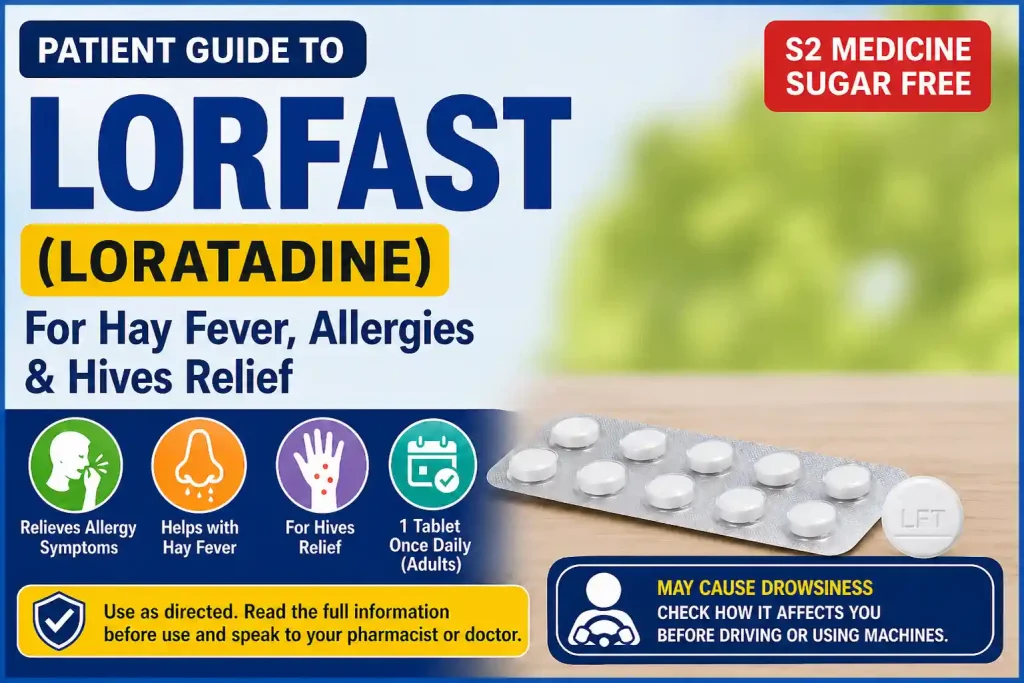
If you are taking LORFAST, you are using a medicine that helps relieve allergy symptoms. It contains loratadine, which is an antihistamine. Antihistamines help reduce the effects of histamine, a natural substance your body releases during an allergic reaction.
You may use LORFAST for hay fever, other allergies, or chronic urticaria, which is a long-lasting hive-like rash. In South Africa, LORFAST is listed as an S2 medicine, and the source describes it as sugar free.
Quick facts: If you are an adult, the usual dose is one tablet once daily. LORFAST is not expected to make you drowsy at the recommended dose, but very rarely, some people may feel sleepy. You should first see how it affects you before driving, using tools, or operating machinery.
What it is and what it is used for
LORFAST contains the active ingredient loratadine.
Loratadine is an antihistamine. This means it helps your body deal with symptoms caused by allergies.
You may use LORFAST for relief of:
- Hay fever
- Other types of allergy
- Chronic urticaria, which is a persistent hive-like rash
The tablet strength is not specified in the source.
How it works
When you have an allergic reaction, your body releases a substance called histamine. Histamine can cause allergy symptoms and skin reactions such as hives.
LORFAST helps by blocking the effects of histamine. In everyday terms, it helps calm your body’s allergy response so that symptoms linked to hay fever, other allergies, or chronic urticaria may improve.
Who should NOT use this medicine
Do not use LORFAST if you:
- Are allergic to loratadine
- Are allergic to any of the other ingredients in LORFAST
- Have ever had an unusual or allergic reaction to antihistamines
- Have porphyria, a rare blood pigment disorder
Warning: If you are unsure whether you have reacted badly to an antihistamine before, ask your doctor or pharmacist before taking LORFAST.
Warnings and precautions
Before using LORFAST, it is important to think about your health history. Certain conditions may affect whether this medicine is suitable for you.
Speak to a healthcare professional first if you have certain conditions
Before taking LORFAST, tell your doctor, pharmacist, or nurse if you:
- Have liver disease
- Have kidney disease
- Have emphysema, described in the source as shortness of breath with a cough
- Have an enlarged prostate
- Have narrow angle glaucoma, which means high pressure in the eye
- Have heart problems
- Have a history of seizures
- Suffer from acute asthma attacks
These conditions do not always mean you cannot take LORFAST, but they should be discussed with a healthcare professional before use.
Allergy skin testing
If you are going for allergy skin tests, do not take LORFAST for 48 hours before the test. LORFAST may affect the results of the test.
Driving, machines, and alertness
At the recommended dose, LORFAST is not expected to make you drowsy or reduce your alertness. However, very rarely, some people may feel drowsy.
Before driving, operating machinery, or doing anything that needs full concentration, check how you feel after taking it.
Warning: You may experience sedation if you take alcohol or other central nervous system depressants while using LORFAST.
Do not share your medicine
Even if someone else has allergy symptoms, do not give them your LORFAST. Their medical situation may be different from yours.
Pregnancy, planning pregnancy, and breastfeeding
If you are pregnant or breastfeeding, ask your doctor, pharmacist, or another healthcare professional before taking LORFAST.
As a precaution, it is preferable to avoid LORFAST during pregnancy.
Do not take LORFAST if you are breastfeeding, because loratadine passes into breast milk.
Planning pregnancy and fertility: Not specified in the source. Speak to your doctor or pharmacist before use.
Interactions
Interactions can happen when one medicine or substance affects how another medicine works. This may increase the chance of side effects.
Other medicines
Tell your doctor, pharmacist, or nurse if you are taking, have recently taken, or may take any other medicine.
This includes:
- Prescription medicines
- Medicines bought without a prescription
- Complementary medicines
- Traditional medicines
The side effects of LORFAST may increase if it is taken with medicines that affect certain liver enzymes involved in breaking down medicines.
These include:
- Cimetidine, used to reduce stomach acid
- Ketoconazole, used for fungal infections
- Clarithromycin, an antibiotic used for bacterial infections
- Erythromycin, an antibiotic used for bacterial infections
Alcohol
LORFAST has been shown to add to the effects of an alcoholic drink.
This means you should be careful with alcohol while taking LORFAST, especially until you know how the medicine affects you.
Allergy tests
LORFAST may affect allergy skin test results. If you are having allergy skin tests, do not take LORFAST for 48 hours before the test.
Food
Whether LORFAST should be taken with or without food is not specified in the source.
How to take
Use LORFAST exactly as your doctor, pharmacist, or nurse has explained, or as directed with the medicine.
Step-by-step
- Take the tablet by mouth.
- If you are an adult, the usual dose is one tablet once daily.
- Try to take it at the same time each day if you use it regularly.
- Do not take more than the recommended amount.
- Do not take a double dose if you forget a dose.
- Keep the tablets in their original blister pack.
- Ask your doctor or pharmacist if you are unsure how to use it.
How to take it with meals: Not specified in the source.
Adults
If you are an adult, the usual dose is:
- One tablet once daily
Children
The dose for children is not specified in the source.
If you forget to take it
If you forget a dose, do not take a double dose to make up for the missed one.
Further missed-dose instructions are not specified in the source.
If you take too much
If you take more LORFAST than you should, speak to your doctor or pharmacist.
If you cannot reach them, contact the nearest hospital or poison centre.
Warning: Do not wait for serious symptoms before asking for help after taking too much.
Simple tips to help you remember
Because LORFAST is usually taken once a day by adults, it may help to link it with a daily routine. You could take it at the same time each day, as long as this fits the instructions you were given.
Keep the tablets in the original blister pack so you can see whether you have already taken a dose.
Dosing table
| Age or weight | Dose | Frequency | Maximum daily dose |
|---|---|---|---|
| Adults | One tablet | Once daily | Not specified in the source |
| Children | Not specified in the source | Not specified in the source | Not specified in the source |
Possible side effects
Like all medicines, LORFAST can cause side effects, although not everyone will get them.
If you feel unwell or notice anything unusual while taking LORFAST, speak to your doctor, pharmacist, or nurse.
Common side effects
You may experience:
- Headache
- Sleepiness
- Confusion
- Nightmares
- Blurred vision
- Dry mouth
- Nausea, which means feeling sick
- Gastritis, which means inflammation, swelling, and redness of the stomach lining
- Increased appetite
- Fatigue, which means tiredness
If you feel sleepy, confused, or have blurred vision, avoid driving or using machinery until you feel safe to do so.
Less common side effects
Less common side effects include:
- Sedation
- Nervousness
- Hair loss
Tell your doctor or pharmacist if these side effects worry you or do not go away.
Serious — seek urgent help
Stop taking LORFAST and get medical help immediately if you notice signs of a serious allergic reaction, such as:
- Rash
- Allergic reaction
- Anaphylaxis, which is a serious life-threatening allergic reaction
You should also seek urgent medical help if you notice:
- Increased heart rate
- Palpitations, which means an unpleasant feeling of irregular or forceful heartbeat
These are serious side effects and may need urgent medical attention.
Reporting side effects in South Africa
If you get side effects, speak to your doctor, pharmacist, or nurse.
You can also report side effects to SAHPRA using the “6.04 Adverse Drug Reaction Reporting Form”, available under SAHPRA’s publications. Reporting side effects helps improve medicine safety information.
Storage and disposal
Store LORFAST correctly so that it stays safe to use.
How to store it
- Store LORFAST at or below 25 °C.
- Protect it from moisture.
- Keep the tablets in the original blister packs.
- Keep all medicines out of reach of children.
Expiry date
Do not use LORFAST after the expiry date shown on the carton.
Safe disposal
Return unused or expired medicine to your pharmacist.
Do not throw medicine away where children or other people may find it. Do not keep old medicine for later use unless your healthcare professional tells you to.
What the medicine contains
Active ingredient
LORFAST contains:
- Loratadine
The amount of loratadine in each tablet is not specified in the source.
Other ingredients
LORFAST also contains:
- Calcium hydrogen phosphate
- Colloidal anhydrous silica
- Magnesium stearate
- Maize starch
- Purified talc
- Purified water
- Sodium starch glycollate
The source states that LORFAST is sugar free.
Pack information and appearance
LORFAST tablets are described as:
- Round
- Flat
- Smooth
- White
- Bevelled at the edges
- Marked with a breakline on one side
- Embossed with “LFT” on the other side
Pack sizes
| Pack size | Description |
|---|---|
| 10 tablets | One blister pack of 10 tablets in a carton |
| 100 tablets | Two blister packs of 50 tablets in a carton |
The blister packs are made from transparent PVC with silver-coloured aluminium foil backing.
Registration and company information
The holder of the Certificate of Registration is:
Ranbaxy Pharmaceuticals (Pty) Ltd
14 Lautre Road
Stormill Ext. 1
Roodepoort
1724
South African registration number:
- A38 / 5.7.1 / 0621 (S.A.)
The source also lists registration information for Botswana and Namibia.
Practical FAQs
Can I take LORFAST for hay fever?
Yes. LORFAST is used to relieve symptoms of hay fever.
Can I use LORFAST for other allergies?
Yes. LORFAST is used for hay fever and other types of allergy.
Can LORFAST help with hives?
Yes. LORFAST is used for chronic urticaria, which is a persistent hive-like rash.
How often should I take LORFAST?
If you are an adult, the usual dose is one tablet once daily.
What should I do if I miss a dose?
Do not take a double dose to make up for a missed dose. Further instructions are not specified in the source.
Can I drink alcohol while taking LORFAST?
Be careful. LORFAST has been shown to add to the effects of an alcoholic drink. Alcohol may also increase sedation when used with LORFAST.
Can I drive after taking LORFAST?
At the recommended dose, LORFAST is not expected to make you drowsy or reduce alertness. However, very rarely, drowsiness can happen. Check how you feel before driving or operating machinery.
Must I stop LORFAST before allergy testing?
Yes. If you are having allergy skin tests, do not take LORFAST for 48 hours before the test.
Can I take LORFAST while pregnant?
As a precaution, it is preferable to avoid LORFAST during pregnancy. Speak to your doctor, pharmacist, or another healthcare professional before taking it.
Can I take LORFAST while breastfeeding?
No. Do not take LORFAST if you are breastfeeding, because loratadine passes into breast milk.
Sources :
Written by: RxZest Editorial Team
Editorial review: Checked for readability, structure, and source alignment
Based on SAHPRA-approved information : Lorfast
Last updated: [01/05/2026]